. 2010 Mar 13;86(11-12):385-92.
doi: 10.1016/j.lfs.2010.01.006. Epub 2010 Jan 21.

Modulation of delta opioid agonist-induced antinociception by repeated morphine pretreatment in rhesus monkeys

Affiliations

Modulation of delta opioid agonist-induced antinociception by repeated morphine pretreatment in rhesus monkeys

S S Negus et al. Life Sci. .

Abstract

Aims: Repeated treatment with morphine increases antinociceptive effects of delta opioid agonists in rodents by a mechanism that may involve increased cell-surface expression of delta receptors. The present study evaluated effects of repeated morphine treatment on behavioral effects of the delta agonist SNC80 and the mu agonist fentanyl in rhesus monkeys.

Main methods: In an assay of schedule-controlled responding, three monkeys responded for food reinforcement under a fixed-ratio 30 schedule. In an assay of thermal nociception, tail-withdrawal latencies were evaluated in three monkeys using thermal stimulus intensities of 48 and 54 degrees C. In both assays, the effects of SNC80 (0.032-3.2mg/kg) and fentanyl (0.001-0.056 mg/kg) were evaluated after repeated treatment with saline or a regimen of morphine doses modeled on the regimen that enhanced delta agonist antinociception and apparent delta receptor availability in previous rodent studies.

Key findings: Both SNC80 and fentanyl dose-dependently decreased rates of schedule-controlled responding, and repeated morphine treatment did not significantly alter these effects. In the assay of thermal nociception, SNC80 had little effect on tail-withdrawal latencies from water heated to 48 or 54 degrees C, whereas fentanyl increased tail-withdrawal latencies at both temperatures. Repeated morphine tended to increase the antinociceptive effects of SNC80 and to decrease the antinociceptive effects of fentanyl, but these effects of repeated morphine were small and were significant only at the higher stimulus intensity (54 degrees C).

Significance: These results provide limited support for the proposition that prior stimulation of mu receptors selectively increases the antinociceptive effects of delta agonists in rhesus monkeys.


Figures

Figure 1
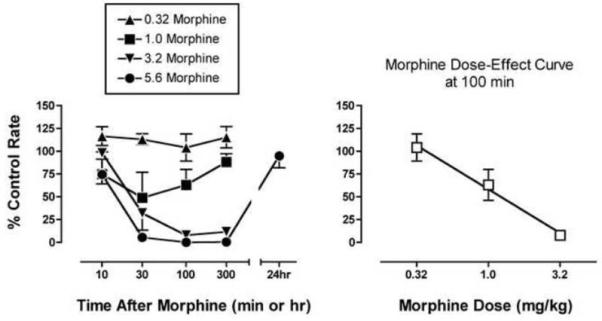
Figure 1. Effects of morphine alone in the assay of schedule-controlled responding
The left panel shows the time course of effects produced by 0.32-5.6 mg/kg morphine. Abscissa: Time after morphine administration in min or hr (log scale). Ordinate: Percent control response rate. The right panel shows the morphine dose-effect curve as the time of peak effect (100 min). Abscissa: Dose morphine in mg/kg (log scale). Ordinate: Percent control response rate in responses per second. All points show mean data ± SEM from three monkeys.
Figure 2
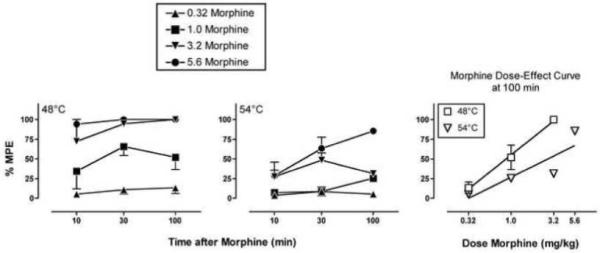
Figure 2. Effects of morphine alone in the assay of thermal nociception
The left and center panels show the time course of effects produced by 0.32-5.6 mg/kg morphine at thermal stimulus intensities of 48 and 54°C, respectively. Abscissae: Time after morphine administration in minutes (log scale). Ordinates: Percent maximum possible effect (%MPE). The right panel shows the morphine dose-effect curve at each stimulus intensity at the time of peak effect (100 min). Abscissa: Dose morphine in mg/kg (log scale). Ordinate: %MPE. All points show mean data ± SEM from three monkeys.
Figure 3
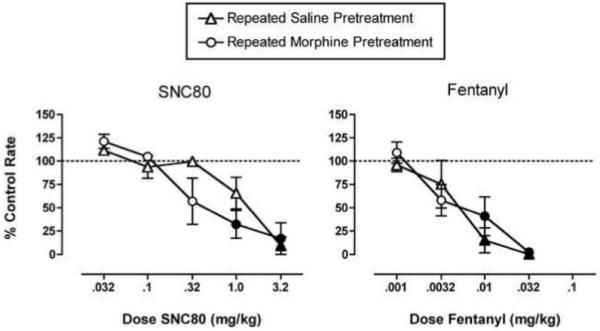
Figure 3. Effects of repeated saline or repeated morphine on the rate-decreasing effects of SNC80 and fentanyl in the assay of schedule-controlled responding
Abscissae: Dose SNC80 (left panel) or fentanyl (right panel) in mg/kg (log scale). Ordinates: Percent control response rate. All points show mean data ± SEM in three monkeys. In the left panel, two-way analysis of variance indicated that there was a significant main effect of SNC80 dose (F(5,24)=20.79, p<0.001) but not a significant main effect of morphine treatment (F(1,24)=1.34, p=0.26) or a significant interaction (F(5,24)=1.97, p=0.12). Similarly, in the right panel, there was a significant main effect of fentanyl dose (F(4,20)=22.88, p<0.001) but not a significant main effect of morphine treatment (F(1,20)=0.33, p=0.57) or a significant interaction (F(4,20)=0.74, p=0.58). Filled points show doses of SNC80 or fentanyl that produced effects significantly different from control as determined by the Holm-Sidak test (p<0.05).
Figure 4
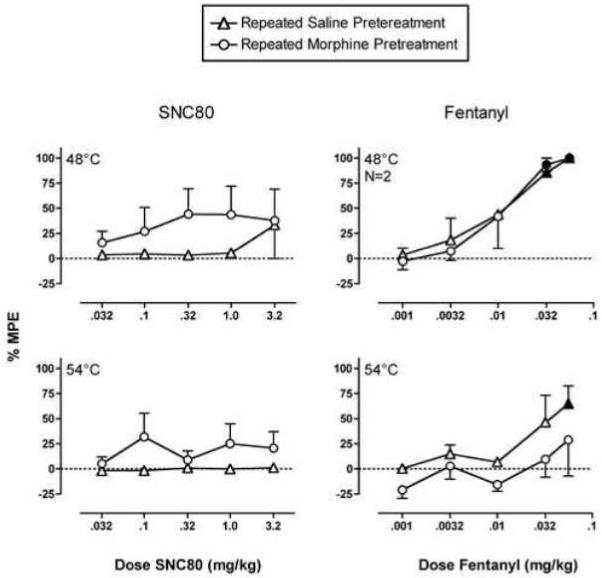
Figure 4. Effects of repeated saline or repeated morphine on the antinociceptive effects of SNC80 and fentanyl in the assay of thermal nociception
Abscissae: Dose SNC80 (left panels) or fentanyl (right panels) in mg/kg (log scale). Ordinates: Percent maximum possible effect at 48°C (top panels) or 54°C (bottom panels). All points show mean data ± SEM in three monkeys except the upper right panel (N=2; one monkey was not included in this comparison, because it did not withdraw its tail from 48°C water after repeated morphine treatment). In the upper left panel, two-way analysis of variance indicated that there was not a significant main effect of SNC80 dose (F(5,24)=0.86, p=0.52) or of morphine treatment (F(1,24)=3.22, p=0.08), nor was there a significant interaction (F(5,24)=0.41, p=0.84). In the lower left panel, there was not a significant main effect of SNC80 dose (F(5,24) = 0.66, p=0.66), but there was a significant main effect of morphine treatment (F(1,24)=6.40, p=0.018); the interaction was not significant (F(5,24)=0.70, p=0.63). In the upper right panel, there was a significant main effect of fentanyl dose (F(5,12)=24.50, p<0.001) but not a significant main effect of morphine treatment (F(1,12)=0.06, p=0.80) or a significant interaction (F(5,12)=0.13, p=0.98). In the lower right panel, there was a significant main effect of fentanyl dose (F(5,24)=3.76, p=0.012) and a significant main effect of morphine treatment (F(1,24) = 5.41, p=0.029); however, the interaction was not significant (F(5,24) = 0.39, p=0.85). Filled points show doses of SNC80 or fentanyl that produced effects significantly different from control as determined by the Holm-Sidak post hoc test (p<0.05). However, post hoc analysis indicated that effects of repeated morphine treatment were not significant at any dose of SNC80 or fentanyl at either stimulus intensity (p>0.05).
Figure 5
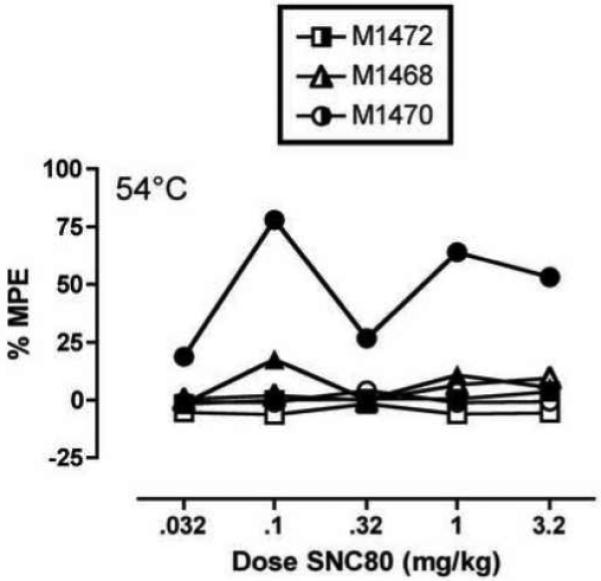
Figure 5. Effects of repeated saline or repeated morphine on the antinociceptive effects of SNC80 in individual monkeys tested at 54°C
Abscissae: Dose SNC80 in mg/kg (log scale). Ordinates: Percent maximum possible effect at 54°C (bottom panels). Data from individual monkeys are indicated by different symbol shapes. Open symbols show data obtained after repeated saline, and closed symbols show data after repeated morphine.

References

    1. Brandt MR, Furness MS, Mello NK, Rice KC, Negus SS. Antinociceptive effects of delta-opioid agonists in Rhesus monkeys: effects on chemically induced thermal hypersensitivity. Journal of Pharmacology and Experimental Therapeutics. 2001;296(3):939–946. - PubMed
    1. Butelman ER, Negus SS, Gatch MB, Chang KJ, Woods JH. BW373U86, a delta-opioid receptor agonist, reverses bradykinin-induced thermal allodynia in rhesus monkeys. European Journal of Pharmacology. 1995;277(2-3):285–287. - PubMed
    1. Cahill CM, Holdridge SV, Morinville A. Trafficking of delta-opioid receptors and other G-protein-coupled receptors: implications for pain and analgesia. Trends in Pharmacological Sciences. 2007;28(1):23–31. - PubMed
    1. Cahill CM, Morinville A, Hoffert C, O’Donnell D, Beaudet A. Up-regulation and trafficking of delta opioid receptor in a model of chronic inflammation: implications for pain control. Pain. 2003;101(1-2):199–208. - PubMed
    1. Cahill CM, Morinville A, Lee MC, Vincent JP, Collier B, Beaudet A. Prolonged morphine treatment targets delta opioid receptors to neuronal plasma membranes and enhances delta-mediated antinociception. Journal of Neuroscience. 2001;21(19):7598–7607. - PMC - PubMed

Publication types