


Review: Placental programming of postnatal diabetes and impaired insulin action after IUGR
- PMID: 20096455
- PMCID: PMC4489545
- DOI: 10.1016/j.placenta.2009.12.015
Review: Placental programming of postnatal diabetes and impaired insulin action after IUGR
Abstract
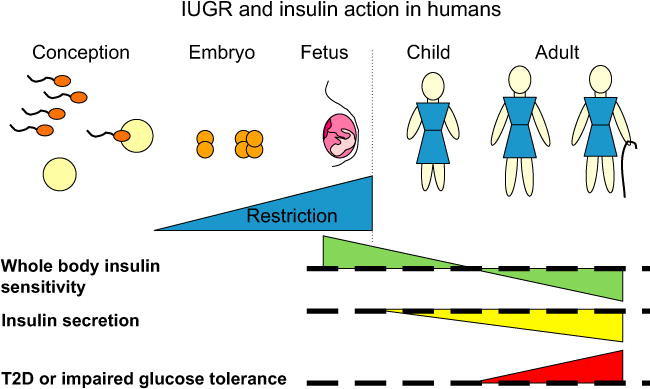
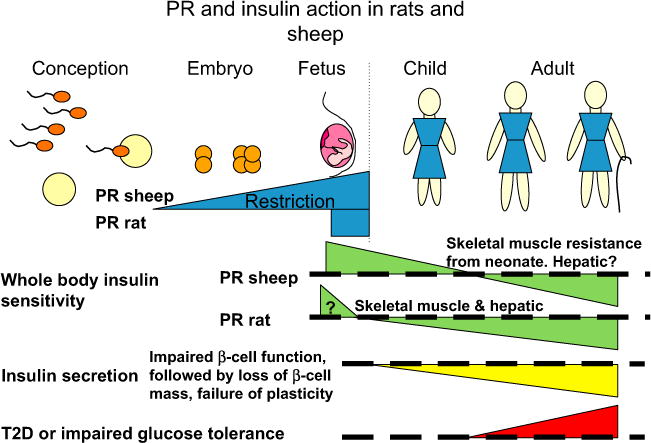
Being born small due to poor growth before birth increases the risk of developing metabolic disease, including type 2 diabetes, in later life. Inadequate insulin secretion and decreasing insulin sensitivity contribute to this increased diabetes risk. Impaired placental growth, development and function are major causes of impaired fetal growth and development and therefore of IUGR. Restricted placental growth (PR) and function in non-human animals induces similar changes in insulin secretion and sensitivity as in human IUGR, making these valuable tools to investigate the underlying mechanisms and to test interventions to prevent or ameliorate the risk of disease after IUGR. Epigenetic changes induced by an adverse fetal environment are strongly implicated as causes of later impaired insulin action. These have been well-characterised in the PR rat, where impaired insulin secretion is linked to epigenetic changes at the Pdx-1 promotor and reduced expression of this transcription factor. Present research is particularly focussed on developing intervention strategies to prevent or reverse epigenetic changes, and normalise gene expression and insulin action after PR, in order to translate this to treatments to improve outcomes in human IUGR.
Copyright 2010 Elsevier Ltd. All rights reserved.
Conflict of interest statement
The authors do not have any potential or actual personal, political, or financial interest in the material, information, or techniques described in this paper.
Figures
References
-
- Newsome CA, Shiell AW, Fall CHD, Phillips DIW, Shier R, Law CM. Is birth weight related to later glucose and insulin metabolism? – a systemic review. Diabet Med. 2003;20:339–48. - PubMed
-
- Harder T, Rodekamp E, Schellong K, Dudenhausen JW, Plagemann A. Birth weight and subsequent risk of type 2 diabetes: a meta-analysis. Am J Epidemiol. 2007;165(8):849–57. - PubMed
-
- Whincup PH, Kaye SJ, Owen CG, Huxley R, Cook DG, Anazawa S, et al. Birth weight and risk of type 2 diabetes: a systematic review. JAMA. 2008;300(24):2886–97. - PubMed
-
- Eriksson M, Wallander M-A, Krakau I, Wedel H, Svardsudd K. Birth weight and cardiovascular risk factors in a cohort followed until 80 years of age: the study of men born in 1913. J Intern Med. 2004;255(2):236–46. - PubMed
Publication types
MeSH terms
Substances
Grants and funding
LinkOut - more resources
Full Text Sources
Medical
Research Materials
