


D2 dopamine receptor internalization prolongs the decrease of radioligand binding after amphetamine: a PET study in a receptor internalization-deficient mouse model
- PMID: 20097293
- PMCID: PMC2838946
- DOI: 10.1016/j.neuroimage.2010.01.055
D2 dopamine receptor internalization prolongs the decrease of radioligand binding after amphetamine: a PET study in a receptor internalization-deficient mouse model
Abstract
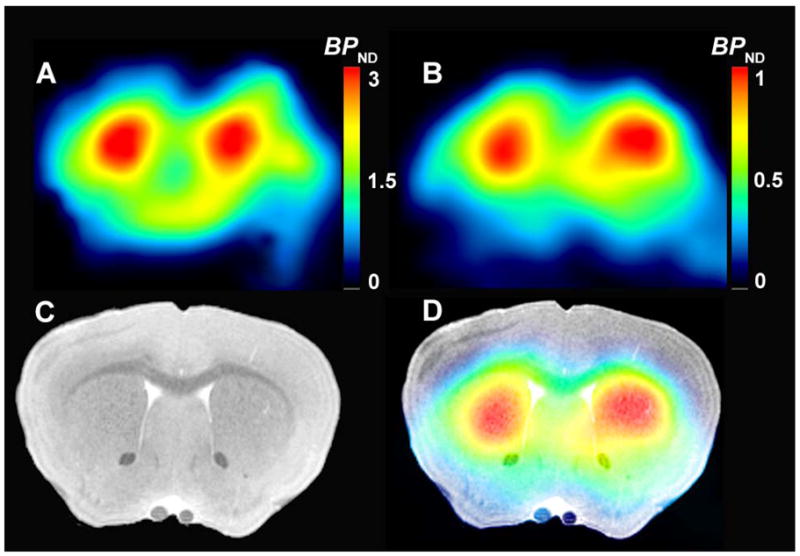
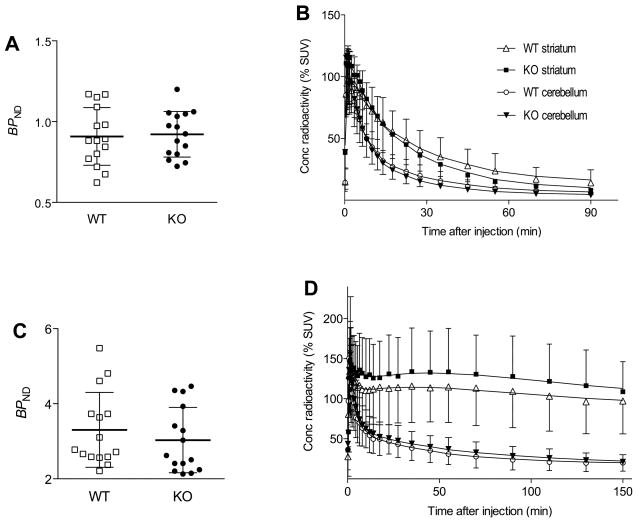
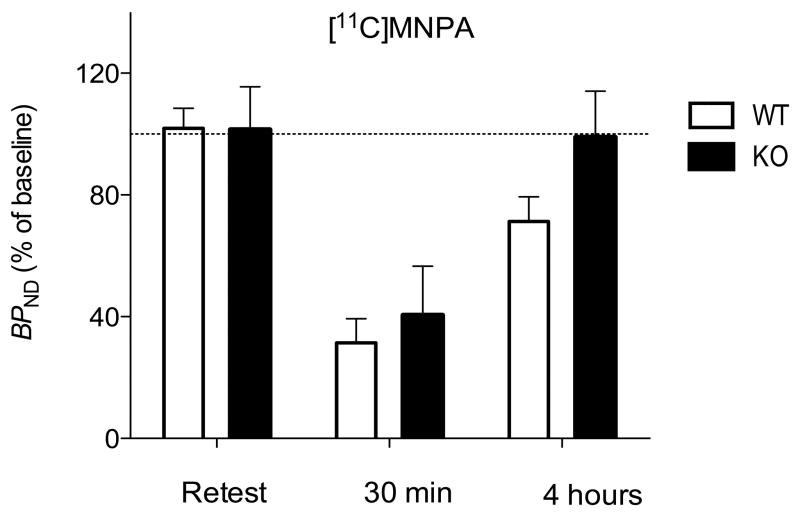
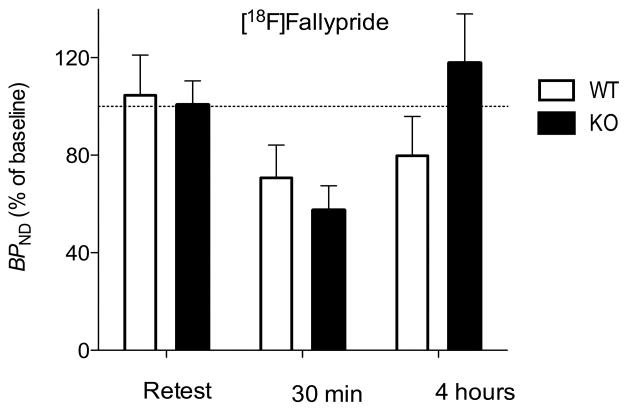
Dopamine released by amphetamine decreases the in vivo binding of PET radioligands to the dopamine D(2) receptor. Although concentrations of extracellular dopamine largely return to baseline within 1 to 2 h after amphetamine treatment, radioligand binding remains decreased for several hours. The purpose of this study was to determine whether the prolonged decrease of radioligand binding after amphetamine administration is caused by receptor internalization. To distinguish dopamine displacement from receptor internalization, we used wild-type and arrestin3 (arr3) knockout mice, which are incapable of internalizing D(2) receptors. In addition, we used both the D(2) selective agonist [(11)C]MNPA (which is thought to bind to the high affinity state of the receptor) and the D(2) selective antagonist [(18)F]fallypride (which does not differentiate between high and low affinity state). After an initial baseline scan, animals were divided in three groups for a second scan: either 30 min or 4 h after amphetamine administration (3 mg/kg, i.p.) or as retest. At 30 min, [(11)C]MNPA showed greater displacement than [(18)F]fallypride, but each radioligand gave similar displacement in knockout and wild-type mice. At 4 h, the binding of both radioligands returned to baseline in arr3 knockout mice, but remained decreased in wild-type mice. Radioligand binding was unaltered on retest scanning. Our results suggest that the prolonged decrease of radioligand binding after amphetamine is mainly due to internalization of the D(2) receptor rather than dopamine displacement. In addition, this study demonstrates the utility of small animal PET to study receptor trafficking in vivo in genetically modified mice.
Published by Elsevier Inc.
Figures
References
-
- Bjork K, Rimondini R, Hansson AC, Terasmaa A, Hyytia P, Heilig M, Sommer WH. Modulation of voluntary ethanol consumption by beta-arrestin 2. Faseb J. 2008;22:2552–2560. - PubMed
-
- Bjurling P, Reineck R, Westerburg G, Gee AD, Sutcliffe J, Långström B. In: Link JM, Ruth TJ, editors. Synthia, a compact radiochemistry system for automated production of radiopharmaceuticals; Proceedings - Sixth Workshop on Targetry and Target Chemistry; TRIUMF, Vancouver. 1995. pp. 282–284.
-
- Cardenas L, Houle S, Kapur S, Busto UE. Oral D-amphetamine causes prolonged displacement of [11C]raclopride as measured by PET. Synapse. 2004;51:27–31. - PubMed
-
- Cumming P, Wong DF, Gillings N, Hilton J, Scheffel U, Gjedde A. Specific binding of [11C]raclopride and N-[3H]propyl-norapomorphine to dopamine receptors in living mouse striatum: occupancy by endogenous dopamine and guanosine triphosphate-free G protein. J Cereb Blood Flow Metab. 2002;22:596–604. - PubMed
-
- Finnema SJ, Halldin C, Bang-Andersen B, Gulyas B, Bundgaard C, Wikstrom HV, Farde L. Dopamine D(2/3) receptor occupancy of apomorphine in the nonhuman primate brain-A comparative PET study with [11C]raclopride and [11C]MNPA. Synapse. 2009;63:378–389. - PubMed
Publication types
MeSH terms
Substances
Grants and funding
LinkOut - more resources
Full Text Sources
Other Literature Sources
