


Risks of pregnancy and birth in obese primiparous women: an analysis of German perinatal statistics
- PMID: 20098995
- PMCID: PMC3022146
- DOI: 10.1007/s00404-009-1349-9
Risks of pregnancy and birth in obese primiparous women: an analysis of German perinatal statistics
Abstract
Purpose: To compare risks of pregnancy and birth in obese (body mass index, BMI ≥ 30) and normal weight women (BMI 18.5-24.99) giving birth to their first child.
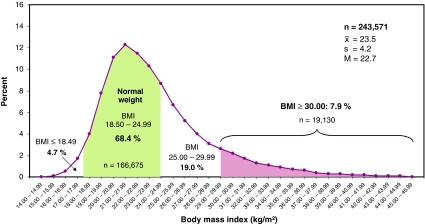
Methods: We analysed data of 243,571 pregnancies in primiparous women from the German perinatal statistics of 1998-2000. We calculated odds ratios (ORs) with 95% confidence intervals (CIs) for selected pregnancy and birth risks. ORs were adjusted for the confounding factors age, smoking status, single mother status, and maternal education.
Results: Obesity during pregnancy is common in primiparous women (n = 19,130; 7.9% of all cases) and it is significantly associated with a number of risks of pregnancy and birth, including diabetes [OR 3.71 (95% CI 2.93; 4.71); p < 0.001], hypertension [OR 8.44 (7.91; 9.00); p < 0.001], preecalmpsia/eclampsia [OR 6.72 (6.30; 7.17); p < 0.001], intraamniotic infection [OR 2.33 (2.05; 2.64); p < 0.001], birth weight ≥ 4,000 g [OR 2.16 (2.05; 2.28); p < 0.001], and an increased rate of Caesarean section [OR 2.23 (2.15; 2.30); p < 0.001]. Some risks were less frequent in the obese such as cervical incompetence [OR 0.55 (0.48; 0.63); p < 0.001] and preterm labour [OR 0.47 (0.43; 0.51); p < 0.001].
Conclusions: Obesity during pregnancy is an important clinical problem in primiparous women because it is common and it is associated with a number of risks of pregnancy and birth. Because of these increased risks, obese women need special attention clinically during the course of their first pregnancy. Weight reduction before the first pregnancy is generally indicated in obese women to prevent the above-mentioned complications of pregnancy and birth.
Figures
References
-
- Voigt M, Zygmunt M, Henrich W, et al. Analysis of subgroup of pregnant women in Germany. 16th communication: morbid obesity: pregnancy risks, birth risks and status of the newborn. Geburtsh Frauenheilk. 2008;68:794–800. doi: 10.1055/s-2008-1038848. - DOI
MeSH terms
LinkOut - more resources
Full Text Sources
Medical
