


New metastatic lymph node ratio system reduces stage migration in patients undergoing D1 lymphadenectomy for gastric adenocarcinoma
- PMID: 20099040
- PMCID: PMC3785005
- DOI: 10.1245/s10434-010-0914-6
New metastatic lymph node ratio system reduces stage migration in patients undergoing D1 lymphadenectomy for gastric adenocarcinoma
Abstract
Background: The American Joint Committee on Cancer (AJCC)/International Union Against Cancer (UICC) staging system for gastric cancer incorporates the absolute number of metastatic lymph nodes (N status) and is optimally used when >or=15 nodes are examined. The ratio of metastatic to examined nodes (N ratio) is an effective prognostic tool, but has not been examined in Western patients undergoing primarily D1 lymphadenectomy.
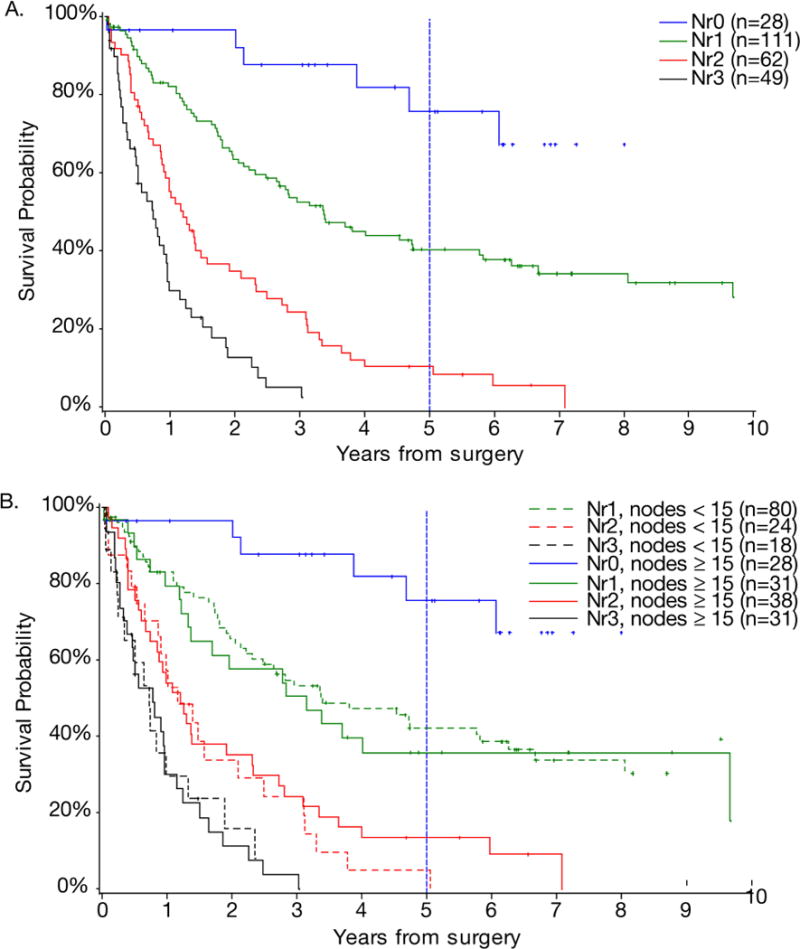
Methods: Two hundred and fifty seven patients with gastric adenocarcinoma who underwent gastric resection between 1995 and 2005 at our institution were examined. Novel N ratio intervals were determined using the best cutoff approach (Nr0: N ratio = 0 and >or=15 nodes examined; Nr1: 0 <or= N ratio <or= 0.3; Nr2: 0.3 < N ratio <or= 0.7; and Nr3: N ratio > 0.7). Overall survival was examined according to N status and N ratio.
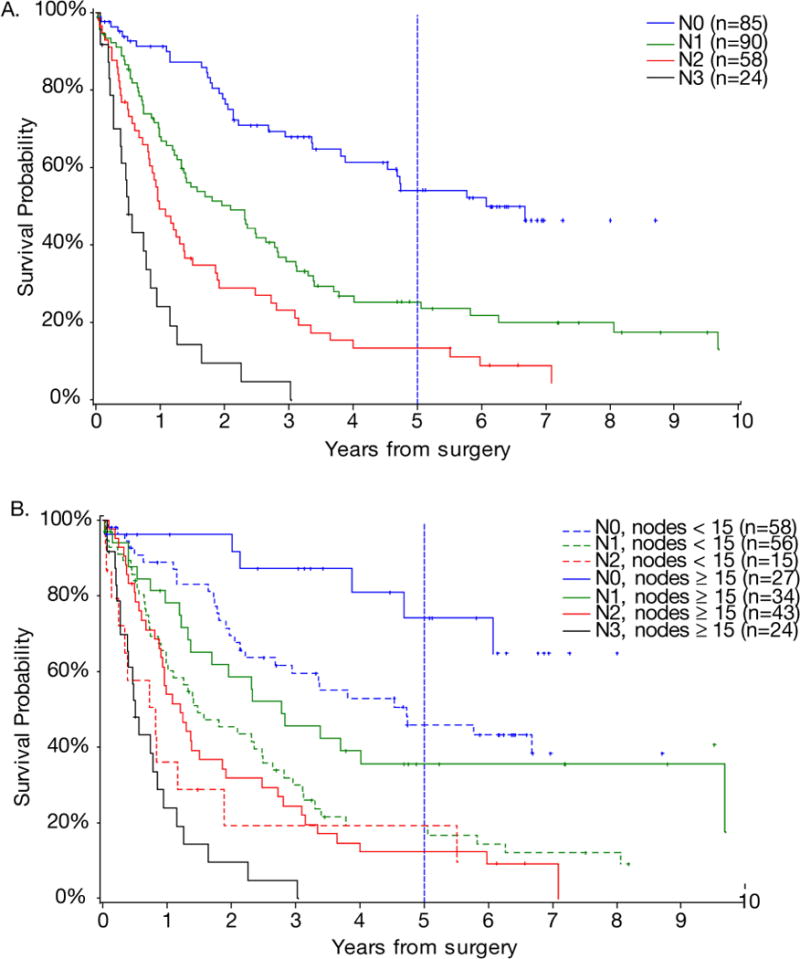
Results: 83% of patients underwent D1 lymphadenectomy with a median of 14 lymph nodes examined. Overall survival stratified by N status was significantly different in patients with <15 nodes examined compared with those with >or=15 nodes examined. When we stratified by N ratio intervals, there was no significant difference in overall survival in patients with <15 versus >or= 15 nodes examined. On multivariate analysis, N ratio but not N status was retained as an independent prognostic factor.
Conclusions: The use of N status for staging patients undergoing primarily D1 lymphadenectomy results in significant stage migration due to varying numbers of nodes examined. Use of N ratio reduces stage migration and may be a more reliable method of staging these patients.
Conflict of interest statement
Disclosures: None
Figures
Comment in
-
Is lymphadenectomy a predictor or savior for patients with gastric cancer?Ann Surg Oncol. 2010 May;17(5):1257-8. doi: 10.1245/s10434-010-0942-2. Ann Surg Oncol. 2010. PMID: 20140527 Free PMC article. No abstract available.
-
Does metastatic lymph node ratio really suit for prognostic prediction of the D1 lymphadenectomy?Ann Surg Oncol. 2010 Jun;17(6):1718; author reply 1719. doi: 10.1245/s10434-010-1064-6. Epub 2010 Apr 16. Ann Surg Oncol. 2010. PMID: 20397057 No abstract available.
References
-
- Jemal A, Siegel R, Ward E, Hao Y, Xu J, Thun MJ. Cancer statistics, 2009. CA Cancer J Clin. 2009;59:225–249. - PubMed
-
- Lee J, Demissie K, Lu SE, Rhoads GG. Cancer incidence among Korean-American immigrants in the United States and native Koreans in South Korea. Cancer Control. 2007;14:78–85. - PubMed
-
- World Health Organization. Fact Sheet No 297, Cancer. 2009 Jan 2; http://www.who.int/mediacentre/factsheets/fs297/en/index.html.
-
- Smith DD, Schwarz RR, Schwarz RE. Impact of total lymph node count on staging and survival after gastrectomy for gastric cancer: data from a large US-population database. J Clin Oncol. 2005;23:7114–7124. - PubMed
-
- Greene FL, Page DL, Fleming ID, et al. AJCC Cancer Staging Manuel. 6. 2002.
Publication types
MeSH terms
Grants and funding
LinkOut - more resources
Full Text Sources
Medical
