


Limited progress in increasing coverage of neonatal and child-health interventions in Africa and Asia
- PMID: 20099759
- PMCID: PMC2928119
- DOI: 10.3329/jhpn.v27i6.4327
Limited progress in increasing coverage of neonatal and child-health interventions in Africa and Asia
Abstract
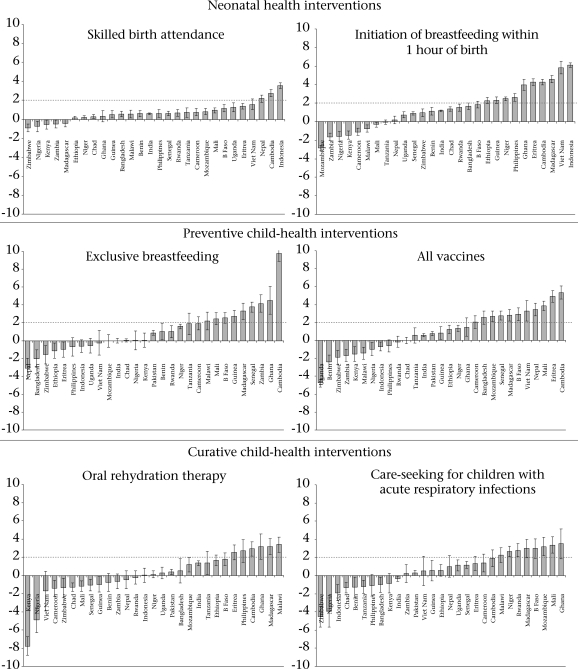
The study was conducted to analyze recent trends in the coverage of selected child-survival interventions. A systematic analysis of the coverage of six key child-health interventions in 29 African and Asian countries that had two recent demographic and health surveys--the latest one carried out in 2001 onwards and the immediately preceding survey conducted after 1990--was undertaken. A regression model was used for examining the relationship between the changes in the coverage of interventions and the changes in rates of mortality among children aged less than five years (under-five mortality). A limited increase in the coverage of key child-health interventions occurred in the past 5-10 years in these 29 countries in sub-Saharan Africa and Asia. More than half of the countries had no significant improvement or a significant reduction in the coverage of oral rehydration therapy (ORT) for diarrhoea (17/29) and care-seeking for acute respiratory infection (ARI) (16/29). Results of multivariate analysis revealed that increases in the coverage of early initiation of breastfeeding, ORT for diarrhoea, and care-seeking for ARI were significantly associated with reductions in under-five mortality. The results of this analysis should serve as a wake-up call for policymakers and programme managers in countries, donors, and international agencies to accelerate efforts to increase the coverage of key child-survival interventions. The following three main actions are proposed: setting of the clear target; mobilization of resources for increasing skilled birth attendants and health workers trained in integrated management of childhood illness; and implementation of community-based approaches.
Figures
References
-
- United Nations Millennium Development Goals. ( http://www.un.org/millenniumgoals, accessed on 7 March 2008).
-
- World Health Organization. Geneva: World Health Organization; 2005. World health report 2005, make every mother and child count; pp. 12–3.
-
- Countdown to 2015: tracking progress in maternal, newborn and child survival. The 2008 report. New York, NY: United Nations Children's Fund; 2008. United Nations Children's Fund; pp. 18–9.
-
- Bryce J. Boschi-Pinto C, Shibuya K, Black RE; WHO Child Health Epidemiology Reference Group. WHO estimates of the causes of death in children. Lancet. 2005;365:1147–52. - PubMed
-
- Progress for children a world fit for children statistical review. New York, NY: United Nations Children's Fund; 2007. United Nations Children's Fund; pp. 18–9.
MeSH terms
LinkOut - more resources
Full Text Sources
Medical
Miscellaneous