


The effects of oral iron supplementation on cognition in older children and adults: a systematic review and meta-analysis
- PMID: 20100340
- PMCID: PMC2831810
- DOI: 10.1186/1475-2891-9-4
The effects of oral iron supplementation on cognition in older children and adults: a systematic review and meta-analysis
Abstract
Background: In observational studies anaemia and iron deficiency are associated with cognitive deficits, suggesting that iron supplementation may improve cognitive function. However, due to the potential for confounding by socio-economic status in observational studies, this needs to be verified in data from randomised controlled trials (RCTs).
Aim: To assess whether iron supplementation improved cognitive domains: concentration, intelligence, memory, psychomotor skills and scholastic achievement.
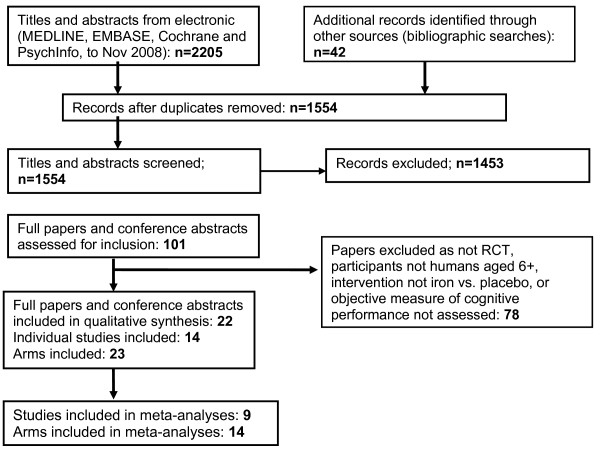
Methodology: Searches included MEDLINE, EMBASE, PsychINFO, Cochrane CENTRAL and bibliographies (to November 2008). Inclusion, data extraction and validity assessment were duplicated, and the meta-analysis used the standardised mean difference (SMD). Subgrouping, sensitivity analysis, assessment of publication bias and heterogeneity were employed.
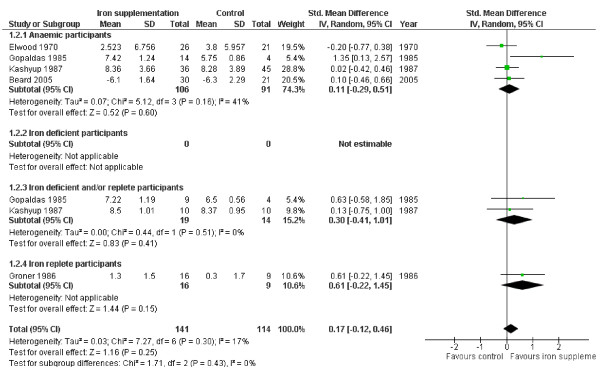
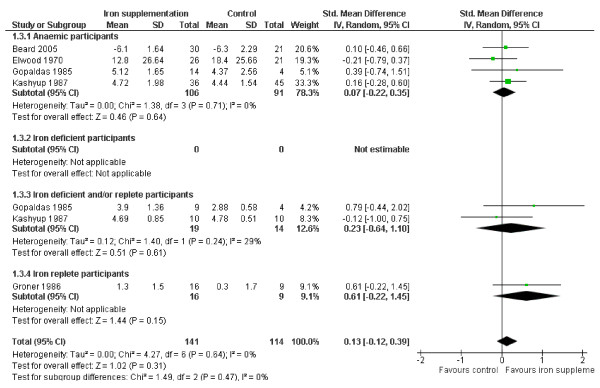
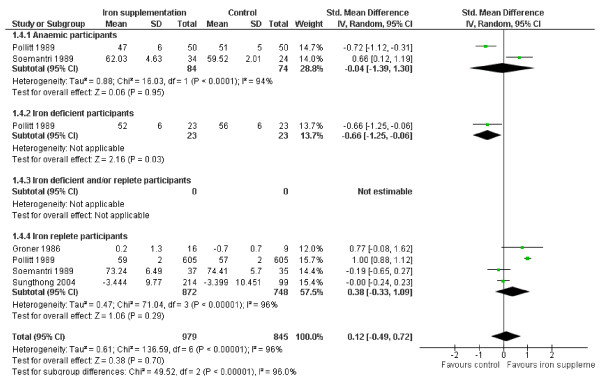
Results: Fourteen RCTs of children aged 6+, adolescents and women were included; no RCTs in men or older people were found. Iron supplementation improved attention and concentration irrespective of baseline iron status (SMD 0.59, 95% CI 0.29 to 0.90) without heterogeneity. In anaemic groups supplementation improved intelligence quotient (IQ) by 2.5 points (95% CI 1.24 to 3.76), but had no effect on non-anaemic participants, or on memory, psychomotor skills or scholastic achievement. However, the funnel plot suggested modest publication bias. The limited number of included studies were generally small, short and methodologically weak.
Conclusions: There was some evidence that iron supplementation improved attention, concentration and IQ, but this requires confirmation with well-powered, blinded, independently funded RCTs of at least one year's duration in different age groups including children, adolescents, adults and older people, and across all levels of baseline iron status.
Figures


References
-
- Oxford concise colour medical dictionary. Oxford, UK: Oxford University Press; 2002.
-
- World Health Organization. Worldwide prevalence of anaemia 1993-2005: WHO global database on anaemia. Geneva, Switzerland: WHO; 2008.
-
- Scholl TO, Hediger ML. Anemia and iron-deficiency anemia: compilation of data on pregnancy outcome. American Journal of Clinical Nutrition. 1994;59:492S–500S. - PubMed
Publication types
MeSH terms
Substances
LinkOut - more resources
Full Text Sources
Medical
Molecular Biology Databases
