. 2010 Mar;16(3):647-53.
doi: 10.1261/rna.1862210. Epub 2010 Jan 25.

Rapid, nondenaturing RNA purification using weak anion-exchange fast performance liquid chromatography

Affiliations

Rapid, nondenaturing RNA purification using weak anion-exchange fast performance liquid chromatography

Laura E Easton et al. RNA. 2010 Mar.

Abstract

We present a simple and fast method for large-scale purification of RNA oligonucleotides suitable for biochemical and structural studies. RNAs are transcribed in vitro with T7 RNA polymerase using linearized plasmid DNA templates. After addition of EDTA, the crude transcription reaction is subjected directly to weak anion-exchange chromatography using DEAE-sepharose to separate the T7 RNA polymerase, unincorporated rNTPs, small abortive transcripts, and the plasmid DNA template from the desired RNA product. The novel method does neither require tedious phenol/chloroform extraction of the T7 RNA polymerase nor denaturation of the RNA, which is desirable especially for larger RNAs. In addition, isotopically labeled rNTPs can be easily recycled from the column flow-through and oligomeric RNA aggregates can be separated from the natively folded monomeric RNA product.


Figures
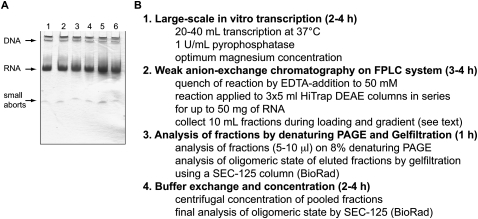
FIGURE 1.
FIGURE 1.
Outline of RNA sample preparation. (A) Addition of pyrophosphatase improves RNA transcription yield. Denaturing PAGE analysis of large-scale transcriptions in the absence (lanes 1–3) or presence (lanes 4–6) of pyrophosphatase (1 U/mL transcription reaction). The yield is analyzed by loading 2 μL of the transcription reaction after 45 (lanes 1,4) and 90 min (lanes 2,3,5,6); in lanes 3,6 (relative to lanes 2,5) the magnesium concentration was increased from 24 to 48 mM by adding 48 uL of a 4.9 M MgCl2 solution to the 10 mL transcription reaction. RNA bands are visualized by staining with 0.1% toluidine blue. The best yield is obtained in the presence of pyrophosphatase without further addition of magnesium (lane 5). (B) Individual steps of RNA sample preparation from in vitro transcription to final concentration of the purified RNA. Estimated time for each step is shown in parentheses.
FIGURE 2.
FIGURE 2.
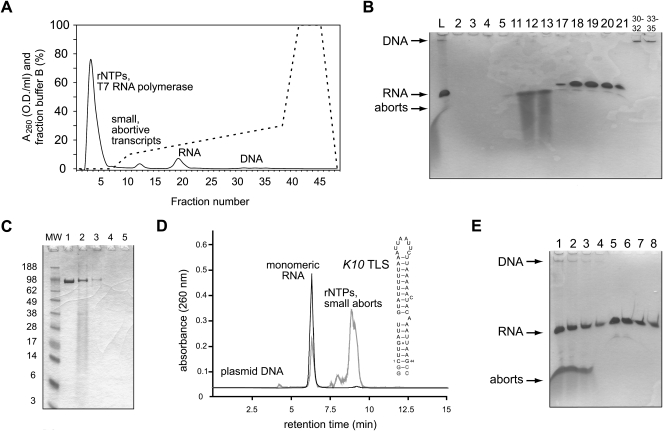
RNA purification using weak anion-exchange FPLC. (A) Elution profile of the 48 nt K10 TLS purified from a 20 mL in vitro transcription reaction using DEAE-sepharose chromatography. Unincorporated rNTPs, T7 RNA polymerase, small abortive transcripts, and the plasmid DNA are well separated from the desired RNA product. The gradient trace (fraction of buffer B in %) is shown as a dashed line. (B) Denaturing PAGE analysis of the eluted fractions. RNA and DNA bands are visualized by staining with 0.1% toluidine blue. The crude transcription reaction is shown in lane L, other lanes are numbered according to the fraction number in A. The very dilute DNA fractions were pooled (30–32 and 33–35) and the plasmid DNA purified from 1 mL of the pooled fractions using QIAGEN PCR purification kit. (C) The purified RNA is free of T7 RNA polymerase. Denaturing SDS PAGE analysis of the eluted fractions. Resuspended pellets from TCA precipitation of 1 mL of the crude transcription reaction (lane 2), the pooled flow-through (lane 3), abortive transcripts (lane 4), and the pooled RNA fractions (lane 5) are loaded. T7 RNA polymerase (lane 1) and a molecular weight marker are loaded as references and the molecular weight is indicated on the left. T7 RNA polymerase bands are visualized by coomassie staining. (D) Gel filtration of the purified K10 TLS RNA. UV trace of the crude in vitro transcription of K10 TLS RNA (gray line) and pooled RNA fractions (17–21) purified by weak anion-exchange chromatography (black line) are shown. Plasmid DNA, RNA species, rNTPs, and small abortive transcripts are indicated and the secondary structure of K10 TLS RNA is shown. (E) The purification scheme recovers over 90% of the transcribed RNA from the crude in vitro transcription. Denaturing PAGE analysis of serial dilutions of the crude 20 mL transcription (lane 1, 2 μL; lane 2, 1 μL; lane 3, 0.5 μL; lane 4, 0.25 μL) and the 50 mL pooled, purified RNA fractions 17–21 (lane 5, 5 μL; lane 6, 2.5 μL; lane 7, 1.25 μL; lane 8, 0.625 μL). RNA bands are visualized by staining with 0.1% toluidine blue.
FIGURE 3.
FIGURE 3.
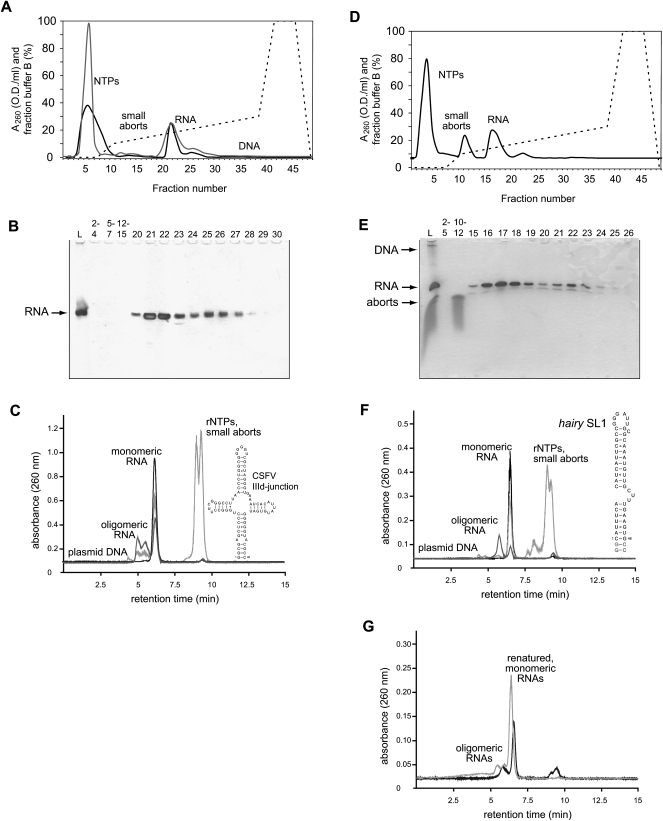
Separation of monomeric from oligomeric RNA species using weak anion-exchange FPLC. (A) Elution profile of the 80 nt CSFV four-way junction RNA purified from a 20 mL in vitro transcription reaction using DEAE-sepharose chromatography. The RNA product elutes in a major peak (fractions 20–23) at lower NaCl concentration followed by a smaller, broad peak (approximately fractions 24–28) at higher NaCl concentration. Three 5 mL HiTrap DEAE-sepharose FF columns (GE Healthcare) connected in series (black UV trace) or one 20 mL HiPrep DEAE-sepharose FF column (gray UV trace) yield very similar elution profiles and resolution. (B) Denaturing PAGE analysis loading 5 μL of the eluted fractions. RNA bands are visualized by staining with 0.1% toluidine blue. The crude transcription reaction is shown in lane L, other lanes are numbered according to the fraction number in A. (C) Gel filtration of the purified CSFV four-way junction RNA. UV trace of the crude in vitro transcription (light gray line) and pooled monomeric RNA fractions (17–21, black line) and the pooled oligomeric RNA fractions (22–28, gray line) are shown. Plasmid DNA, RNA species, rNTPs, and small abortive transcripts are indicated and the secondary structure of the CSFV four-way junction RNA is shown. (D) Elution profile of the 50 nt hairy SL1 RNA purified from a 20 mL in vitro transcription reaction using DEAE-sepharose chromatography. The RNA product elutes in a major peak (fractions 15–18) at lower NaCl concentration followed by a smaller, broad peak (approximately fractions 19–23) at higher NaCl concentration. (E) Denaturing PAGE analysis loading 5 μL of the eluted fractions. RNA bands are visualized by staining with 0.1% toluidine blue. The crude transcription reaction is shown in lane L, other lanes are numbered according to the fraction number in D. (F) Gel filtration of the purified hairy SL1 RNA. UV trace of the crude in vitro transcription (light gray line) and pooled monomeric RNA fractions (15–18, black line) and the pooled dimeric RNA fractions (19–23, gray line) are shown. Plasmid DNA, RNA species, rNTPs, and small abortive transcripts are indicated and the secondary structure of the hairy SL1 RNA is shown. (G) Renaturation of the oligomeric RNA species by heating and rapid cooling on ice analyzed by gel filtration. UV trace of the renatured CSFV four-way junction RNA (gray line) and hairy SL1 RNA (black line) are shown. The corresponding oligomeric species are shown in C and F.

References

    1. Anderson AC, Scaringe SA, Earp BE, Frederick CA. HPLC purification of RNA for crystallography and NMR. RNA. 1996;2:110–117. - PMC - PubMed
    1. Batey RT, Kieft JS. Improved native affinity purification of RNA. RNA. 2007;13:1384–1389. - PMC - PubMed
    1. Batey RT, Inada M, Kujawinski E, Puglisi JD, Williamson JR. Preparation of isotopically labeled ribonucleotides for multidimensional NMR spectroscopy of RNA. Nucleic Acids Res. 1992;20:4515–4523. - PMC - PubMed
    1. Bullock SL, Zicha D, Ish-Horowicz D. The Drosophila hairy RNA localization signal modulates the kinetics of cytoplasmic mRNA transport. EMBO J. 2003;22:2484–2494. - PMC - PubMed
    1. Doudna JA. Preparation of homogeneous ribozyme RNA for crystallization. Methods Mol Biol. 1997;74:365–370. - PubMed

Publication types

MeSH terms

LinkOut - more resources