


Comparison of the sensitivity for detecting foreign bodies among conventional plain radiography, computed tomography and ultrasonography
- PMID: 20100917
- PMCID: PMC3520196
- DOI: 10.1259/dmfr/68589458
Comparison of the sensitivity for detecting foreign bodies among conventional plain radiography, computed tomography and ultrasonography
Abstract
Objective: The purpose of this study was to compare the sensitivity for detecting foreign bodies among conventional plain radiography, CT and ultrasonography in in vitro models.
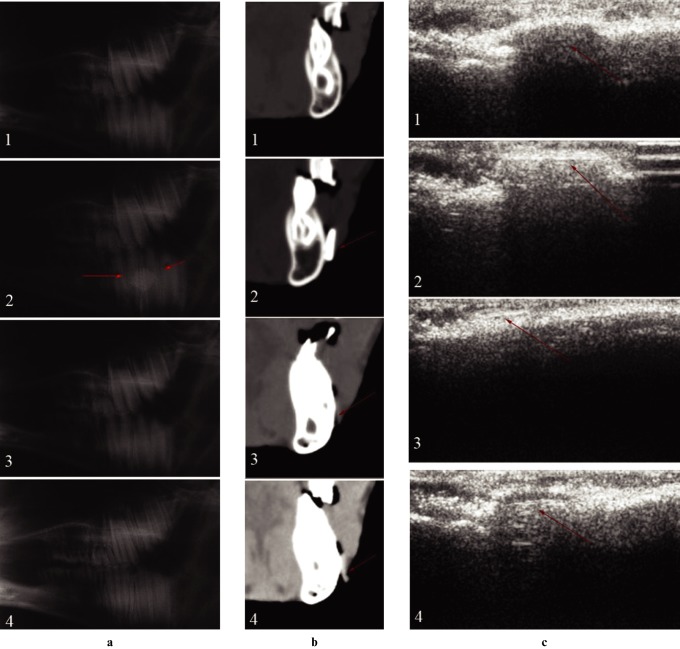
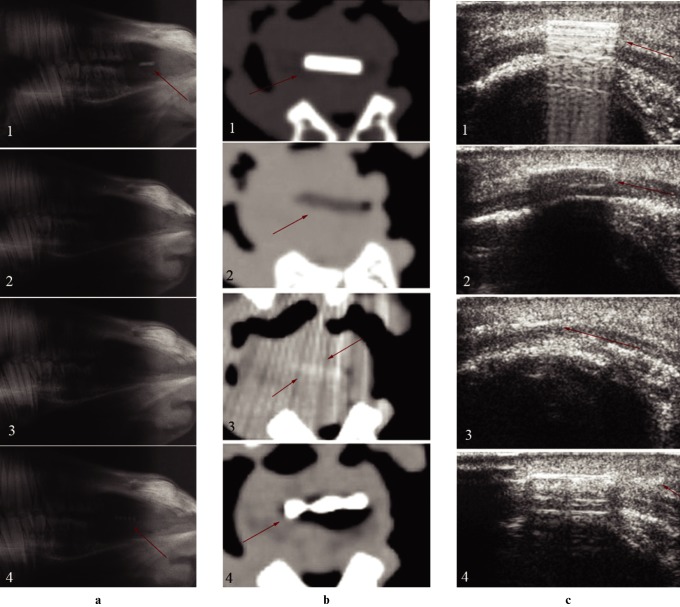
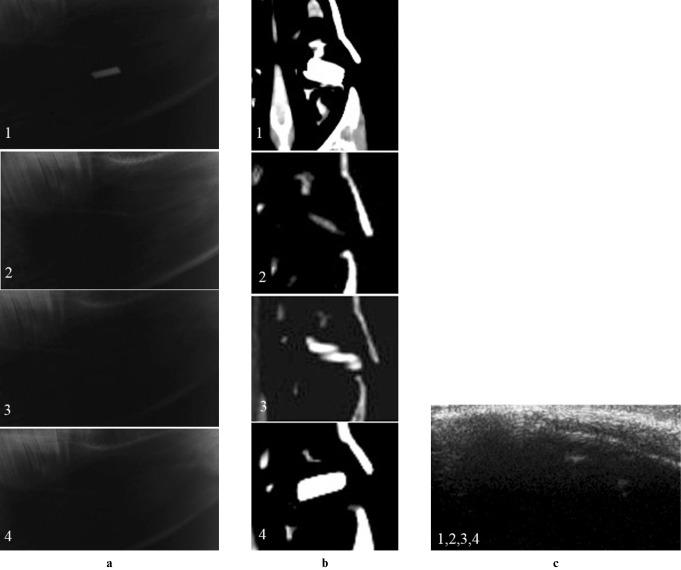
Methods: Seven different materials were selected as foreign bodies with dimensions of approximately 1 x 1 x 0.1 cm. These materials were metal, glass, wood, stone, acrylic, graphite and Bakelite. These foreign bodies were placed into a sheep's head between the corpus mandible and muscle, in the tongue and in the maxillary sinus. Conventional plain radiography, CT and ultrasonography imaging methods were compared to investigate their sensitivity for detecting these foreign bodies.
Results: Metal, glass and stone can be detected with all the visualization techniques used in the study in all of the zones. In contrast to this, foreign bodies with low radiopacity, which could be detected in air with CT, became less visible or almost invisible in muscle tissue and between bone and muscle tissue. The performance of ultrasonography for visualizing foreign bodies with low radiopacity is relatively better than CT.
Conclusions: Ultrasonography detects and localizes superficial foreign bodies with low radiopacity in the tissues of the body more effectively than CT and conventional plain radiography. However, CT is a more effective technique for visualization of foreign bodies in air than ultrasound and conventional plain radiography.
Figures
References
-
- Eggers G, Welzel T, Mukhamadiev D, Wortche R, Hassfeld S, Muhling J. X-ray-based volumetric imaging of foreign bodies: a comparison of computed tomography and digital volume tomography. J Oral Maxillofac Surg 2007;65:1880–1885 - PubMed
-
- Hunter TB, Taljanovic MS. Foreign bodies. Radiographics 2003;23:731–757 - PubMed
-
- Eggers G, Mukhamadiev D, Hassfeld S. Detection of foreign bodies of the head with digital volume tomography. Dentomaxillofac Radiol 2005;34:74–79 - PubMed
-
- Oikarinen KS, Nieminen TM, Makarainen H, Pyhtinen J. Visibility of foreign bodies in soft tissue in plain radiographs, computed tomography, magnetic resonance imaging, and ultrasound. An in vitro study. Int J Oral Maxillofac Surg 1993;22:119–124 - PubMed
-
- Lagalla R, Manfre L, Caronia A, Bencivinni F, Duranti C, Ponte F. Plain film, CT and MRI sensibility in the evaluation of intraorbital foreign bodies in an in vitro model of the orbit and in pig eyes. Eur Radiol 2000;10:1338–1341 - PubMed
Publication types
MeSH terms
LinkOut - more resources
Full Text Sources
Medical
