. 2010 Mar;42(3):268-71.
doi: 10.1038/ng.528. Epub 2010 Jan 31.

Plasmodium falciparum genome-wide scans for positive selection, recombination hot spots and resistance to antimalarial drugs

Affiliations

Plasmodium falciparum genome-wide scans for positive selection, recombination hot spots and resistance to antimalarial drugs

Jianbing Mu et al. Nat Genet. 2010 Mar.

Abstract

Antimalarial drugs impose strong selective pressure on Plasmodium falciparum parasites and leave signatures of selection in the parasite genome; screening for genes under selection may suggest potential drug or immune targets. Genome-wide association studies (GWAS) of parasite traits have been hampered by the lack of high-throughput genotyping methods, inadequate knowledge of parasite population history and time-consuming adaptations of parasites to in vitro culture. Here we report the first Plasmodium GWAS, which included 189 culture-adapted P. falciparum parasites genotyped using a custom-built Affymetrix molecular inversion probe 3K malaria panel array with a coverage of approximately 1 SNP per 7 kb. Population structure, variation in recombination rate and loci under recent positive selection were detected. Parasite half-maximum inhibitory concentrations for seven antimalarial drugs were obtained and used in GWAS to identify genes associated with drug responses. This study provides valuable tools and insight into the P. falciparum genome.


Conflict of interest statement

COMPETING INTEREST STATEMENT

The authors declare that they do not have any competing financial interests.

Figures
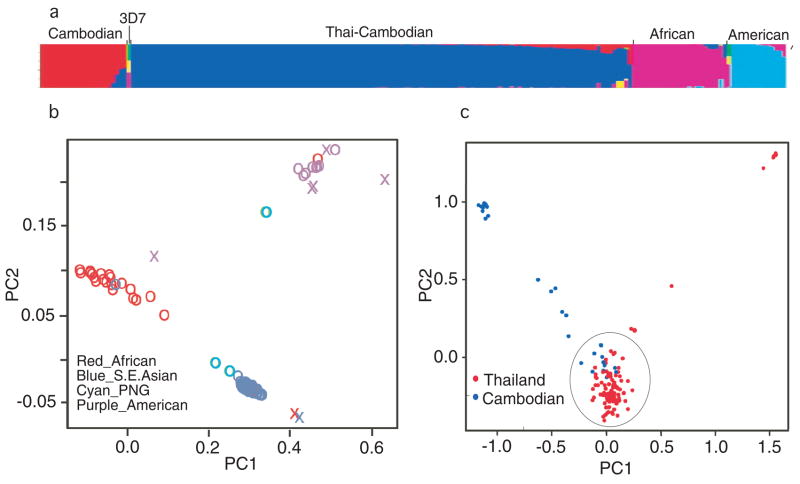
Figure 1
Figure 1
Population structure and principal component analysis (PCA) of Plasmodium falciparum parasite populations. (a) Population partitions using STRUCTURE (v2.2) . The Cambodian group (red) consists of parasites CP195, CP201, CP216, CP285, CP286, CP291, CP313, CP268, CP325, CP305, CP307, CP256, CP238, and CP211. (b) PCA plot of all the parasites. Parasite continental origins are as color-coded and ‘X’ indicates outliers. PNG, Papua New Guinea. (c) PCA plot of the Thai-Cambodian parasites showing outliers from the region.
Figure 2
Figure 2
Loci subject to positive selection in Plasmodium falciparum populations from Africa, Asia and America. (a) plots of −Log P values showing loci significantly under positive selection. Arrowheads point to loci containing the genes encoding chloroquine resistance transporter (pfcrt) on chromosome 7, the apical membrane antigen (pfama-1) on chromosome 11, and an ABC transporter on chromosome 13, respectively; Dots above the dash lines indicate significant. (b) plots of integrated haplotype scores (iHS) showing loci under selection. Arrowheads indicate the pfcrt and pfama-1 loci on chromosome 7 and 11, respectively. SNPs with |iHS| values≥2.3 were those above the horizontal line in each graph. Each dot represents an |iHS| value from a window of 21 SNPs (a core SNP plus 10 SNPs on each side). (c) plots of −logP values from cross population extended haplotype homozygosity (XP-EHH) analyses. AF/AM, comparison of African and American populations; AF/AS, comparison of African and Asian populations; AS/AM, comparison of Asian and American populations. The horizontal lines indicate significant P-values (<0.05), and the arrowhead points to the pfcrt locus on chromosome 7 and PFE1445c locus on chromosome 5, respectively.
Figure 3
Figure 3
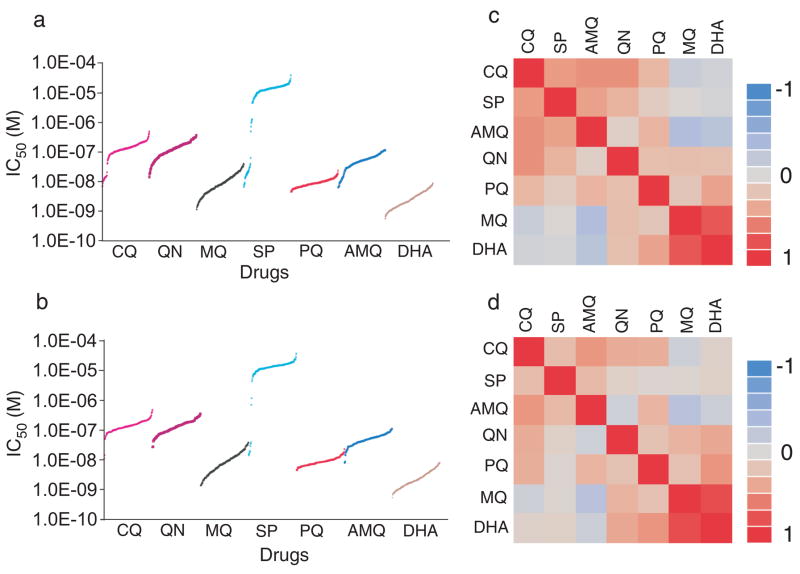
In vitro parasite responses (IC50) to seven antimalarial drugs. (a) IC50 values to seven different antimalarial drugs from 185 parasites were sorted from the lowest to the highest values. Note gaps in IC50 values in parasite responses to chloroquine (CQ) and sulfadoxine-pyrimethamine (SP), but continuous distributions for the other drugs. IC50 curves for each drug as marked in the figure; (b) similar plots as in (a) for parasites from Thai-Cambodian population; (c), (d) multivariate analyses showing correlations between responses to seven different drugs for all the parasites (c) and Thai-Cambodian parasites (d). Dihydroartemisinin (DHA) and mefloquine (MQ) had strong positive correlation; CQ, amodiaquine (AMQ), piperaquine (PQ), quinine (QN), and SP also had positive correlation to some degree; whereas AMQ/DHA, AMQ/MQ had negative correlation.
Figure 4
Figure 4
Genome-wide scan for SNPs associated with responses to antimalarial drugs in the Asian population. Values of −Log P for four drugs were plotted against chromosomal positions. The arrowheads indicate SNPs with Bonferroni corrected P<0.05. (a) plots from EIGENSOFT; (b) plots from PLINK. CQ, chloroquine; QN, quinine; MQ, mefloquine; DHA, dihydroartemisinin.

References

    1. Wootton JC, et al. Genetic diversity and chloroquine selective sweeps in Plasmodium falciparum. Nature. 2002;418:320–323. - PubMed
    1. Roper C, et al. Intercontinental spread of pyrimethamine-resistant malaria. Science. 2004;305:1124. - PubMed
    1. Mu J, et al. Genome-wide variation and identification of vaccine targets in the Plasmodium falciparum genome. Nat Genet. 2007;39:126–130. - PubMed
    1. Zalis MG, Pang L, Silveira MS, Milhous WK, Wirth DF. Characterization of Plasmodium falciparum isolated from the Amazon region of Brazil: evidence for quinine resistance. Am J Trop Med Hyg. 1998;58:630–637. - PubMed
    1. Baird JK. Effectiveness of antimalarial drugs. N Engl J Med. 2005;352:1565–1577. - PubMed

Publication types

MeSH terms