


Impact of ambient bright light on agitation in dementia
- PMID: 20104513
- PMCID: PMC3711022
- DOI: 10.1002/gps.2453
Impact of ambient bright light on agitation in dementia
Abstract
Objective: To evaluate the effect of ambient bright light therapy (BLT) on agitation among institutionalized persons with dementia.
Methods: High intensity, low glare ambient lighting was installed in activity and dining areas of a state psychiatric hospital unit in North Carolina and a dementia-specific residential care facility in Oregon. The study employed a cluster-unit crossover design involving four ambient lighting conditions: AM bright light, PM bright light, All Day bright light, and Standard light. Sixty-six older persons with dementia participated. Outcome measures included direct observation by research personnel and completion by staff caregivers of the 14-item, short form of the Cohen-Mansfield Agitation Inventory (CMAI).
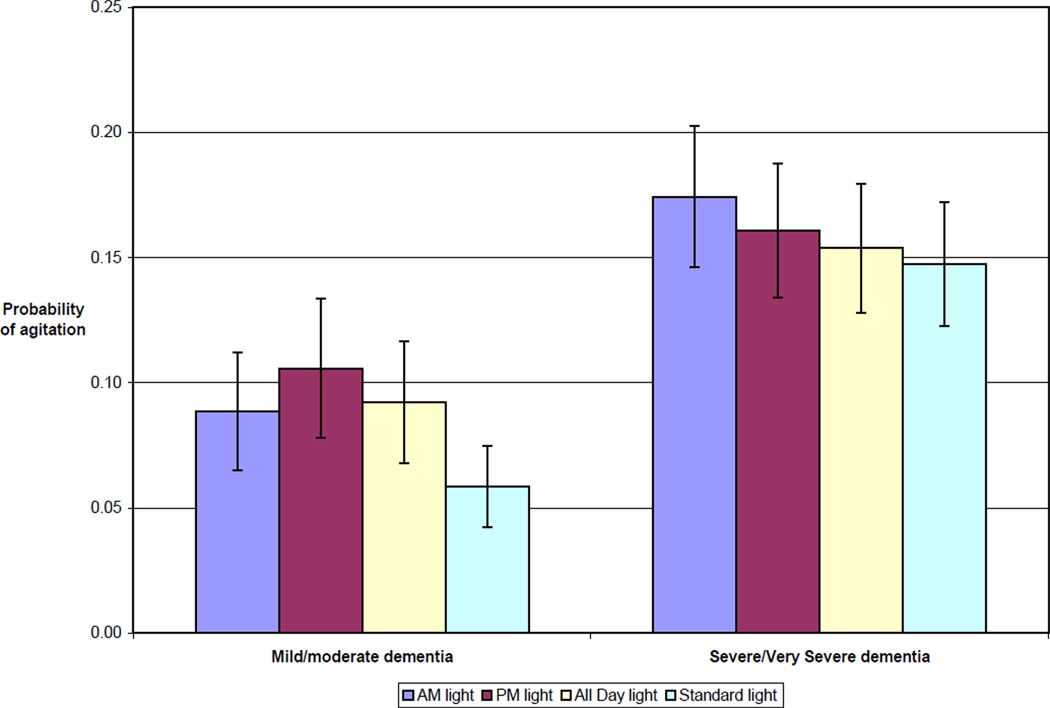
Results: Analyses of observational data revealed that for participants with mild/moderate dementia, agitation was higher under AM light (p = 0.003), PM light (p < 0.001), and All Day light (p = 0.001) than Standard light. There was also a trend toward severely demented participants being more agitated during AM light than Standard light (p = 0.053). Analysis of CMAI data identified differing responses by site: the North Carolina site significantly increased agitation under AM light (p = 0.002) and PM light (p = 0.013) compared with All Day light while in Oregon, agitation was higher for All Day light compared to AM light (p = 0.030). In no comparison was agitation significantly lower under any therapeutic condition, in comparison to Standard lighting.
Conclusions: Ambient bright light is not effective in reducing agitation in dementia and may exacerbate this behavioral symptom.
Copyright © 2010 John Wiley & Sons, Ltd.
Conflict of interest statement
None of the authors have a conflict of interest or any financial agreement with any company that gave support to this research.
Figures
References
-
- Ancoli-Israel S, Martin JL, Gehrman P, et al. Effect of light on agitation in institutionalized patients with severe Alzheimer's disease. American Journal of Geriatric Psychiatry. 2003;11(2):194–203. - PubMed
-
- Bliwise DL, Carroll JS, Dement WC. Apparent seasonal variation in sundowning behavior in a skilled nursing facility. Sleep Research. 1989;18:408.
-
- Burgio LD, Butler F, Engel BT. Nurses' attitudes towards geriatric behavior problems in long-term care settings. Clinical Gerontologist. 1988;7(3/4):23–34.
-
- Chesson AL, Jr, Littner M, Davila D, et al. Practice parameters for the use of light therapy in treatment of sleep disorders. Sleep. 1999;22(5):641–660. - PubMed
-
- Cohen-Mansfield J, Billig N. Agitated behaviors in the elderly. I. A conceptual review. Journal of the American Geriatrics Society. 1986;34(10):711–721. - PubMed
Publication types
MeSH terms
Grants and funding
LinkOut - more resources
Full Text Sources
Medical
