. 2010 Feb;31(3):544-55.
doi: 10.1111/j.1460-9568.2009.07073.x. Epub 2010 Jan 25.

Repetitive behavior and increased activity in mice with Purkinje cell loss: a model for understanding the role of cerebellar pathology in autism

Affiliations

Repetitive behavior and increased activity in mice with Purkinje cell loss: a model for understanding the role of cerebellar pathology in autism

Loren A Martin et al. Eur J Neurosci. 2010 Feb.

Abstract

Repetitive behaviors and hyperactivity are common features of developmental disorders, including autism. Neuropathology of the cerebellum is also a frequent occurrence in autism and other developmental disorders. Recent studies have indicated that cerebellar pathology may play a causal role in the generation of repetitive and hyperactive behaviors. In this study, we examined the relationship between cerebellar pathology and these behaviors in a mouse model of Purkinje cell loss. Specifically, we made aggregation chimeras between Lc/+ mutant embryos and +/+ embryos. Lc/+ mice lose 100% of their Purkinje cells postnatally due to a cell-intrinsic gain-of-function mutation. Through our histological examination, we demonstrated that Lc/+<-->+/+ chimeric mice have Purkinje cells ranging from zero to normal numbers. Our analysis of these chimeric cerebella confirmed previous studies on Purkinje cell lineage. The results of both open-field activity and hole-board exploration testing indicated negative relationships between Purkinje cell number and measures of activity and investigatory nose-poking. Additionally, in a progressive-ratio operant paradigm, we found that Lc/+ mice lever-pressed significantly less than +/+ controls, which led to significantly lower breakpoints in this group. In contrast, chimeric mice lever-pressed significantly more than controls and this repetitive lever-pressing behavior was significantly and negatively correlated with total Purkinje cell numbers. Although the performance of Lc/+ mice is probably related to their motor deficits, the significant relationships between Purkinje cell number and repetitive lever-pressing behavior as well as open-field activity measures provide support for a role of cerebellar pathology in generating repetitive behavior and increased activity in chimeric mice.


Figures
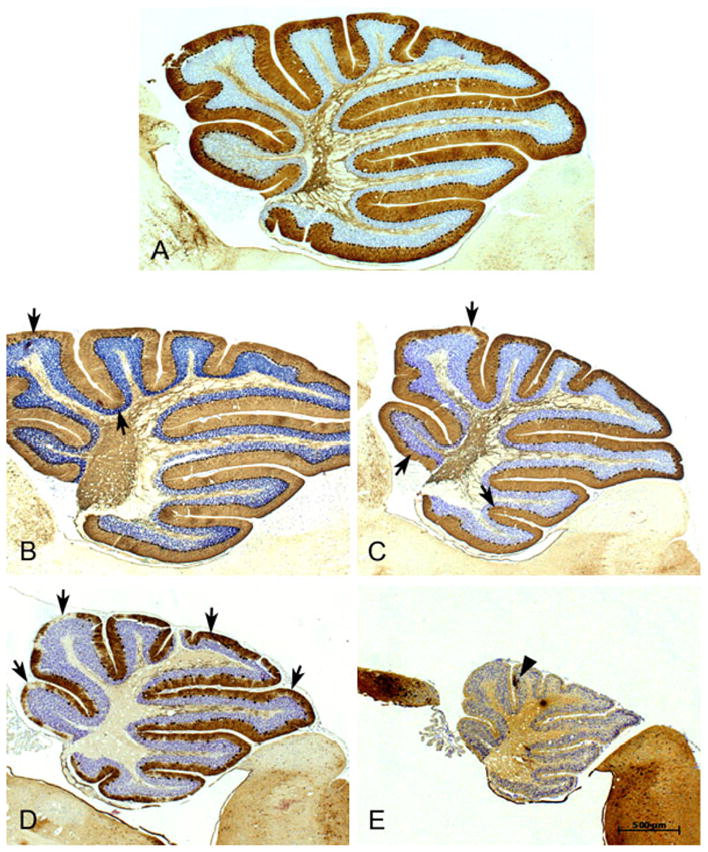
Fig. 1
Fig. 1
Examples of the cerebellum from the spectrum of chimeras that were studied. Material is stained for anti-Calbindin to highlight Purkinje cell bodies, their dendritic arborizations into the molecular layer and their axons which pass out through the white matter en route to the cerebellar nuclei. (A) This midline section is from a cerebellum that had normal numbers of Purkinje cells and is thus considered a 100% +/+ chimera. Note the large size of the cerebellum as well as the full complement of Purkinje cells aligned without interruptions along the internal granule cells. The arbors of the dendritic trees highlight the molecular layer. (B) The cerebellum from this chimera was estimated to be about 85% wild-type and the relative normality of the cerebellum is indicated by a total size that is only slightly smaller than the 100% wild-type cerebellum and has only a few gaps in Purkinje cells (arrows). (C) This cerebellum is from a chimera that was estimated to be a 50% chimera. Note the smaller size of the cerebellum and the larger gaps in the Purkinje cell layer (PCL) that are void of Purkinje cells (arrows show a few examples). (D) Although over-stained for immunocytochemistry this cerebellum is obviously smaller than the cerebella in A–C and there are large gaps of Purkinje-cell-free regions in the PCL. One can also see a dramatic reduction in the Calbindin-positive axons in the white matter. This cerebellum is from a 80% lurcher chimera. (E) From a virtually 100% lurcher chimera showing the diminished size of the cerebellum and the virtual lack of anti-Calbindin staining within the cerebellum except for one Purkinje cell (arrowhead) found in this midline section. The rest of the brain stains normally for the antibody, indicating the specific loss of Purkinje cells. The scale bar applies to all images.
Fig. 2
Fig. 2
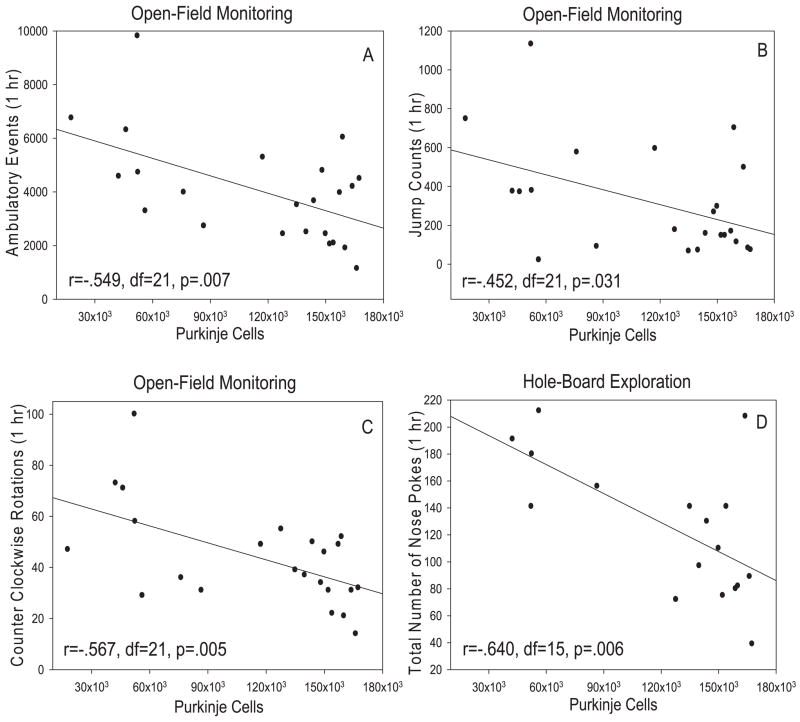
Scatterplots showing the relationship between total cerebellar Purkinje cell number and some of the measures of ambulation during open-field monitoring and the total number of hole pokes during hole-board exploration. Total Purkinje cell number was negatively related to ambulatory events (A; r = −0.549, d.f. = 21, P = 0.007), total jump counts (B; r = −452, d.f. = 21, P = 0.031) and counter clockwise rotations (C; r = −0.567, d.f. = 21, P = 0.005) as determined by Pearson correlations. (D) Total Purkinje cell number was also negatively related to the total number of nose-pokes during the 60-min session of hole-board exploration (r = −0.640, d.f. = 15, P = 0.006). Data from six mice tested in this task were unavailable due to computer malfunction.
Fig. 3
Fig. 3
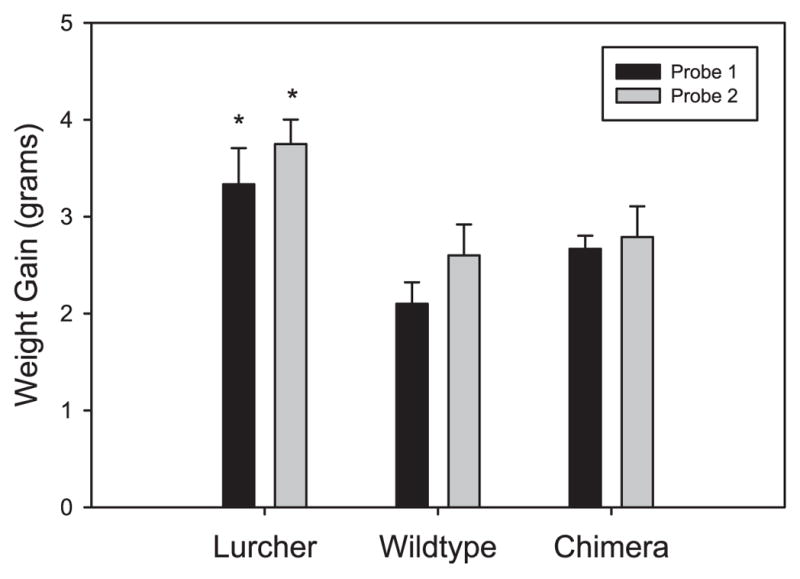
Mean weight gain of Lc/+, +/+ and Lc/+↔+/+ chimeras in each of two 40-min sessions of the hunger motivation task. Dunnett’s t-tests revealed that Lc/+ mice gained significantly more weight than control and chimeric mice following these probes (*P < 0.01).
Fig. 4
Fig. 4
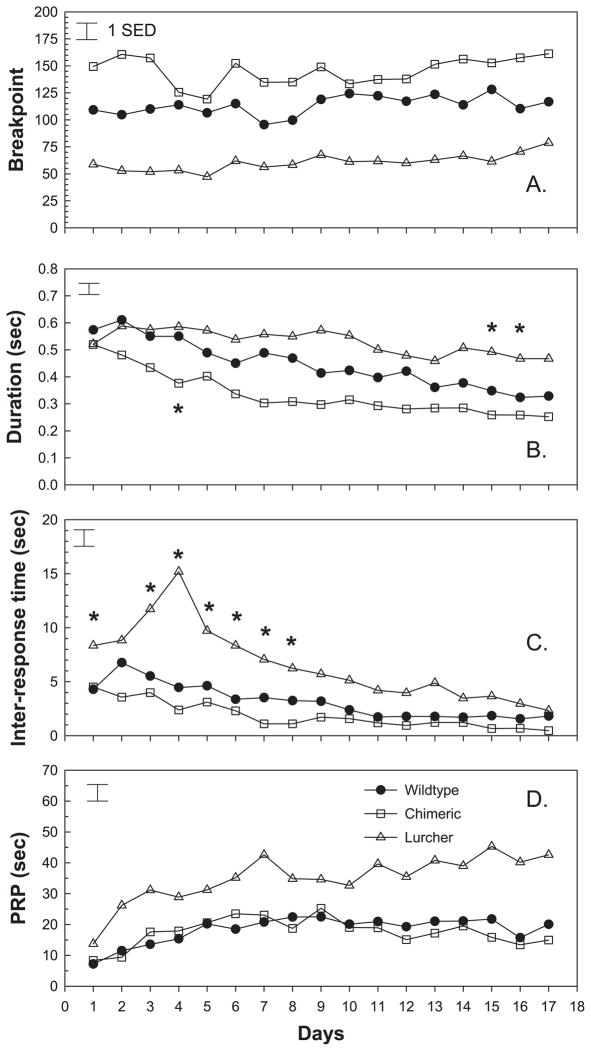
Mean breakpoint, lever-press duration, inter-response time and post-reinforcement pause of Lc/+, +/+ and Lc/+↔+/+ chimeras in each trial session of the PR task. *Individual trial sessions in which there were significant differences (P < 0.05) between Lc/+ and wildtype control mice or chemeric and control mice (Panel B session 4 only). (A) Mean breakpoint increased with repeated testing in all groups (Day; F = 2.98, d.f. = 16.944, P < 0.001). In addition, analysis of mean breakpoint across all test days revealed that chimeric mice (145.5) lever-pressed significantly more than controls (113.5) while Lc/+ mice (60.7) lever-pressed significantly less (Group; F = 20.61, d.f. = 2.59, P < 0.001). (B) Mean lever-press duration decreased with repeated testing in all three groups (Day; F = 17.84, d.f. = 16.944, P < 0.001), but the groups differed in how much they changed over the course of testing (Group × Day; F = 2.04, d.f. = 32.944, P < 0.001). Lc/+ mice had significantly longer durations during test days 15 and 16, while chimeras had a significantly shorter duration on day 4. (C) Mean inter-response time across all test days differed between groups (Group; F = 17.72, d.f. = 2.59, P < 0.001). Lc/+ mice (6.57 s) had significantly longer inter-response intervals than control mice (3.15 s), but chimeric mice did not differ significantly from controls. In addition, Lc/+ mice displayed a different pattern of change across test days (Group × Day; F = 3.55, d.f. = 32.944, P < 0.001). IRTs lengthened during the first four test days and then began to decline with repeated testing, resulting in significantly longer IRTs during most of the first eight test days. (D) Mean post-reinforcement pause differed between groups across all test days (Group; F = 22.99, d.f. = 2.59, P < 0.001). Lc/+ mice maintained consistently longer PRPs over the 17 test days than controls.
Fig. 5
Fig. 5
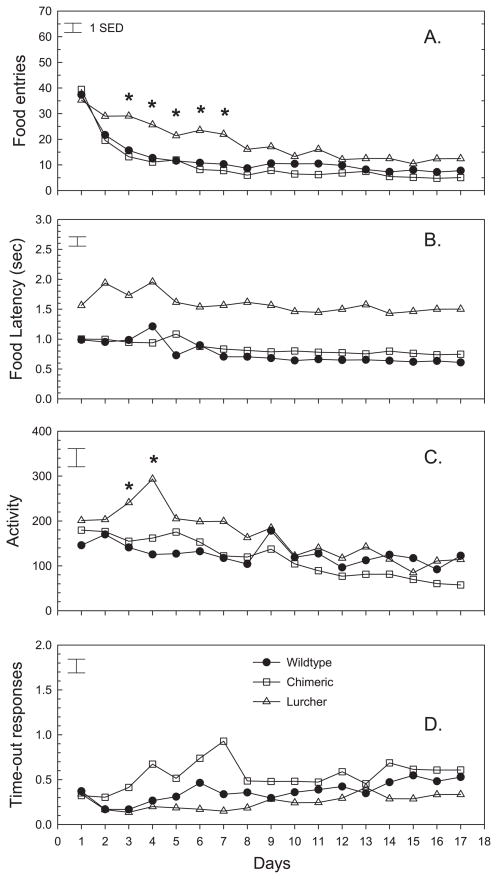
Mean number of food entries, food latency, off-task activity and number of time-out responses of Lc/+, +/+ and Lc/+↔+/+ chimeras in each trial session of the PR task. *Individual trial sessions in which there were significant differences (P < 0.05) between Lc/+ and wildtype control mice. (A) The number of times per trial that each group entered into the food magazine declined significantly across test days (Day; F = 41.47, d.f. = 16.944, P < 0.001). Lc/+ animals showed a significantly slower rate of decline in entries than control mice (Group × Day, F = 1.82, d.f. = 32.944, P < 0.005), which accounted for significant group differences between test days 3 and 7. (B) The latency to reach the food magazine once reinforcement had been delivered differed between groups (Group; F = 51.74, d.f. = 2.59, P < 0.001). Lc/+ mice (1.59 s) demonstrated significantly longer food latencies than control mice (0.76) across all test days. (C) Activity in the rear of the test chamber declined significantly in all groups with repeated testing (Day; F = 11.21, d.f. = 16.944, P < 0.001). There were relatively small group differences in activity over the test days (Group × Day; F = 1.84, d.f. = 32.944, P < 0.005) in that Lc/+ mice had higher levels of activity on test days 3 and 4 in comparison with controls. (D) Mean time-out responses differed between groups but remained relatively constant over all test days (Group; F = 5.49, d.f. = 2.59, P = 0.007). Lc/+ mice exhibited fewer time-out responses than chimeric mice over the 17 test days, although neither group differed significantly from controls.
Fig. 6
Fig. 6
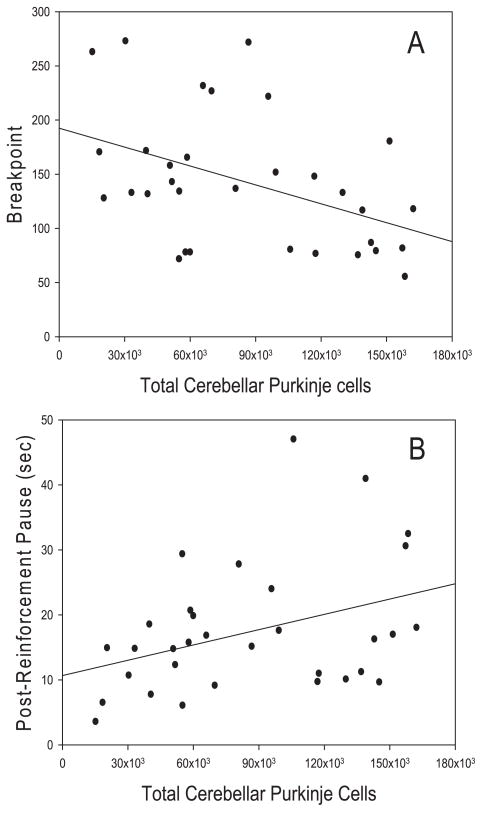
Scatterplots showing the relationships between total cerebellar Purkinje cell number and both breakpoint and post-reinforcement pause. (A) Total Purkinje cell number was negatively related to breakpoint as revealed by Pearson correlations (r = −0.439, d.f. = 31, P = 0.01). Breakpoint declined as total Purkinje cell number decreased. (B) Total Purkinje cell number was positively related to post-reinforcement pause (r = 0.369, d.f. = 31, P < 0.05) in that mice with lower numbers of Purkinje cells had shorter PRPs.

References

    1. Abercrombie M. Estimation of nuclear population from microtome sections. Anat Rec. 1946;94:239–247. - PubMed
    1. Baader SL, Schilling ML, Rosengarten B, Pretsch W, Teutsch HF, Oberdick J, Schilling K. Purkinje cell lineage and the topographic organization of the cerebellar cortex: a view from X inactivation mosaics. Dev Biol. 1996;174:393–406. - PubMed
    1. Bleuler EP. Dementia Praecox or the Group of Schizophrenias. International University Press; New York: 1950.
    1. Bodfish JW, Symons FJ, Parker DE, Lewis MH. Varieties of repetitive behavior in autism: comparisons to mental retardation. J Autism Dev Disord. 2000;30:237–243. - PubMed
    1. Boltshauser E, Steinlin M, Martin E, Deonna T. Unilateral cerebellar aplasia. Neuropediatrics. 1996;27:50–53. - PubMed

Publication types