


Metabolic programming due to alterations in nutrition in the immediate postnatal period
- PMID: 20107149
- PMCID: PMC2821890
- DOI: 10.3945/jn.109.110155
Metabolic programming due to alterations in nutrition in the immediate postnatal period
Abstract
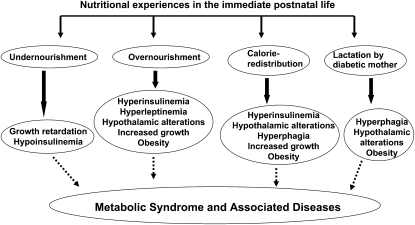
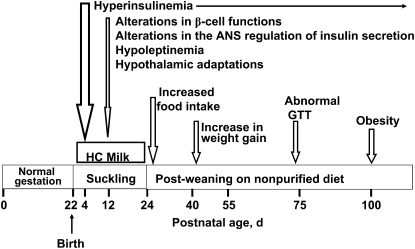
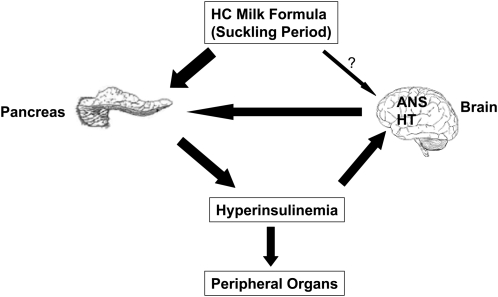
Altered nutritional experiences such as undernutrition, overnutrition, and modified milk formula in the immediate postnatal life via the phenomenon of metabolic programming have been identified as one of the components in the etiology of metabolic syndrome. We have developed a rat model in which an altered dietary experience in the form of a high-carbohydrate (HC) milk formula in the immediate postnatal life of rat pups results in chronic hyperinsulinemia and adult-onset obesity in these rats. The HC dietary modification causes functional alterations in pancreatic islets and the hypothalamus during the period of the dietary modification. These early adaptations in islets (supporting hyperinsulinemia) and the hypothalamus (supporting hyperphagia and increased body weight gain) persist in the postweaning period despite withdrawal of the HC milk formula at the time of weaning. In female rat pups receiving the HC milk formula, metabolic programming effects translate into an adverse (hyperinsulinemic, hyperleptinemic, and obese) intrauterine environment during pregnancy, causing spontaneous transfer of the maternal phenotype to the progeny (generational effect). Our results suggest that alterations in feeding practices for babies (early introduction of cereals, fruits, etc.) and babies born to obese/hyperinsulinemic mothers may be contributing factors for the obesity epidemic prevalent in developed and developing countries.
Figures
Similar articles
-
Metabolic programming in the immediate postnatal life.Ann Nutr Metab. 2011;58 Suppl 2(Suppl 2):18-28. doi: 10.1159/000328040. Epub 2011 Aug 12. Ann Nutr Metab. 2011. PMID: 21846978 Free PMC article.
-
Programming of islet functions in the progeny of hyperinsulinemic/obese rats.Diabetes. 2003 Apr;52(4):984-90. doi: 10.2337/diabetes.52.4.984. Diabetes. 2003. PMID: 12663470
-
Neonatal nutrition: metabolic programming of pancreatic islets and obesity.Exp Biol Med (Maywood). 2003 Jan;228(1):15-23. doi: 10.1177/153537020322800102. Exp Biol Med (Maywood). 2003. PMID: 12524468 Review.
-
Maternal obesity and fetal programming: effects of a high-carbohydrate nutritional modification in the immediate postnatal life of female rats.Am J Physiol Endocrinol Metab. 2008 Oct;295(4):E895-903. doi: 10.1152/ajpendo.90460.2008. Epub 2008 Aug 5. Am J Physiol Endocrinol Metab. 2008. PMID: 18682533 Free PMC article.
-
Metabolic programming: Role of nutrition in the immediate postnatal life.J Inherit Metab Dis. 2009 Apr;32(2):218-28. doi: 10.1007/s10545-008-1033-4. Epub 2008 Dec 22. J Inherit Metab Dis. 2009. PMID: 19096914 Review.
Cited by
-
Impact of Metabolic Hormones Secreted in Human Breast Milk on Nutritional Programming in Childhood Obesity.J Mammary Gland Biol Neoplasia. 2017 Sep;22(3):171-191. doi: 10.1007/s10911-017-9382-y. Epub 2017 Jun 27. J Mammary Gland Biol Neoplasia. 2017. PMID: 28653126 Review.
-
Mechanisms Underlying the Expansion and Functional Maturation of β-Cells in Newborns: Impact of the Nutritional Environment.Int J Mol Sci. 2022 Feb 14;23(4):2096. doi: 10.3390/ijms23042096. Int J Mol Sci. 2022. PMID: 35216239 Free PMC article. Review.
-
Long-term effect of early postnatal overnutrition on insulin resistance and serum fatty acid profiles in male rats.Lipids Health Dis. 2015 Aug 26;14:96. doi: 10.1186/s12944-015-0094-2. Lipids Health Dis. 2015. PMID: 26302954 Free PMC article.
-
Maternal intake of methyl-group donors affects DNA methylation of metabolic genes in infants.Clin Epigenetics. 2017 Feb 7;9:16. doi: 10.1186/s13148-017-0321-y. eCollection 2017. Clin Epigenetics. 2017. PMID: 28191262 Free PMC article.
-
Impaired Antioxidant Defence Status Is Associated With Metabolic-Inflammatory Risk Factors in Preterm Children With Extrauterine Growth Restriction: The BIORICA Cohort Study.Front Nutr. 2021 Dec 21;8:793862. doi: 10.3389/fnut.2021.793862. eCollection 2021. Front Nutr. 2021. PMID: 34993223 Free PMC article.
References
-
- Flegal KM, Graubard BI, Williamson DF, Gail MH. Excess deaths associated with underweight, overweight, and obesity. JAMA. 2005;293:1861–7. - PubMed
-
- Ogden CL, Carroll MD, Curtin LR, McDowell MA, Tabak CJ, Flegal KM. Prevalence of overweight and obesity in the United States, 1999–2004. JAMA. 2006;295:1549–55. - PubMed
-
- Gluckman PD, Hanson MA, Beedle AS. Early life events and their consequences for later disease: a life history and evolutionary perspective. Am J Hum Biol. 2007;19:1–19. - PubMed
-
- Kaung HL. Growth dynamics of pancreatic islet cell populations during fetal and neonatal development of the rat. Dev Dyn. 1994;200:163–75. - PubMed
-
- Grove KL, Smith MS. Ontogeny of the hypothalamic neuropeptide Y system. Physiol Behav. 2003;79:47–63. - PubMed
