Gelatinase expression in retinoblastoma: modulation of LH(BETA)T(AG) retinal tumor development by anecortave acetate
- PMID: 20107171
- PMCID: PMC2891454
- DOI: 10.1167/iovs.09-4500
Gelatinase expression in retinoblastoma: modulation of LH(BETA)T(AG) retinal tumor development by anecortave acetate
Abstract
Purpose: Gelatinases, matrix metalloproteinase (MMP)-2, and MMP-9 are known for their importance in angiogenesis and tumor biology. The purpose of this study was to test the hypothesis that anecortave acetate (AA) decreases transgenic retinoblastoma (RB) tumor burden by modulating gelatinase activity.
Methods: To assess the possible gelatinase modulation after AA treatment, a single subconjunctival injection of AA (300 microg) was delivered to the right eyes of 10-week-old LH(BETA)T(AG) mice. Eyes were evaluated for gelatinase expression and activity by gel and in situ zymography at 24 hours, 48 hours, and 1 week after treatment.
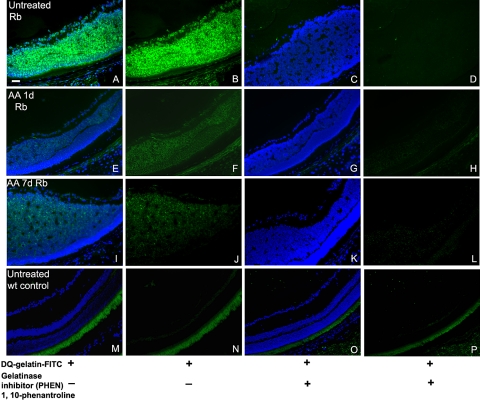
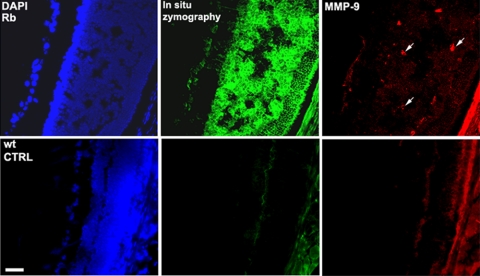
Results: Gel zymography of whole eye extracts and in situ zymography of retinal tumors showed strong gelatinase expression and activity within transgenic RB tumors. AA treatment in RB transgenic mice resulted in a significant decrease of gelatinase activity 1 week after AA treatment. Surprisingly, there was an initial transient upregulation of MMP-9 activity in whole eye extracts at 24 and 48 hours after AA treatment in both LH(BETA)T(AG) transgenic and wild-type mice. This increase was not observed in the tumors.
Conclusions: As suggested by our data, inhibition of gelatinase activity appears to be a mechanism of action of AA. AA treatment results in a decrease in gelatinase activity that correlates with the significant decrease in tumor burden shown by the authors' previous studies. However, the significance of the initial, transient upregulation of gelatinase by AA injection is unknown, and further studies are warranted. Combining antiangiogenic agents with multiple mechanisms of action has the potential to enhance RB tumor control.
Figures
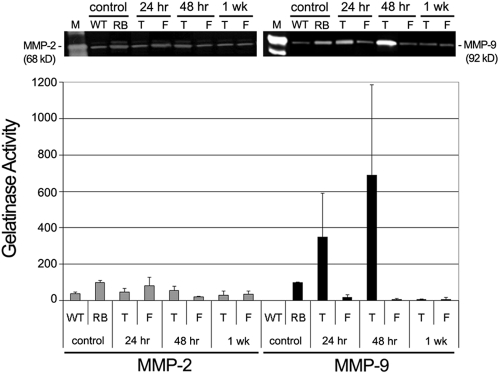
 ) and MMP-9 (■) activities at 24 hours, 48 hours, and 1 week after injection. Top: gelatin zymogram from a representative experiment. Mouse recombinant MMP-9 and MMP-2 were used as positive controls (M). Bottom: average results of three independent gel zymograms. Error bars represent standard deviations from the mean. WT, wild-type; RB, LHBETATAG.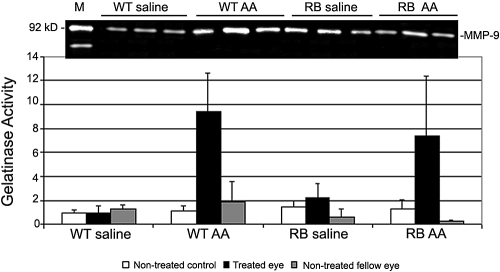
References
-
- Tamboli A, Podgor MJ, Horm JW. The incidence of retinoblastoma in the United States: 1974 through 1985. Arch Ophthalmol 1990;108:128–132 - PubMed
-
- Abramson DH, Beaverson KL, Chang ST, Dunkel IJ, McCormick B. Outcome following initial external beam radiotherapy in patients with Reese-Ellsworth group Vb retinoblastoma. Arch Ophthalmol 2004;122:1316–1323 - PubMed
-
- Khelfaoui F, Validire P, Auperin A, et al. Histopathologic risk factors in retinoblastoma: a retrospective study of 172 patients treated in a single institution. Cancer 1996;77:1206–1213 - PubMed
-
- Rouic LL, Aerts I, Levy-Gabriel C, et al. Conservative treatments of intraocular retinoblastoma. Ophthalmology In press - PubMed
-
- Eng C, Li FP, Abramson DH, et al. Mortality from second tumors among long-term survivors of retinoblastoma. J Natl Cancer Inst 1993;85:1121–1128 - PubMed
Publication types
MeSH terms
Substances
Grants and funding
LinkOut - more resources
Full Text Sources
Molecular Biology Databases
Research Materials
Miscellaneous