


What rheumatologists in the United States think of complementary and alternative medicine: results of a national survey
- PMID: 20109215
- PMCID: PMC2824634
- DOI: 10.1186/1472-6882-10-5
What rheumatologists in the United States think of complementary and alternative medicine: results of a national survey
Abstract
Background: We aimed to describe prevailing attitudes and practices of rheumatologists in the United States toward complementary and alternative medicine (CAM) treatments. We wanted to determine whether rheumatologists' perceptions of the efficacy of CAM therapies and their willingness to recommend them relate to their demographic characteristics, geographic location, or clinical practices.
Methods: A National Institutes of Health-sponsored cross-sectional survey of internists and rheumatologists was conducted regarding CAM for treatment of chronic back pain or joint pain. In this study we analyzed responses only from rheumatologists. Response items included participant characteristics and experience with 6 common CAM categories, as defined by the National Institutes of Health. Descriptive statistics were used to describe attitudes to CAM overall and to each CAM category. Composite responses were devised for respondents designating 4 or more of the 6 CAM therapies as "very" or "moderately" beneficial or "very likely" or "somewhat likely" to recommend.
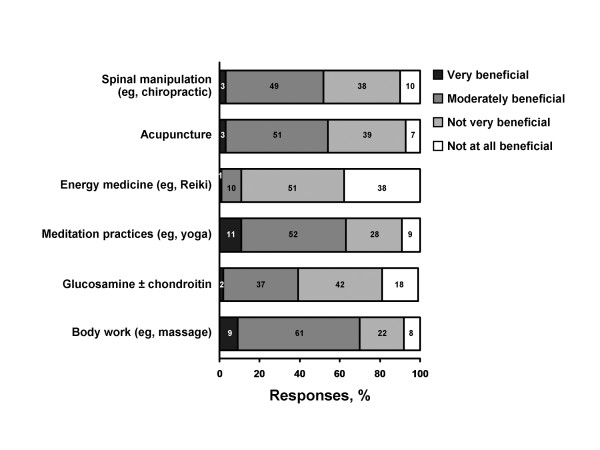
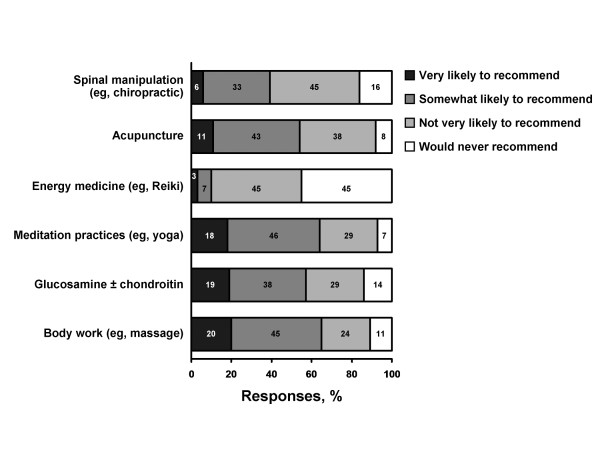
Results: Of 600 rheumatologists who were sent the questionnaire, 345 responded (58%); 80 (23%) were women. Body work had the highest perceived benefit, with 70% of respondents indicating benefit. Acupuncture was perceived as beneficial by 54%. Most were willing to recommend most forms of CAM. Women had significantly higher composite benefit and recommend responses than men. Rheumatologists not born in North America were more likely to perceive benefit of select CAM therapies.
Conclusions: In this national survey of rheumatologists practicing in the United States, we found widespread favorable opinion toward many, but not all, types of CAM. Further research is required to determine to what extent CAM can or should be integrated into the practice of rheumatology in the United States.
Figures
References
-
- Barnes P, Heyman KM. Early release of selected estimates based on data from the January-June 2007 National Health Interview Survey. National Center for Health Statistics; 2007. http://www.cdc.gov/nchs/ December 2007.
MeSH terms
Grants and funding
LinkOut - more resources
Full Text Sources
Medical
