


Predicting happiness among centenarians
- PMID: 20110722
- PMCID: PMC2874733
- DOI: 10.1159/000272017
Predicting happiness among centenarians
Abstract
Background: Happiness is believed to evolve from the comparison of current circumstances relative to past achievement. However, gerontological literature on happiness in extreme old age has been limited.
Objective: The purpose of this study was to determine how perceptions of health, social provisions, and economics link past satisfaction with life to current feelings of happiness among persons living to 100 years of age and beyond.
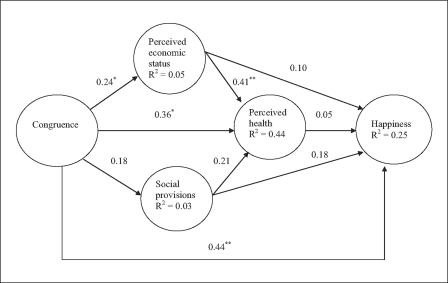
Methods: A total of 158 centenarians from the Georgia Centenarian Study were included to conduct the investigation. Items reflecting congruence and happiness from the Life Satisfaction Index were used to evaluate a model of happiness. Pathways between congruence, perceived economic security, subjective health, perceived social provisions, and happiness were analyzed using structural equation modeling.
Results: Congruence emerged as a key predictor of happiness. Furthermore, congruence predicted perceived economic security and subjective health, whereas perceived economic security had a strong influence on subjective health status.
Conclusion: It appears that past satisfaction with life influences how centenarians frame subjective evaluations of health status and economic security. Furthermore, past satisfaction with life is directly associated with present happiness. This presents implications relative to understanding how perception of resources may enhance quality of life among persons who live exceptionally long lives.
Copyright 2010 S. Karger AG, Basel.
Figures
References
-
- Jopp D, Rott C. Adaptation in very old age: exploring the role of resources, beliefs, and attitudes for centenarians' happiness. Psychol Aging. 2006;21:266–280. - PubMed
-
- Mroczek DK, Spiro A., III Change in life satisfaction during adulthood: findings from the Veterans Affairs normative aging study. J Pers Soc Psychol. 2005;88:189–202. - PubMed
-
- Lucas RE. Adaptation and the set-point model of subjective well-being: does happiness change after major life events? Curr Dir Psychol Sci. 2007;16:75–79.
-
- von Hippel W. Aging and social satisfaction: offsetting positive and negative effects. Psychol Aging. 2008;23:435–439. - PubMed
-
- Cohen K, Shmotkin D. Emotional ratings of anchor periods in life and their relation to subjective well-being among holocaust survivors. Pers Individ Dif. 2007;43:495–506.
Publication types
MeSH terms
Grants and funding
LinkOut - more resources
Full Text Sources
Medical
Miscellaneous
