


Semen analysis with regard to sperm number, sperm morphology and functional aspects
- PMID: 20111078
- PMCID: PMC3739674
- DOI: 10.1038/aja.2008.58
Semen analysis with regard to sperm number, sperm morphology and functional aspects
Abstract
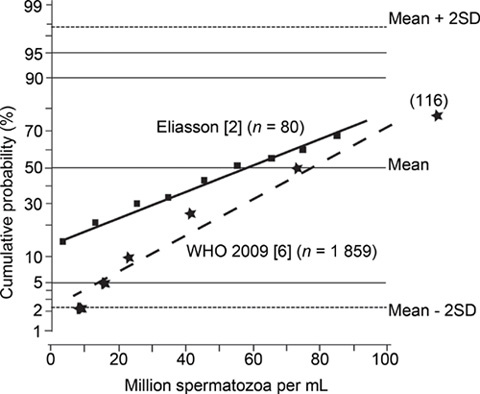
The new World Health Organization (WHO) Manual for Semen Analysis contains several improvements. One is that the 20 million spermatozoa per mL paradigm has been ousted in favour of proper calculations of lower reference limits for semen from men, whose partners had a time-to-pregnancy of 12 months or less. The recommendation to grade the progressive motility as described in the third and fourth editions of the WHO manual was not evidence-based, and WHO was therefore motivated to abandon it. However, the new recommendation is not evidence-based either, and it is difficult to understand the rational for the new assessment. It may have been a compromise to avoid returning to the rather robust system recommended in the first edition (1980). The unconditional recommendation of the 'Tygerberg strict criteria' is not evidence-based, and seems to be the result of an unfortunate bias in the composition of the Committee in favour of individuals known to support the 'strict criteria' method. This recommendation will have negative effects on the development of andrology as a scientific field. Given the importance of the WHO manual, it is unfortunate that the recommendations for such important variables, as motility and morphology, lack evidence-based support.
Figures

References
-
- Gribbin J, Gribbin M, Feynman R.A Life in ScienceDutton: Penguin Books; 1997. Available from: http://www.friesian.com/feynman.htm .
-
- Eliasson R.Basic semen analysisIn: Matson P, editor. Current Topics in Andrology. Perth: Ladybrook Publishing; 2003p35–89.
-
- Handelsman DJ, Conway AJ, Boylan LM, Turtle JR. Testicular function in potential sperm donors: normal ranges and the effects of smoking and varicocele. Int J Androl. 1984;7:369–82. - PubMed
-
- Andersen AG, Jensen TK, Carlsen E, Jørgensen N, Andersson AM, et al. High frequency of sub-optimal semen quality in an unselected population of young men. Hum Reprod. 2000;15:366–72. - PubMed
MeSH terms
LinkOut - more resources
Full Text Sources
