


Clinical significance of the low normal sperm morphology value as proposed in the fifth edition of the WHO Laboratory Manual for the Examination and Processing of Human Semen
- PMID: 20111081
- PMCID: PMC3739680
- DOI: 10.1038/aja.2009.14
Clinical significance of the low normal sperm morphology value as proposed in the fifth edition of the WHO Laboratory Manual for the Examination and Processing of Human Semen
Abstract
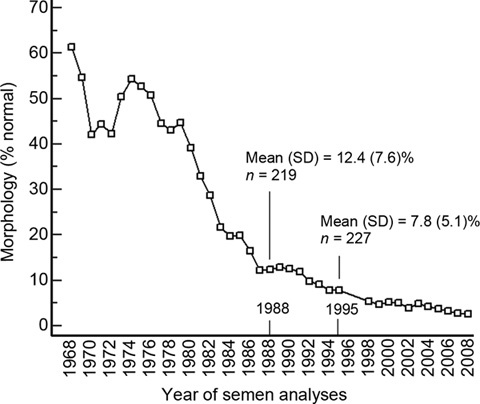
The very low cut-off value for sperm morphology of 4% morphologically normal spermatozoa, as proposed in the new edition of the World Health Organization (WHO) manual on semen analysis, is in agreement with recently published values and reflects the trend of a decline in reported mean values for normal sperm morphology. The reduced value for morphologically normal spermatozoa over the years may be due to several factors. The first is the introduction of strict criteria for the evaluation of sperm morphology. Other reasons may include the introduction of additional criteria for sperm morphology abnormalities and the suggested decrease in semen parameters because of increasing negative environmental influences. Although on its own the newly proposed very low normal value may not provide the strong predictive value for a males' fertility potential, as originally reported for sperm morphology evaluated according to strict criteria, a good predictive value can still be obtained if the holistic, strict approach for sperm morphology evaluation is followed together with additional sperm morphology parameters now available, because certain morphology patterns and sperm abnormalities are now known to be of strong prognostic value. In addition, better international standardization of the technical methodology, consensus on the interpretation of sperm morphology evaluation criteria and standardized international external quality control (EQC) schemes, are of utmost importance to maintain the good predictive value of sperm morphology.
Figures
Comment in
-
Assessment of sperm morphology without quality control may be meaningless for clinicians.Asian J Androl. 2010 Jul;12(4):607-8. doi: 10.1038/aja.2010.35. Epub 2010 May 24. Asian J Androl. 2010. PMID: 20495583 Free PMC article. No abstract available.
-
Our experience in sperm morphology assessment.Asian J Androl. 2011 Mar;13(2):201-2. doi: 10.1038/aja.2010.119. Epub 2010 Nov 15. Asian J Androl. 2011. PMID: 21076434 Free PMC article. No abstract available.
References
-
- World Health Organisation. WHO Laboratory Manual for the Examination and Processing of Human Semen, 5th ed. Geneva: World Health Organization; 2010
-
- Menkveld R, Kruger TF.Evaluation of sperm morphology by light microscopyIn: Acosta AA, Kruger TF, editors. Human Spermatozoa in Assisted Reproduction. Carnforth: Parthenon Publishing; 1996, p89–107.
-
- Cary HW. Examination of semen with reference to gynaecological aspects. Am J Obstet Dis Women Child. 1916;74:615–38.
-
- Williams WW, Salvage A. Observations on the seminal micro-pathology of bulls. Cornell Vet. 1925;15:353–75.
-
- Moench GL, Holt H. Sperm morphology in relation to fertility. Am J Obstet Gynecol. 1931;22:199–210.
MeSH terms
LinkOut - more resources
Full Text Sources
