Body image and body satisfaction differ by race in overweight postpartum mothers
- PMID: 20113143
- PMCID: PMC2834437
- DOI: 10.1089/jwh.2008.1238
Body image and body satisfaction differ by race in overweight postpartum mothers
Abstract
Background: Body image (BI) and body satisfaction may be important in understanding weight loss behaviors, particularly during the postpartum period. We assessed these constructs among African American and white overweight postpartum women.
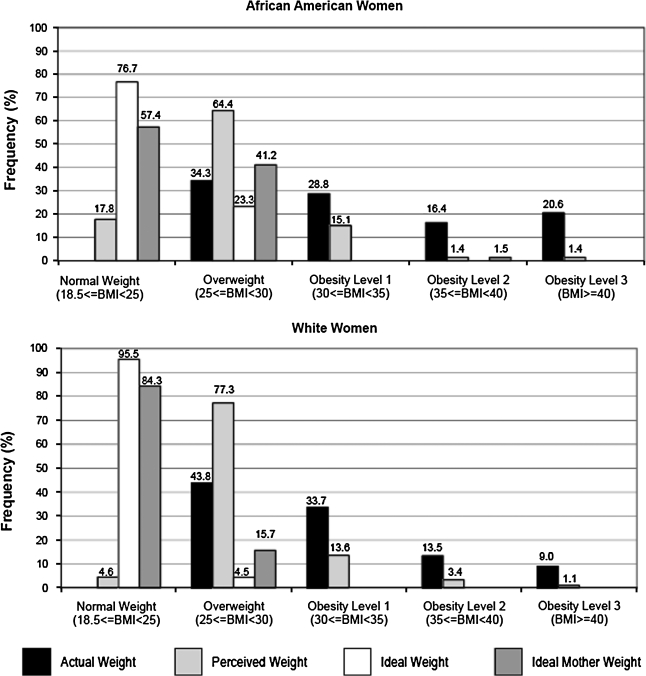
Methods: The sample included 162 women (73 African American and 89 white) in the intervention arm 6 months into the Active Mothers Postpartum (AMP) Study, a nutritional and physical activity weight loss intervention. BIs, self-reported using the Stunkard figure rating scale, were compared assessing mean values by race. Body satisfaction was measured using body discrepancy (BD), calculated as perceived current image minus ideal image (BD<0: desire to be heavier; BD>0: desire to be lighter). BD was assessed by race for: BD(Ideal) (current image minus the ideal image) and BD(Ideal Mother) (current image minus ideal mother image).
Results: Compared with white women, African American women were younger and were less likely to report being married, having any college education, or residing in households with annual incomes >$30,000 (all p < 0.01). They also had a higher mean body mass index (BMI) (p = 0.04), although perceived current BI did not differ by race (p = 0.21). African Americans had higher mean ideal (p = 0.07) and ideal mother (p = 0.001) BIs compared with whites. African Americans' mean BDs (adjusting for age, BMI, education, income, marital status, and interaction terms) were significantly lower than those of whites, indicating greater body satisfaction among African Americans (BD(Ideal): 1.7 vs. 2.3, p = 0.005; BD(Ideal Mother): 1.1 vs. 1.8, p = 0.0002).
Conclusions: Racial differences exist in postpartum weight, ideal images, and body satisfaction. Healthcare providers should consider tailored messaging that accounts for these racially different perceptions and factors when designing weight loss programs for overweight mothers.
Figures
References
-
- Flegal KM. Carroll MD. Ogden CL, et al. Prevalence and trends in obesity among U.S. adults, 1999–2000. JAMA. 2002;288:1723–1727. - PubMed
-
- Ogden CLCM. Curtin LR. McDowell MA. Tabak CJ. Flegal KM. Prevalence of overweight and obesity in the United States, 1999–2004. JAMA. 2006;295:1549–1555. - PubMed
-
- Mokdad AH. Marks JS. Stroup DF, et al. Actual causes of death in the United States, 2000. JAMA. 2004;291:1238–1245. - PubMed
-
- Mack KA. Anderson L. Galuska D, et al. Health and sociodemographic factors associated with body weight and weight objectives for women: 2000 Behavioral Risk Factor Surveillance System. J Womens Health. 2004;13:1019–1032. - PubMed
-
- Fitzgibbon ML. Blackman LR. Avellone ME, et al. The relationship between body image discrepancy and body mass index across ethnic groups. Obes Res. 2000;8:582–589. - PubMed
Publication types
MeSH terms
Grants and funding
LinkOut - more resources
Full Text Sources
Medical
Miscellaneous