


Deep brain stimulation for intractable obsessive compulsive disorder: pilot study using a blinded, staggered-onset design
- PMID: 20116047
- PMCID: PMC5796545
- DOI: 10.1016/j.biopsych.2009.11.028
Deep brain stimulation for intractable obsessive compulsive disorder: pilot study using a blinded, staggered-onset design
Abstract
Background: Prior promising results have been reported with deep brain stimulation (DBS) of the anterior limb of the internal capsule in cases with severe obsessive compulsive disorder (OCD) who had exhausted conventional therapies.
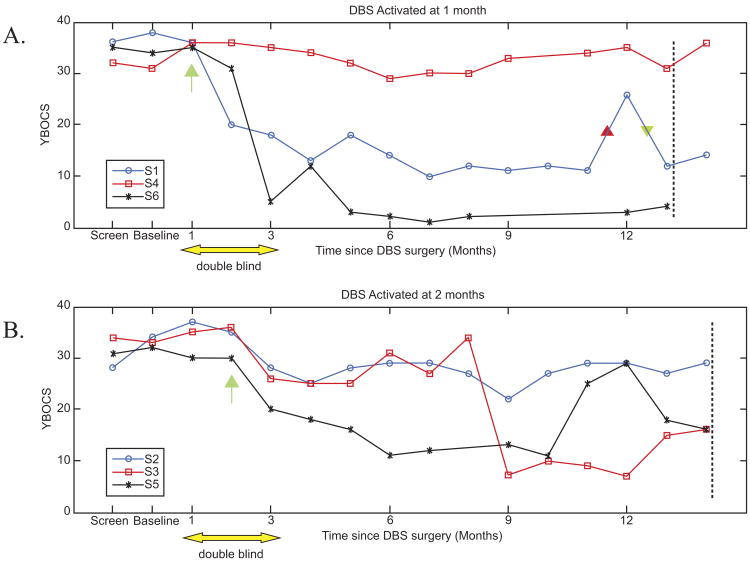
Methods: In this pilot study, six adult patients (2 male; 4 female) meeting stringent criteria for severe (minimum Yale-Brown Obsessive Compulsive Scale [Y-BOCS] of 28) and treatment-refractory OCD had DBS electrode arrays placed bilaterally in an area spanning the ventral anterior limb of the internal capsule and adjacent ventral striatum referred to as the ventral capsule/ventral striatum. Using a randomized, staggered-onset design, patients were stimulated at either 30 or 60 days following surgery under blinded conditions.
Results: After 12 months of stimulation, four (66.7%) of six patients met a stringent criterion as "responders" (> or =35% improvement in the Y-BOCS and end point Y-BOCS severity < or =16). Patients did not improve during sham stimulation. Depressive symptoms improved significantly in the group as a whole; global functioning improved in the four responders. Adverse events associated with chronic DBS were generally mild and modifiable with setting changes. Stimulation interruption led to rapid but reversible induction of depressive symptoms in two cases.
Conclusions: This pilot study suggests that DBS of the ventral capsule/ventral striatum region is a promising therapy of last resort for carefully selected cases of severe and intractable OCD. Future research should attend to subject selection, lead location, DBS programming, and mechanisms underpinning therapeutic benefits.
Trial registration: ClinicalTrials.gov NCT00057603.
Copyright 2010 Society of Biological Psychiatry. Published by Elsevier Inc. All rights reserved.
Conflict of interest statement
All other authors reported no biomedical financial interests or potential conflicts of interest.
Figures
References
-
- Goodman WK, Ward HE, Kablinger AS, Murphy TK. Biological approaches to treatment-resistant obsessive compulsive disorder. In: Goodman WK, Rudorfer MV, Maser J, editors. Obsessive Compulsive Disorder: Contemporary Issues in Treatment. New York: Lawrence Erlbaum Associates; 2000.
-
- Baer L, Rauch SL, Ballantine HT, Jr, Martuza R, Cosgrove R, Cassem E, et al. Cingulotomy for intractable obsessive-compulsive disorder. Prospective long-term follow-up of 18 patients. Arch Gen Psychiatry. 1995;52:384–392. - PubMed
-
- Goodman WK, Insel TR. Deep brain stimulation in psychiatry: Concentrating on the road ahead. Biol Psychiatry. 2009;65:263–266. - PubMed
-
- Rezai AR, Machado AG, Deogaonkar M, Azmi H, Kubu C, Boulis NM. Surgery for movement disorders. Neurosurgery. 2008;62(suppl 2):809–838. - PubMed
-
- Nuttin B, Cosyns P, Demeulemeester H, Gybels J, Meyerson B. Electrical stimulation in anterior limbs of internal capsules in patients with obsessive-compulsive disorder. Lancet. 1999;354:1526. - PubMed
Publication types
MeSH terms
Associated data
Grants and funding
LinkOut - more resources
Full Text Sources
Other Literature Sources
Medical
Miscellaneous
