


The response of the QT interval to the brief tachycardia provoked by standing: a bedside test for diagnosing long QT syndrome
- PMID: 20116193
- PMCID: PMC2862092
- DOI: 10.1016/j.jacc.2009.12.015
The response of the QT interval to the brief tachycardia provoked by standing: a bedside test for diagnosing long QT syndrome
Abstract
Objectives: This study was undertaken to determine whether the short-lived sinus tachycardia that occurs during standing will expose changes in the QT interval that are of diagnostic value.
Background: The QT interval shortens during heart rate acceleration, but this response is not instantaneous. We tested whether the transient, sudden sinus tachycardia that occurs during standing would expose abnormal QT interval prolongation in patients with long QT syndrome (LQTS).
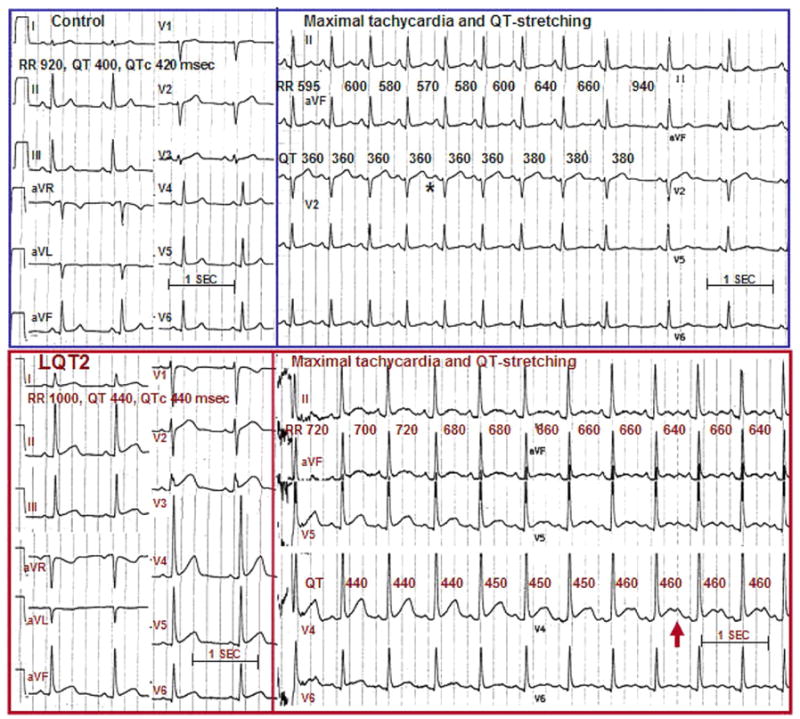
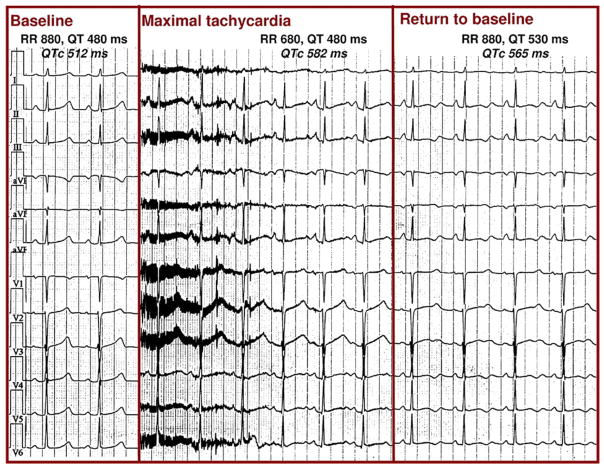
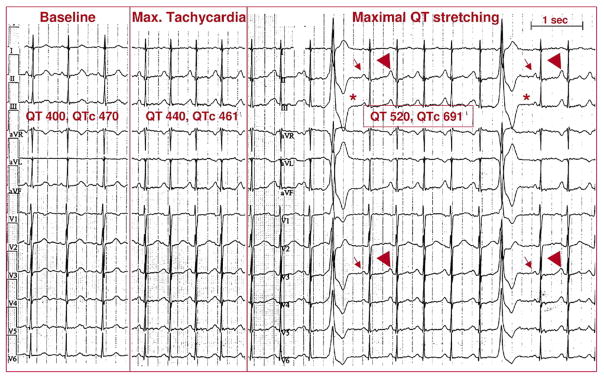
Methods: Patients (68 with LQTS [LQT1 46%, LQT2 41%, LQT3 4%, not genotyped 9%] and 82 control subjects) underwent a baseline electrocardiogram (ECG) while resting in the supine position and were then asked to get up quickly and stand still during continuous ECG recording. The QT interval was studied at baseline and during maximal sinus tachycardia, maximal QT interval prolongation, and maximal QT interval stretching.
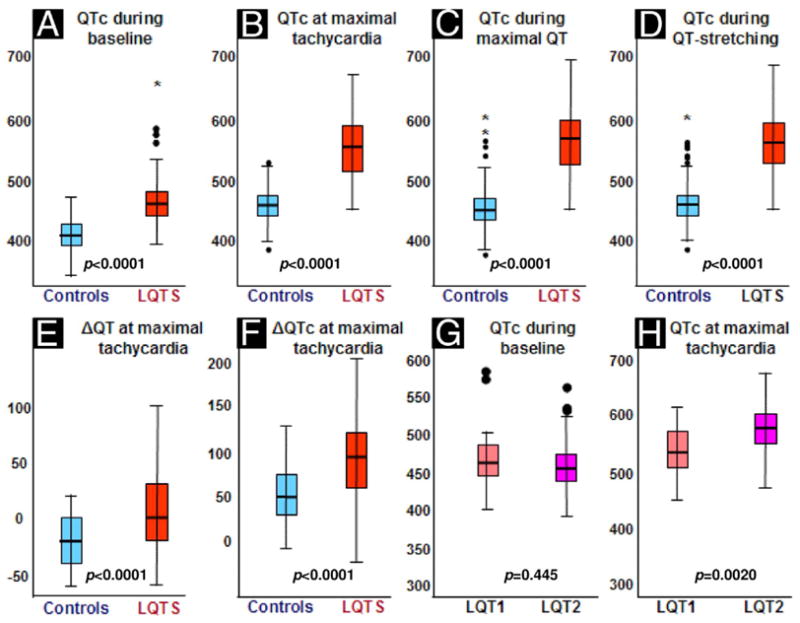
Results: In response to brisk standing, patients and control subjects responded with similar heart rate acceleration of 28 +/- 10 beats/min (p = 0.261). However, the response of the QT interval to this tachycardia differed: on average, the QT interval of controls shortened by 21 +/- 19 ms whereas the QT interval of LQTS patients increased by 4 +/- 34 ms (p < 0.001). Since the RR interval shortened more than the QT interval, during maximal tachycardia the corrected QT interval increased by 50 +/- 30 ms in the control group and by 89 +/- 47 ms in the LQTS group (p < 0.001). Receiver-operating characteristic curves showed that the test adds diagnostic value. The response of the QT interval to brisk standing was particularly impaired in patients with LQT2.
Conclusions: Evaluation of the response of the QT interval to the brisk tachycardia induced by standing provides important information that aids in the diagnosis of LQTS.
Copyright 2010 American College of Cardiology Foundation. Published by Elsevier Inc. All rights reserved.
Figures
Comment in
-
Challenges of diagnosing long QT syndrome in patients with nondiagnostic resting QTc.J Am Coll Cardiol. 2010 May 4;55(18):1962-4. doi: 10.1016/j.jacc.2010.02.018. J Am Coll Cardiol. 2010. PMID: 20430268 No abstract available.
-
New test for long QT syndrome.Nat Rev Cardiol. 2010 Jul;7(7):358. doi: 10.1038/nrcardio.2010.75. Nat Rev Cardiol. 2010. PMID: 21077281 No abstract available.
References
-
- Viskin S. The long QT syndromes and torsade de pointes. Lancet. 1999;354:1625–33. - PubMed
-
- Moss AJ. Long QT syndrome. JAMA. 2003;289:2041–4. - PubMed
-
- Vincent GM, Timothy KW, Leppert M, Keating M. The spectrum of symptoms and QT intervals in carriers of the gene for the long QT syndrome. N Engl J Med. 1992;327:846–52. - PubMed
-
- Viskin S. The QT interval: too long, too short or just right. Heart Rhythm. 2009;6:711–5. - PubMed
Publication types
MeSH terms
Grants and funding
LinkOut - more resources
Full Text Sources
Other Literature Sources
Medical
