


Secondary hyperparathyroidism and anemia in children treated by hemodialysis
- PMID: 20116689
- PMCID: PMC2818429
- DOI: 10.1053/j.ajkd.2009.09.033
Secondary hyperparathyroidism and anemia in children treated by hemodialysis
Abstract
Background: Many patients treated using hemodialysis remain anemic despite exogenous erythropoietin therapy, suggesting that the anemia experienced by these patients is multifactorial in cause. Iron deficiency, infection, inflammation, and malnutrition have been implicated in this process. Additionally, secondary hyperparathyroidism has been associated with anemia in adults, but few data exist about this topic in children.
Study design: Cross-sectional retrospective.
Setting & participants: Children treated in hemodialysis centers (N = 588) within the Centers for Medicare & Medicaid Services' 2002 Clinical Performance Measures Project.
Predictor: Intact parathyroid hormone (iPTH) levels assessed in October, November, and December 2001 and categorized as quintiles.
Outcomes & measurements: Achievement of serum hemoglobin level > or = 11 g/dL was assessed using Poisson regression adjusting for sex, age, race, dialysis vintage, vascular access type, single-pool Kt/V, serum albumin level, normalized protein catabolic rate, calcium-phosphorus product, and erythropoietin alfa dose.
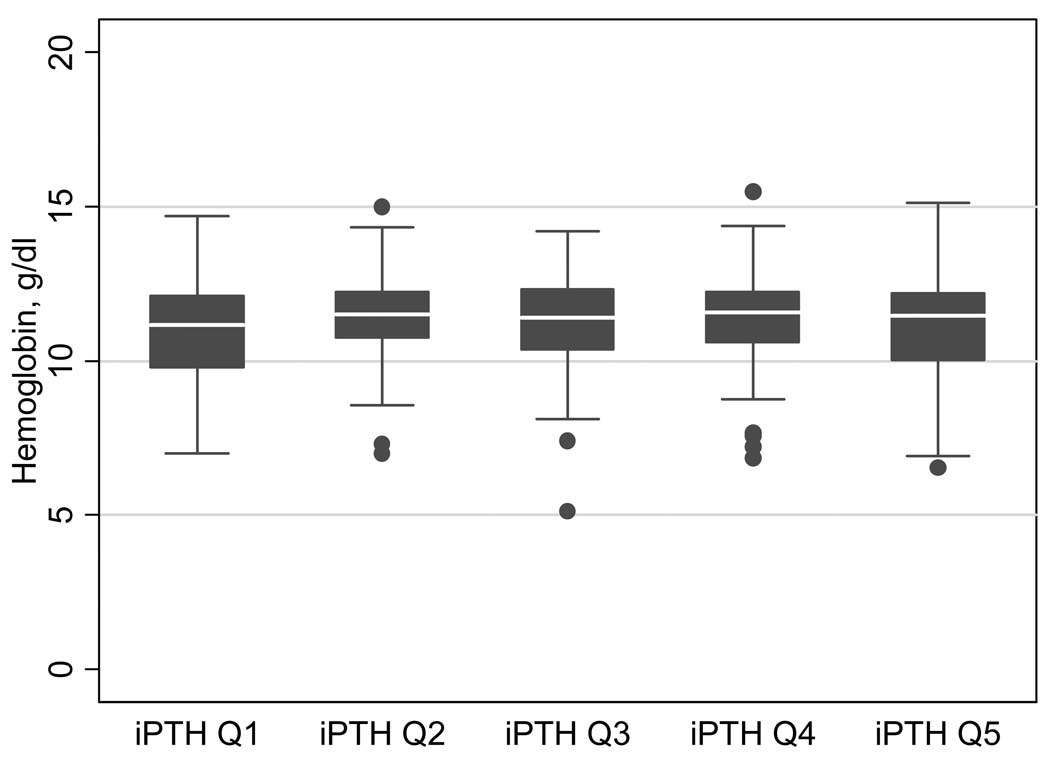
Results: Using the second quintile (iPTH, 103-224 pg/mL) as the reference quintile, there was no association between iPTH quintile and achievement of the hemoglobin goal: quintile 1 prevalence ratio, 1.0 (95% CI, 0.9-1.2); quintile 3, 0.95 (95% CI, 0.8-1.1); quintile 4, 0.99 (95% CI, 0.8-1.2); and quintile 5, 0.97 (95% CI, 0.8-1.1). Only serum albumin level >/= 3.5 g/dL (bromocresol green assay method) or > or = 3.2 g/dL (bromocresol purple assay method) was significantly associated with meeting the hemoglobin goal: 1.4 (95% CI, 1.2-1.6).
Limitations: The simultaneous collection of iPTH and hemoglobin limits causal inference. Iron stores and iron therapy are potential confounders not accounted for in this study.
Conclusions: In the largest study of this topic in children, no association was found between iPTH level and achievement of a hemoglobin level > or = 11 g/dL. Serum albumin level was associated strongly with achievement of the hemoglobin goal.
Copyright 2010 National Kidney Foundation, Inc. Published by Elsevier Inc. All rights reserved.
Figures
References
-
- National Kidney Foundation. KDOQI Clinical Practice Guidelines and Clinical Practice Recommendations for Anemia in Chronic Kidney Disease: 2007 Update of Hemoglobin Target. Am J Kidney Dis. 2007;50(3):471–529. - PubMed
-
- Mitsnefes MM, Daniels SR, Schwartz SM, Meer RA, Khoury P, Strife CF. Severe left ventricular hypertrophy in pediatric dialysis: prevalence and predictors. Pediatr nephrol. 2000;14:898–902. - PubMed
-
- Eknoyan G. The importance of early treatment of the anemia of chronic kidney disease. Nephrol Dial Transplant. 2001;16 suppl 5:45–49. - PubMed
-
- Dowling T. Prevalence, etiology, and consequences of anemia and clinical and economic benefits of anemia correction in patients with chronic kidney disease: an overview. Am J Health-Syst Pharm. 2007;64 suppl 8:S3–S7. - PubMed
-
- Amaral S, Hwang W, Fivush B, Neu A, Frankenfield D, Furth S. Association of mortality and hospitalization with achievement of adult hemoglobin targets in adolescents maintained on hemodialysis. J Am Soc Nephro. 2006;17:2878–2885. - PubMed
Publication types
MeSH terms
Grants and funding
- K23 ES016514/ES/NIEHS NIH HHS/United States
- 5T32DK007732/DK/NIDDK NIH HHS/United States
- U01 DK066174/DK/NIDDK NIH HHS/United States
- U01 DK063549/DK/NIDDK NIH HHS/United States
- 5F31DA022114-02/DA/NIDA NIH HHS/United States
- K23ES01651/ES/NIEHS NIH HHS/United States
- U01 DK63549/DK/NIDDK NIH HHS/United States
- F31 DA022114/DA/NIDA NIH HHS/United States
- UL1 RR025005/RR/NCRR NIH HHS/United States
- U01 DK074082/DK/NIDDK NIH HHS/United States
- K24DR078737-01/PHS HHS/United States
- T32 DK007732/DK/NIDDK NIH HHS/United States
- U01DK074082/DK/NIDDK NIH HHS/United States
- K24 DK078737/DK/NIDDK NIH HHS/United States
LinkOut - more resources
Full Text Sources
Medical
