


Health-related quality of life across pediatric chronic conditions
- PMID: 20117793
- PMCID: PMC3115583
- DOI: 10.1016/j.jpeds.2009.11.008
Health-related quality of life across pediatric chronic conditions
Abstract
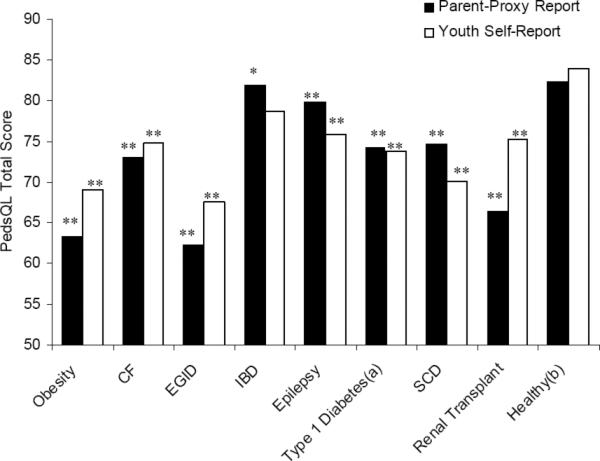
Objective: To compare health-related quality of life (HRQOL) across 8 pediatric chronic conditions, including 5 understudied populations, and examine convergence between youth self-report and parent-proxy report.
Study design: Secondary data from 589 patients and their caregivers were collected across the following conditions: obesity, eosinophilic gastrointestinal disorder, inflammatory bowel disease, epilepsy, type 1 diabetes, sickle cell disease, post-renal transplantation, and cystic fibrosis. Youth and caregivers completed age-appropriate self-report and/or parent-proxy report generic HRQOL measures.
Results: Youth diagnosed with eosinophilic gastrointestinal disorder and obesity had lower HRQOL than other pediatric conditions by parent report. Caregivers reported lower HRQOL by proxy report than youth self-reported across most subscales.
Conclusions: Use of brief, easily administered, and reliable assessments of psychosocial functioning, such as HRQOL, may provide clinicians additional opportunities for intervention or services targeting improved HRQOL relative to the needs of each population.
Copyright 2010 Mosby, Inc. All rights reserved.
Figures
References
-
- Newacheck PW, Strickland B, Shonkoff JP, Perrin JM, McPherson M, McManus M, et al. An epidemiologic profile of children with special health care needs. Pediatrics. 1998;102:117–123. - PubMed
-
- Resnikoff JR, Conrad DJ. Recent advances in the understanding and treatment of cystic fibrosis. Curr Opin Pulm Med. 1998;4:130–134. - PubMed
-
- Food and Drug Administration Guidance for industry. Patient-reported outcome measures: use in medical product development to support labeling claims. [30, 2009];2006 Available from: http://www.fda.gov/cder/guidance/5460dft.pdf. - PMC - PubMed
-
- Schor EL. The future pediatrician: promoting children's health and development. J Pediatr. 2007;151:S11–S16. - PubMed
Publication types
MeSH terms
Grants and funding
LinkOut - more resources
Full Text Sources
Medical
