. 2010 Jun;27(6):1436-48.
doi: 10.1093/molbev/msq029. Epub 2010 Jan 29.

Insights into the evolution of mitochondrial genome size from complete sequences of Citrullus lanatus and Cucurbita pepo (Cucurbitaceae)

Affiliations

Insights into the evolution of mitochondrial genome size from complete sequences of Citrullus lanatus and Cucurbita pepo (Cucurbitaceae)

Andrew J Alverson et al. Mol Biol Evol. 2010 Jun.

Abstract

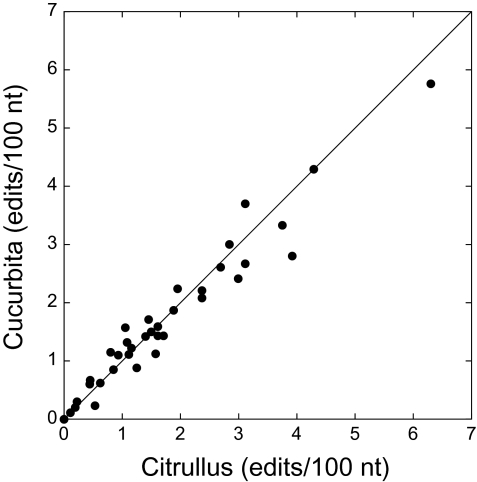
The mitochondrial genomes of seed plants are unusually large and vary in size by at least an order of magnitude. Much of this variation occurs within a single family, the Cucurbitaceae, whose genomes range from an estimated 390 to 2,900 kb in size. We sequenced the mitochondrial genomes of Citrullus lanatus (watermelon: 379,236 nt) and Cucurbita pepo (zucchini: 982,833 nt)--the two smallest characterized cucurbit mitochondrial genomes--and determined their RNA editing content. The relatively compact Citrullus mitochondrial genome actually contains more and longer genes and introns, longer segmental duplications, and more discernibly nuclear-derived DNA. The large size of the Cucurbita mitochondrial genome reflects the accumulation of unprecedented amounts of both chloroplast sequences (>113 kb) and short repeated sequences (>370 kb). A low mutation rate has been hypothesized to underlie increases in both genome size and RNA editing frequency in plant mitochondria. However, despite its much larger genome, Cucurbita has a significantly higher synonymous substitution rate (and presumably mutation rate) than Citrullus but comparable levels of RNA editing. The evolution of mutation rate, genome size, and RNA editing are apparently decoupled in Cucurbitaceae, reflecting either simple stochastic variation or governance by different factors.


Figures

F<sc>IG</sc>. 1.
FIG. 1.
Evolution of mitochondrial genome size (shown proportional to oval size) in Cucurbitaceae. Genome sizes for Citrullus (379,236 nt) and Cucurbita (982,833 nt) are based on this study. Genome sizes for Cucumis sativus (∼1.8 Mb) and Cucumis melo (∼2.9 Mb) are estimates from Ward et al. (1981) that are in good agreement with values from draft genome sequences (Alverson AJ, Palmer JD, unpublished data). Phylogenetic relationships and divergence times are based on Schaefer et al. (2009).
F<sc>IG</sc>. 2.
FIG. 2.
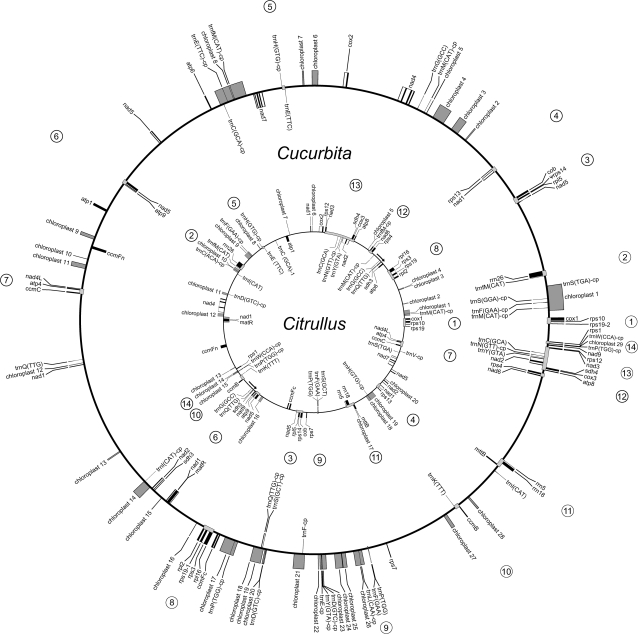
The mitochondrial genomes of Citrullus (inner circle) and Cucurbita (outer circle), drawn proportional to genome size and displayed as circles, without implying that this is their in vivo conformation (Bendich 1996). Features on forward and reverse strands are drawn on the outside and inside of the circles, respectively. Protein-coding, rRNA, and tRNA genes are all shown in black, introns in white, and chloroplast-derived insertions in dark gray. Syntenic gene blocks conserved between the two genomes are numbered (1–14) and delimited by light gray boxes on the respective circles. In Citrullus, the black arrows mark the locations of a large 7.3-kb inverted repeat. Of the many chloroplast-derived genes present in the two genomes, only those that encode potentially functional tRNAs are annotated. In some cases, the scale of tRNAs and short chloroplast-derived regions was increased to improve their legibility. Genome maps were made with OGDRAW (Lohse et al. 2007).
F<sc>IG</sc>. 3.
FIG. 3.
Density of C-to-U RNA editing (number of edits/100 nt cDNA sequence) for 37 protein genes from the Citrullus and Cucurbita mitochondrial genomes. Data points falling directly on the diagonal identify genes with equal editing density in both species. Primary data are summarized in supplementary table 3 (Supplementary Material online).
F<sc>IG</sc>. 4.
FIG. 4.
Nucleotide substitution rates in 17 angiosperms with fully sequenced mitochondrial genomes. Branch lengths are proportional to rates of synonymous (left panel) and nonsynonymous (right panel) substitutions, based on a concatenated alignment of 30 protein genes (25,553 positions), and with the tree topology constrained as shown (see Materials and Methods). Relative rate tests show significantly higher dS and dN in Cucurbita compared with Citrullus. Cycas was included in the analysis to root the basal angiosperm divergence but, for simplicity, is not shown.

References

    1. Adams KL, Qiu Y-L, Stoutemyer M, Palmer JD. Punctuated evolution of mitochondrial gene content: high and variable rates of mitochondrial gene loss and transfer to the nucleus during angiosperm evolution. Proc Natl Acad Sci U S A. 2002;99:9905–9912. - PMC - PubMed
    1. Allen JO, Fauron CM, Minx P, et al. 16 co-authors. Comparisons among two fertile and three male-sterile mitochondrial genomes of maize. Genetics. 2007;177:1173–1192. - PMC - PubMed
    1. André C, Levy A, Walbot V. Small repeated sequences and the structure of plant mitochondrial genomes. Trends Genet. 1992;8:128–132. - PubMed
    1. Barker NP, Clark LG, Davis JI, et al. 13 co-authors. Phylogeny and subfamilial classification of the grasses (Poaceae) Ann Mo Bot Gard. 2001;88:373–457.
    1. Bartoszewski G, Gawronski P, Szklarczyk M, Verbakel H, Havey MJ. A one-megabase physical map provides insights on gene organization in the enormous mitochondrial genome of cucumber. Genome. 2009;52:299–307. - PubMed

Publication types

LinkOut - more resources