. 2010 Mar 26;285(13):9803-9812.
doi: 10.1074/jbc.M109.033944. Epub 2010 Jan 29.

Last step in the conversion of trehalose to glycogen: a mycobacterial enzyme that transfers maltose from maltose 1-phosphate to glycogen

Affiliations

Last step in the conversion of trehalose to glycogen: a mycobacterial enzyme that transfers maltose from maltose 1-phosphate to glycogen

Alan D Elbein et al. J Biol Chem. .

Abstract

We show that Mycobacterium smegmatis has an enzyme catalyzing transfer of maltose from [(14)C]maltose 1-phosphate to glycogen. This enzyme was purified 90-fold from crude extracts and characterized. Maltose transfer required addition of an acceptor. Liver, oyster, or mycobacterial glycogens were the best acceptors, whereas amylopectin had good activity, but amylose was a poor acceptor. Maltosaccharides inhibited the transfer of maltose from [(14)C]maltose-1-P to glycogen because they were also acceptors of maltose, and they caused production of larger sized radioactive maltosaccharides. When maltotetraose was the acceptor, over 90% of the (14)C-labeled product was maltohexaose, and no radioactivity was in maltopentaose, demonstrating that maltose was transferred intact. Stoichiometry showed that 0.89 micromol of inorganic phosphate was produced for each micromole of maltose transferred to glycogen, and 56% of the added maltose-1-P was transferred to glycogen. This enzyme has been named alpha1,4-glucan:maltose-1-P maltosyltransferase (GMPMT). Transfer of maltose to glycogen was inhibited by micromolar amounts of inorganic phosphate or arsenate but was only slightly inhibited by millimolar concentrations of glucose-1-P, glucose-6-P, or inorganic pyrophosphate. GMPMT was compared with glycogen phosphorylase (GP). GMPMT catalyzed transfer of [(14)C]maltose-1-P, but not [(14)C]glucose-1-P, to glycogen, whereas GP transferred radioactivity from glucose-1-P but not maltose-1-P. GMPMT and GP were both inhibited by 1,4-dideoxy-1,4-imino-d-arabinitol, but only GP was inhibited by isofagomine. Because mycobacteria that contain trehalose synthase accumulate large amounts of glycogen when grown in high concentrations of trehalose, we propose that trehalose synthase, maltokinase, and GMPMT represent a new pathway of glycogen synthesis using trehalose as the source of glucose.


Figures
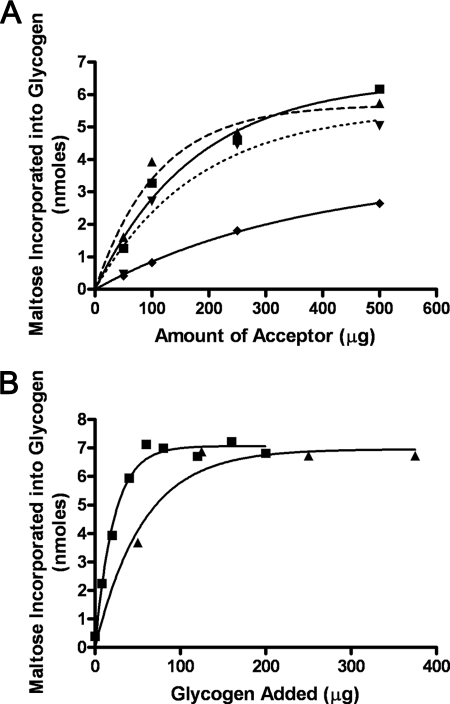
FIGURE 1.
FIGURE 1.
Effect of concentration of acceptor molecule on the incorporation of radioactivity from [14C]maltose-1-P into methanol-insoluble product. A, incubations contained 25 mm Tris-HCl buffer, pH 7.0, 125,000 cpm of maltose-1-P (12.5 nmol), various amounts of either mycobacterial glycogen (■), liver glycogen (▴), amylopectin (▾), or amylose (♦), and 25 μg of protein from the DE52 extract in a final volume of 300 μl. After an incubation of 20 min, reactions were stopped by placing tubes in a boiling water bath, and after cooling, 900 μl of methanol were added, and tubes were placed in a −20 °C freezer for 30 min. The precipitated glycogen was isolated by centrifugation, and its radioactive content was determined. B, incubations were as in A but contained various amounts of either mycobacterial glycogen (■) or liver glycogen (▴).
FIGURE 2.
FIGURE 2.
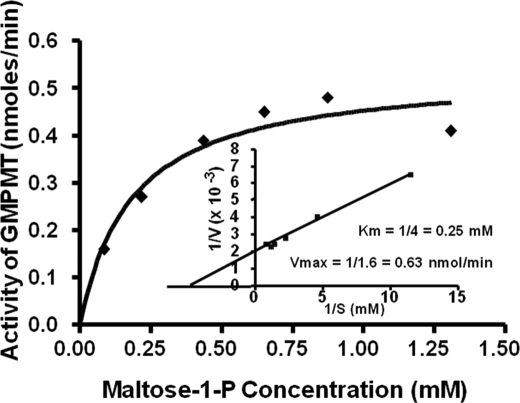
Effect of concentration of maltose 1-phosphate on the incorporation of radioactive maltose into glycogen. Incubations contained 25 mm Tris-HCl buffer, pH 7.0, various amounts of maltose-1-P from 15 to 450 nmol (specific activity of 1000 cpm/nmol), 100 μg of oyster glycogen, and 25 μg of enzyme from DE52, all in a final volume of 0.3 ml. After an incubation of 20 min, glycogen was isolated as described in the text, and its radioactive content was determined. The data were also plotted by the method of Lineweaver and Burk as shown by the inset.
FIGURE 3.
FIGURE 3.
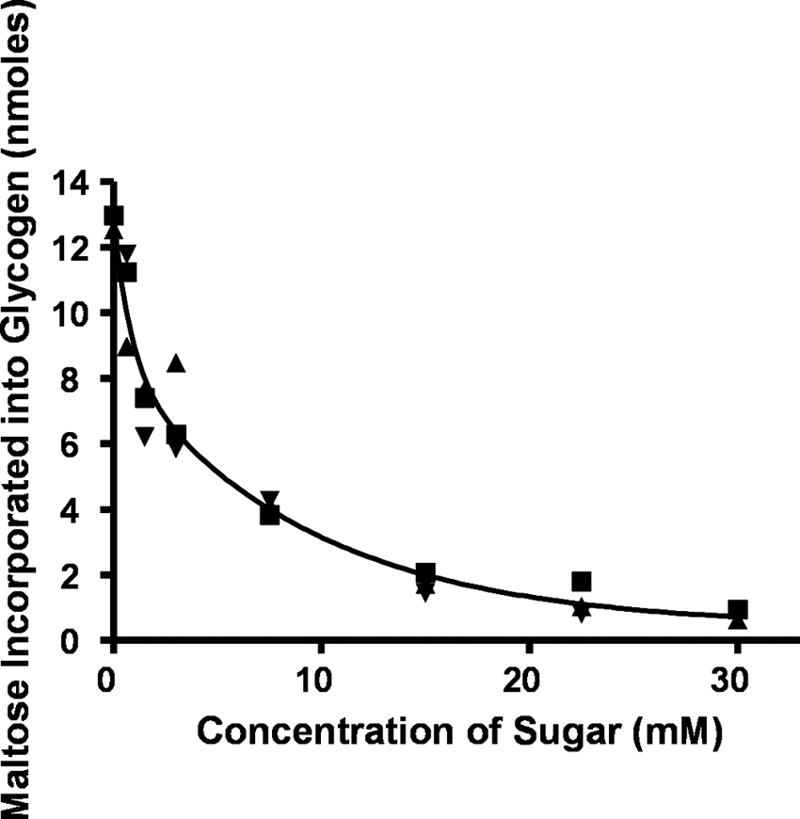
Effect of maltose and higher maltosaccharides on the transfer of radioactive maltose to the glycogen acceptor. Incubation mixtures containing buffer, oyster glycogen, [14C]maltose-1-P (125,000 cpm, 12.5 nmol), and enzyme (25 μg) were the same as described in Fig. 1 but contained various amounts of maltose (■), maltotriose (▴), maltopentaose (▾), or maltohexaose (data not shown). After an incubation of 20 min, the glycogen was isolated as described in Fig. 1 and subjected to scintillation counting.
FIGURE 4.
FIGURE 4.
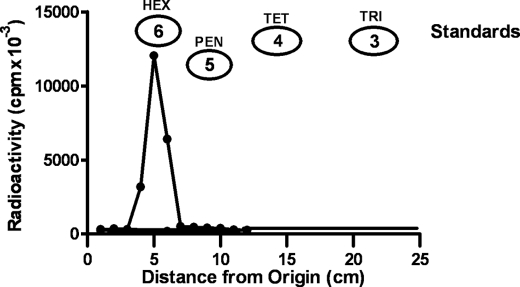
Identification of maltohexaose produced using maltotetraose as the acceptor. A large scale incubation was prepared with maltotetraose (2 mg), 50 nmol of [14C]-maltose-1-P (150,000 cpm), 25 mm Tris buffer, and enzyme (50 μg) in a final volume of 0.5 ml. After an incubation of 60 min, reactions were stopped by heating, and the methanol supernatant liquid was taken to dryness. The residue was dissolved in 2 ml of water and treated with mixed-bed ion-exchange resin to remove salt and other charged molecules. The neutral fraction was subjected to paper chromatography on Whatman 3MM paper in solvent A. Standards of various maltooligosaccharides were run on the same papers to determine the size of any newly formed malto-oligosaccharides. The radioactive band was cut into 1-cm strips and subjected to scintillation counting. Standard sugars were as follows: maltohexose (HEX), maltopentose (PEN), maltotetraose (TET), and maltotriose (TRI).
FIGURE 5.
FIGURE 5.
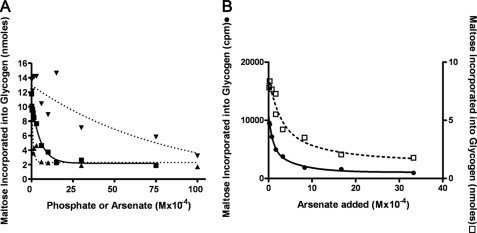
Inhibition of maltose incorporation into glycogen by inorganic phosphate and arsenate. A, incubation mixtures contained buffer, glycogen, maltose-1-P, and enzyme as in Figs. 1 and 2 but also contained various amounts of sodium phosphate (■), sodium arsenate (▴), or sodium pyrophosphate (▾). After an incubation of 20 min, reactions were stopped with heating, and glycogen was isolated, and its radioactive content was determined. B, the incubations were similar to those in A except that the maltose-1-P concentration was increased 10-fold to 5 × 10⁻⁴ m to be above the Km value for this substrate. Both high (□) and low (●) maltose-1-P concentrations were run with arsenate as the inhibitor.
FIGURE 6.
FIGURE 6.
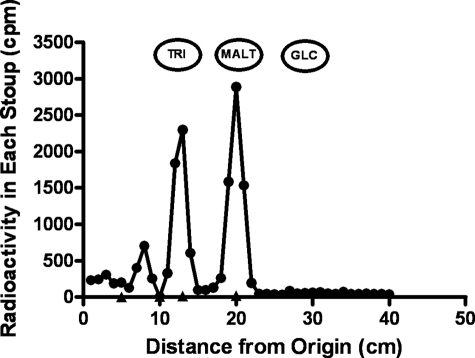
Paper chromatographic identification of radioactive maltose resulting from arsenolysis of [14C]glycogen by GMPMT. GMPMT (50 μg) was incubated with 100,000 cpm of radioactive glycogen in the presence of 10 μmol of arsenate. Glycogen was precipitated with methanol, and the methanol supernatant liquid was taken to dryness, suspended in water, and applied to a column of DE52. The column was washed with water, and most of the radioactivity in the methanol supernatant fraction emerged in the water wash. This fraction was deionized with mixed-bed resin, and the radioactive sugar(s) was identified by paper chromatography as in Fig. 4. Standard sugars were as follows: maltotriose (TRI), maltose (MALT), and glucose (GLC).
FIGURE 7.
FIGURE 7.
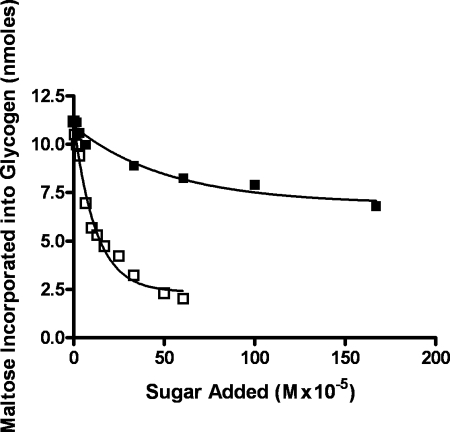
Effect of unlabeled glucose 1-phosphate, glucose 6-phosphate, or maltose 1-phosphate on the incorporation of radioactive maltose from [14C]maltose 1-phosphate into glycogen. Standard assay mixtures were prepared as indicated in Figs. 1–3 but also had various amounts of nonradioactive glucose-1-P or glucose-6-P (■) or maltose-1-P (□) added to determine whether these sugar phosphates would inhibit incorporation of radioactivity into glycogen. This experiment was done at low maltose-1-P concentrations, but essentially the same results were obtained at the high maltose-1-P concentration.
FIGURE 8.
FIGURE 8.
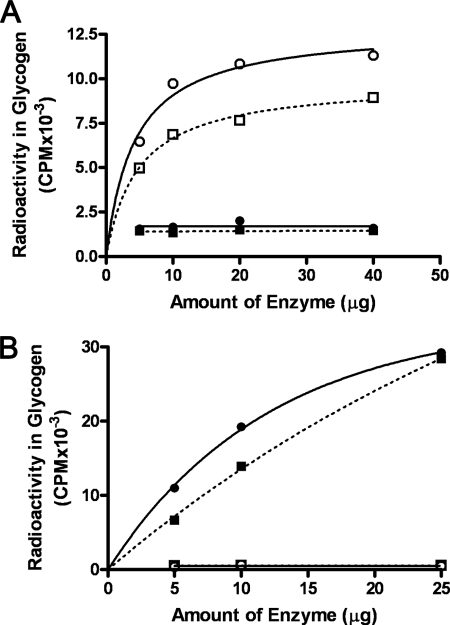
Comparison of the substrate specificity of GMPMT and glycogen phosphorylase. A, 25 μg of GMPMT eluted from DE52 was incubated with [14C]maltose-1-P for 15 (□) or 30 min (○) in the standard assay mixture described in other figures. Also shown in this figure are results when GMPMT was incubated with [14C]glucose-1-P (125,000 cpm, 10 nmol) for 15 (■) or 30 min (●) in similar incubation mixtures that also contained buffer, glycogen, and GMPMT. In all cases, glycogen was isolated by methanol precipitation, and its radioactive content was determined. B, a similar set of experiments using [14C]glucose-1-P for 15 (■) or 30 min (●) and [14C]maltose-1-P for 15 (□) or 30 min (○) as substrates for glycogen biosynthesis by glycogen phosphorylase. Incubation mixtures in this case were the same as in A and contained 20 μg of protein.
FIGURE 9.
FIGURE 9.
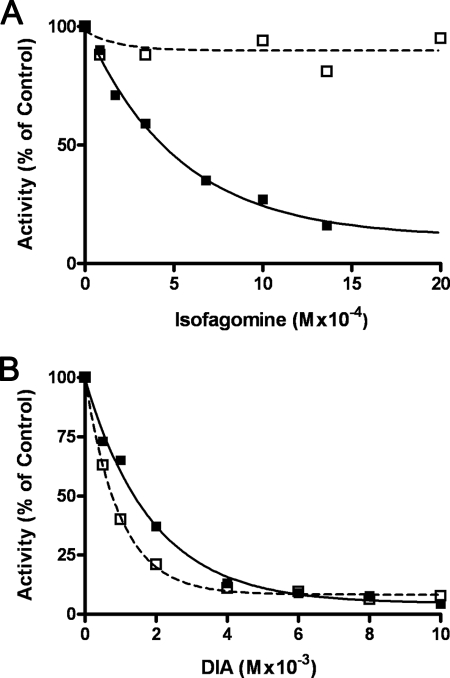
Comparison of inhibition of GMPMT and glycogen phosphorylase by glycogen phosphorylase inhibitors, isofagomine and DIA. Incubations for measuring activity of glycogen phosphorylase were as described in Fig. 8 but contained various amounts of either isofagomine (A) or DIA (B). Incubations for measuring activity of GMPMT were as described in Fig. 8 but also contained various amounts of either isofagomine (A) or DIA (B). A, glycogen phosphorylase (■) activity and GMPMT (□) activity was measured and compared in the presence of various amounts of isofagomine. B, both glycogen phosphorylase (■) and GMPMT (□) were assayed in the presence of increasing amounts of DIA.

References

    1. Elbein A. D. (1974) Adv. Carbohydr. Chem. Biochem. 30, 227–256 - PubMed
    1. Nwaka S., Holzer H. (1998) Prog. Nucleic Acid Res. Mol. Biol. 58, 197–237 - PubMed
    1. Bell W., Klaassen P., Ohnacker M., Boller T., Herweijer M., Schoppink P., Van der Zee P., Wiemken A. (1992) Eur. J. Biochem. 209, 951–959 - PubMed
    1. Crowe J. H., Hoekstra F. A., Crowe L. M. (1992) Annu. Rev. Physiol. 54, 579–599 - PubMed
    1. Takayama K., Armstrong E. L. (1976) Biochemistry 15, 441–446 - PubMed

LinkOut - more resources