


Autophagy in hypertensive heart disease
- PMID: 20118246
- PMCID: PMC2838272
- DOI: 10.1074/jbc.R109.025023
Autophagy in hypertensive heart disease
Abstract
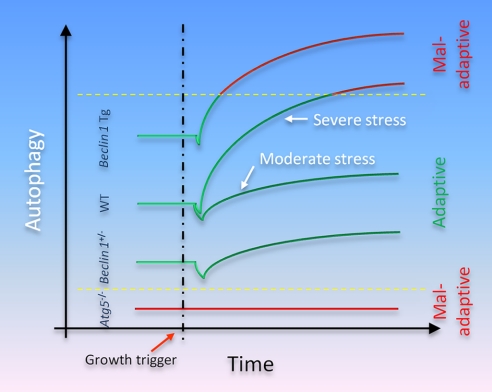
In response to hypertension, the heart manifests robust hypertrophic growth, which offsets load-induced elevations in wall stress. If sustained, this hypertrophic response is a major risk factor for systolic dysfunction and heart failure. Extensive research efforts have focused on the progression from hypertrophy to failure; however, precise understanding of underlying mechanisms remains elusive. Recently, autophagy, a process of cellular cannibalization, has been implicated. Autophagy is activated during ventricular hypertrophy, serving to maintain cellular homeostasis. Excessive autophagy eliminates, however, essential cellular elements and possibly provokes cell death, which together contribute to hypertension-related heart disease.
Figures

References
-
- Ezzati M., Lopez A. D., Rodgers A., Vander Hoorn S., Murray C. J. (2002) Lancet 360, 1347–1360 - PubMed
-
- Kearney P. M., Whelton M., Reynolds K., Muntner P., Whelton P. K., He J. (2005) Lancet 365, 217–223 - PubMed
-
- Wang Y., Wang Q. J. (2004) Arch. Intern. Med. 164, 2126–2134 - PubMed
-
- Vasan R. S., Larson M. G., Leip E. P., Evans J. C., O'Donnell C. J., Kannel W. B., Levy D. (2001) N. Engl. J. Med. 345, 1291–1297 - PubMed
-
- Lopez A. D., Mathers C. D., Ezzati M., Jamison D. T., Murray C. J. (2006) Lancet 367, 1747–1757 - PubMed
Publication types
MeSH terms
Grants and funding
LinkOut - more resources
Full Text Sources
Medical
