


Metabolic syndrome reduces the contribution of K+ channels to ischemic coronary vasodilation
- PMID: 20118408
- PMCID: PMC2853415
- DOI: 10.1152/ajpheart.00888.2009
Metabolic syndrome reduces the contribution of K+ channels to ischemic coronary vasodilation
Abstract
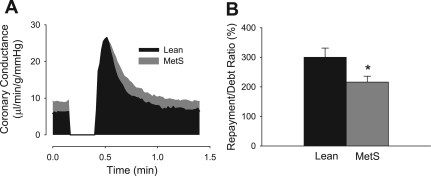
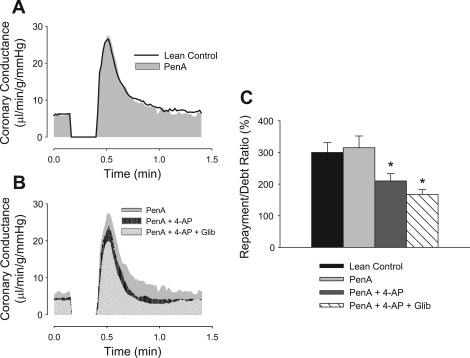
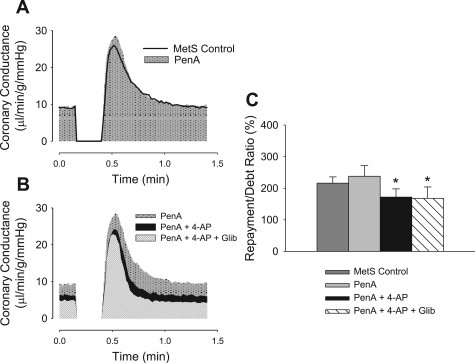
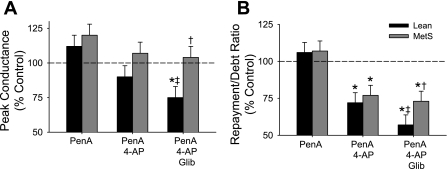
This investigation tested the hypothesis that metabolic syndrome decreases the relative contribution of specific K(+) channels to coronary reactive hyperemia. Ca(2+)-activated (BK(Ca)), voltage-activated (K(V)), and ATP-dependent (K(ATP)) K(+) channels were investigated. Studies were conducted in anesthetized miniature Ossabaw swine fed a normal maintenance diet (11% kcal from fat) or an excess calorie atherogenic diet (43% kcal from fat, 2% cholesterol, 20% kcal from fructose) for 20 wk. The latter diet induces metabolic syndrome, increasing body weight, fasting glucose, total cholesterol, and triglyceride levels. Ischemic vasodilation was determined by the coronary flow response to a 15-s occlusion before and after cumulative administration of antagonists for BK(Ca) (penitrem A; 10 microg/kg iv), K(V) (4-aminopyridine; 0.3 mg/kg iv) and K(ATP) (glibenclamide; 1 mg/kg iv) channels. Coronary reactive hyperemia was diminished by metabolic syndrome as the repayment of flow debt was reduced approximately 30% compared with lean swine. Inhibition of BK(Ca) channels had no effect on reactive hyperemia in either lean or metabolic syndrome swine. Subsequent inhibition of K(V) channels significantly reduced the repayment of flow debt ( approximately 25%) in both lean and metabolic syndrome swine. Additional blockade of K(ATP) channels further diminished ( approximately 45%) the repayment of flow debt in lean but not metabolic syndrome swine. These data indicate that the metabolic syndrome impairs coronary vasodilation in response to cardiac ischemia via reductions in the contribution of K(+) channels to reactive hyperemia.
Figures
References
-
- Banitt PF, Smits P, Williams SB, Ganz P, Creager MA. Activation of ATP-sensitive potassium channels contributes to reactive hyperemia in humans. Am J Physiol Heart Circ Physiol 271: H1594–H1598, 1996 - PubMed
-
- Borbouse L, Dick GM, Payne GA, Payne BD, Svendsen MC, Neeb ZP, Alloosh M, Bratz IN, Sturek M, Tune JD. Contribution of BKCa channels to local metabolic coronary vasodilation: effects of metabolic syndrome. Am J Physiol Heart Circ Physiol doi:10.1152/ajpheart.00876.2009 - DOI - PMC - PubMed
Publication types
MeSH terms
Substances
Grants and funding
LinkOut - more resources
Full Text Sources
Medical
Molecular Biology Databases
Miscellaneous
