


Antioxidative defense under salt stress
- PMID: 20118663
- PMCID: PMC2958586
- DOI: 10.4161/psb.5.4.10873
Antioxidative defense under salt stress
Abstract
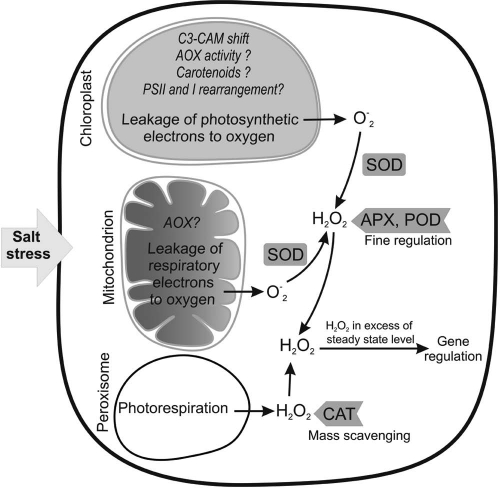
Salt tolerance is a complex trait involving the coordinated action of many gene families that perform a variety of functions such as control of water loss through stomata, ion sequestration, metabolic adjustment, osmotic adjustment and antioxidative defense. In spite of the large number of publications on the role of antioxidative defense under salt stress, the relative importance of this process to overall plant salt tolerance is still a matter of controversy. In this article, the generation and scavenging of reactive oxygen species (ROS) under normal and salt stress conditions in relation to the type of photosynthesis is discussed. The CO(2) concentrating mechanism in C4 and CAM plants is expected to contribute to decreasing ROS generation. However, the available data supports this hypothesis in CAM but not in C4 plants. We discuss the specific roles of enzymatic and non enzymatic antioxidants in relation to the oxidative load in the context of whole plant salt tolerance. The possible preventive antioxidative mechanisms are also discussed.
Figures
References
-
- FAO, author. FAO Land and Plant Nutrition Management Service. 2007. http://www.fao.org/ag/agl/agll/spush.
-
- Hasegawa PM, Bressan RA, Zhu J-K, Bohnert HJ. Plant cellular and molecular responses to high salinity. Ann Rev Plant Biol. 2000;51:463–499. - PubMed
-
- Munns R, Tester M. Mechanisms of salinity tolerance. Ann Rev Plant Biol. 2008;59:651–681. - PubMed
-
- Miller G, Suzuki N, Rizhsky L, Hegie A, Koussevitzky S, Mittler R. Double mutants deficient in cytosolic and thylakoid acsorbate peroxidase reveal a complex mode of interaction between reactive oxygen species, plant development and a response to abiotic stress. Plant Physiol. 2007;144:1777–1785. - PMC - PubMed
Publication types
MeSH terms
Substances
LinkOut - more resources
Full Text Sources
Medical
Miscellaneous
