


Traction forces during collective cell motion
- PMID: 20119479
- PMCID: PMC2799984
- DOI: 10.2976/1.3185785
Traction forces during collective cell motion
Abstract
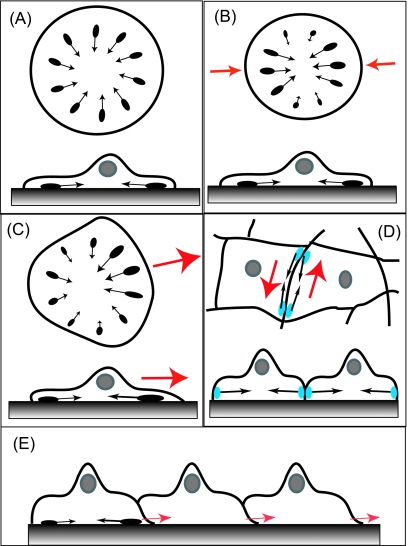
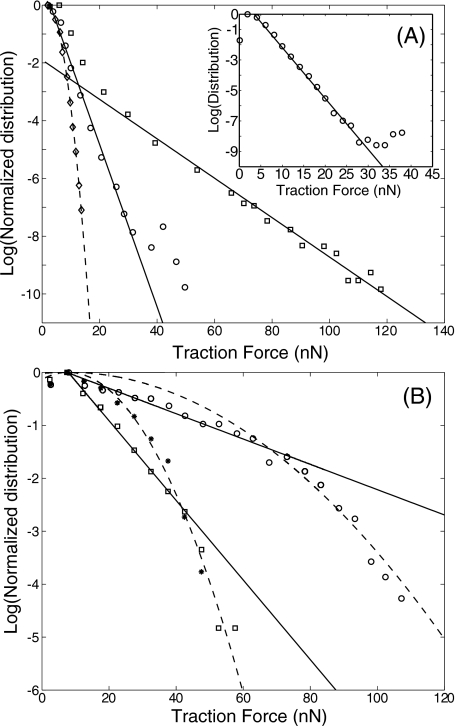
Collective motion of cell cultures is a process of great interest, as it occurs during morphogenesis, wound healing, and tumor metastasis. During these processes cell cultures move due to the traction forces induced by the individual cells on the surrounding matrix. A recent study [Trepat, et al. (2009). Nat. Phys. 5, 426-430] measured for the first time the traction forces driving collective cell migration and found that they arise throughout the cell culture. The leading 5-10 rows of cell do play a major role in directing the motion of the rest of the culture by having a distinct outwards traction. Fluctuations in the traction forces are an order of magnitude larger than the resultant directional traction at the culture edge and, furthermore, have an exponential distribution. Such exponential distributions are observed for the sizes of adhesion domains within cells, the traction forces produced by single cells, and even in nonbiological nonequilibrium systems, such as sheared granular materials. We discuss these observations and their implications for our understanding of cellular flows within a continuous culture.
Figures
Comment on
- Trepat, et al. (2009). Nat. Phys. 5, 426–430
References
-
- Balaban, N Q, Schwarz, U S, Riveline, D, Goichberg, P, Tzur, G, Sabanay, I, Mahalu, D, Safran, S, Bershadsky, A, Addadi, L, and Geiger, B (2001). “Force and focal adhesion assembly: a close relationship studied using elastic micro-patterned substrates.” Nat. Cell Biol. 3, 466–472. 10.1038/35074532 - DOI - PubMed
LinkOut - more resources
Full Text Sources