Prognostic value of p53 and bcl-2 expression in patients treated with breast conservative therapy
- PMID: 20119576
- PMCID: PMC2811290
- DOI: 10.3346/jkms.2010.25.2.235
Prognostic value of p53 and bcl-2 expression in patients treated with breast conservative therapy
Abstract
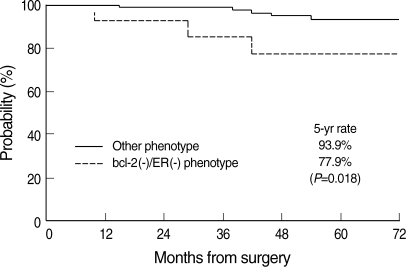
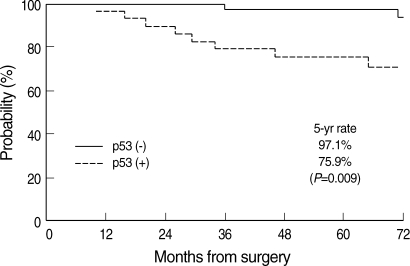
Prognostic value of p53 and bcl-2 expression on treatment outcome in breast cancer patients has been extensively evaluated, but the results were inconclusive. We evaluated the prognostic significance of these molecular markers in patients treated with breast conserving surgery and radiotherapy. One hundred patients whose immunostaining of p53 and bcl-2 expression was available among 125 patients who underwent radiotherapy after breast conserving surgery and axillary lymph node dissection were enrolled into this study. Eighty-seven patients also received adjuvant chemotherapy and/or hormonal therapy. Conventional clinicopathologic variables and treatment-related factors were also considered. The 5-yr loco-regional relapse-free and distant metastasis-free survival rates were 91.7% and 90.9%, respectively. On univariate analysis, age, T stage and the absence of bcl-2 & estrogen receptor (ER) expression were associated with loco-regional relapse-free survival. When incorporating these variables into Cox proportional hazard model, only bcl-2(-)/ER(-) phenotype was an adverse prognostic factor (P=0.018). As for the distant metastasis-free survival, age, T stage, and p53 expression were significant on univariate analysis. However, p53 expression was the only prognosticator on multivariate analysis (P=0.009). A bcl-2(-)/ER(-) phenotype and p53 expression are useful molecular markers predicting loco-regional relapse-free and distant metastasis-free survival, respectively, in patients treated with breast conserving surgery and radiotherapy.
Keywords: Breast Neoplasms; bcl-2; p53.
Figures
References
-
- Cianfrocca M, Goldstein LJ. Prognostic and predictive factors in early-stage breast cancer. Oncologist. 2004;9:606–616. - PubMed
-
- Alizadeh AA, Ross DT, Perou CM, van de Rijn M. Towards a novel classification of human malignancies based on gene expression patterns. J Pathol. 2001;195:41–52. - PubMed
-
- Thor AD, Moore DH, II, Edgerton SM, Kawasaki ES, Reihsaus E, Lynch HT, Marcus JN, Schwartz L, Chen LC, Mayall BH, Smith HS. Accumulation of p53 tumor suppressor gene protein: an independent marker of prognosis in breast cancers. J Natl Cancer Inst. 1992;84:845–855. - PubMed
-
- Bergh J, Norberg T, Sjogren S, Lindgren A, Holmberg L. Complete sequencing of the p53 gene provides prognostic information in breast cancer patients, particularly in relation to adjuvant systemic therapy and radiotherapy. Nat Med. 1995;1:1029–1034. - PubMed
-
- Silvestrini R, Veneroni S, Daidone MG, Benini E, Boracchi P, Mezzetti M, Di Fronzo G, Rilke F, Veronesi U. The Bcl-2 protein: a prognostic indicator strongly related to p53 protein in lymph node-negative breast cancer patients. J Natl Cancer Inst. 1994;86:499–504. - PubMed
MeSH terms
Substances
LinkOut - more resources
Full Text Sources
Medical
Research Materials
Miscellaneous