Comparative Study
. 2010 Jan 18;11 Suppl 1(Suppl 1):S49.
doi: 10.1186/1471-2105-11-S1-S49.

Comparative analysis of thermophilic and mesophilic proteins using Protein Energy Networks

Affiliations
Comparative Study

Comparative analysis of thermophilic and mesophilic proteins using Protein Energy Networks

M S Vijayabaskar et al. BMC Bioinformatics. .

Abstract

Background: Thermophilic proteins sustain themselves and function at higher temperatures. Despite their structural and functional similarities with their mesophilic homologues, they show enhanced stability. Various comparative studies at genomic, protein sequence and structure levels, and experimental works highlight the different factors and dominant interacting forces contributing to this increased stability.

Methods: In this comparative structure based study, we have used interaction energies between amino acids, to generate structure networks called as Protein Energy Networks (PENs). These PENs are used to compute network, sub-graph, and node specific parameters. These parameters are then compared between the thermophile-mesophile homologues.

Results: The results show an increased number of clusters and low energy cliques in thermophiles as the main contributing factors for their enhanced stability. Further more, we see an increase in the number of hubs in thermophiles. We also observe no community of electrostatic cliques forming in PENs.

Conclusion: In this study we were able to take an energy based network approach, to identify the factors responsible for enhanced stability of thermophiles, by comparative analysis. We were able to point out that the sub-graph parameters are the prominent contributing factors. The thermophiles have a better-packed hydrophobic core. We have also discussed how thermophiles, although increasing stability through higher connectivity retains conformational flexibility, from a cliques and communities perspective.


Figures
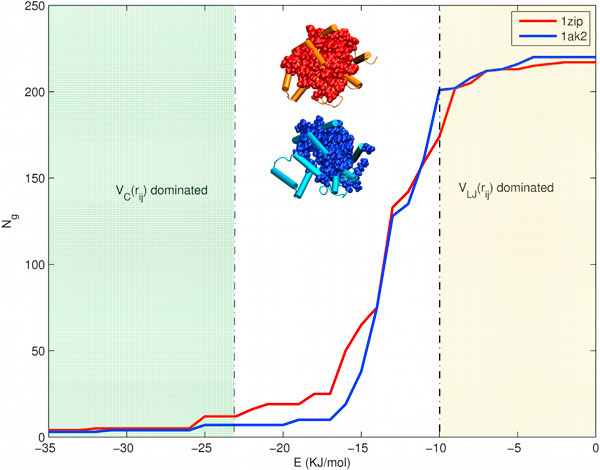
Figure 1
Figure 1
Transition profile of largest connected component in Adenylate Kinases. Largest Connected Component (LCC) profile of thermophile(1zip, also orange cartoon) and mesophile(1ak2, also cyan cartoon) Adenylate Kinases is shown in the figure. The thermophile has a larger LCC (shown as red VdW representation over the cartoon representation of the protein) than the mesophile (shown as blue VdW spheres). The LCC represented in VdW spheres are for PEN-14. The region below the transition is the low energy region (yellow) where LJ interactions dominate. The high-energy region (green) beyond ~-25 KJ/mol is dominated mainly be salt-bridge interactions. The region of transition is in between these low and high energy regions.
Figure 2
Figure 2
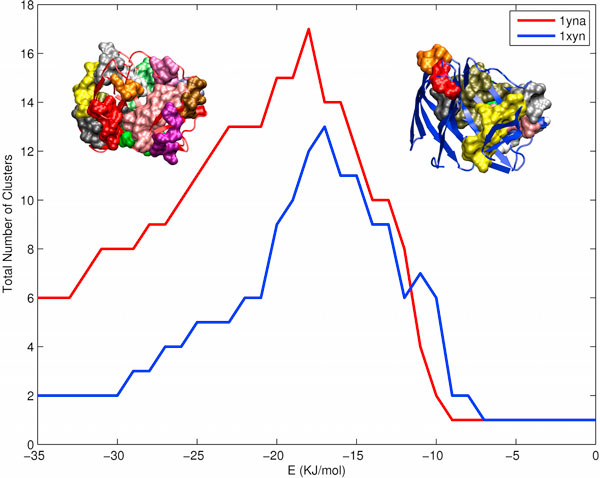
Cluster population change with 'e' in Endo-1,4-Beta Xylanases. Cluster population change as a function of 'e' denoted in KJ/mol in E14B Xylanases is shown as a line plot. The graph shows the increased number of clusters in thermophile(1yna, also red cartoon) as compared to mesophile(1xyn, also blue cartoon) protein. The isolated clusters in each protein (for PEN-20) are represented as Surf in various colors for both 1yna (red cartoon) and 1xyn (blue cartoon) to highlight the increased occurrence of clusters in the thermophilic E14B Xylanase.
Figure 3
Figure 3
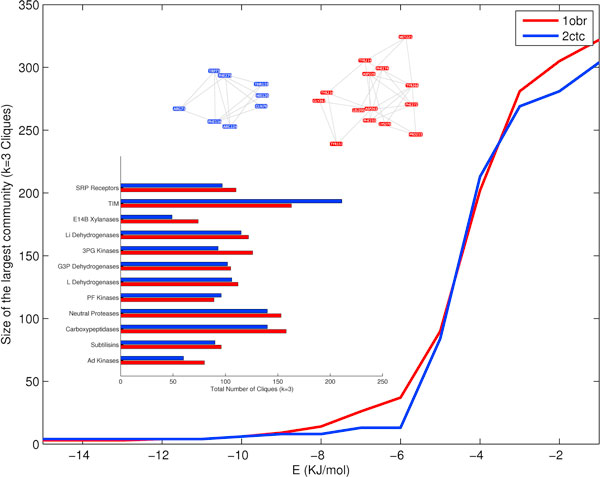
Largest community transition profile in Carboxypeptidases. The size of the largest community (of k = 3 cliques) for Carboxypeptidases, is plotted as a function of 'e'. The largest community (k = 3 cliques for PEN-8) for thermophile, 1obr (red nodes), is almost always bigger than the mesophile, 2ctc (blue nodes). The bar diagram given below is the total number of cliques for PEN-6. This shows the increased number of cliques in thermophilic proteins (except TIM and PF Kinases) at low energies. This increased clique population is clearer from Fig S5.
Figure 4
Figure 4
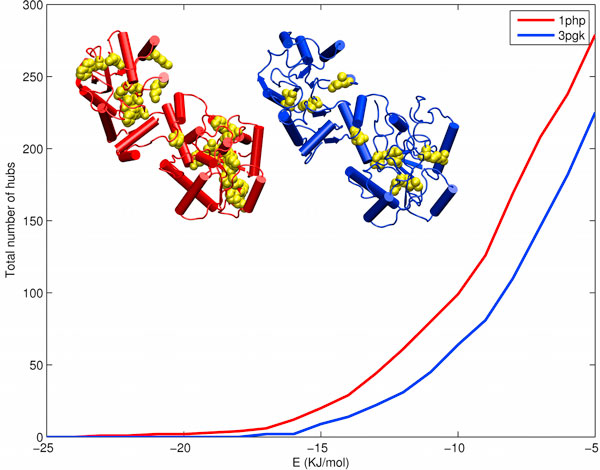
Hub population change as a function of 'e' in Phosphoglycerate Kinases. The hub population change as a function of 'e' for Phosphoglycerate Kinases is shown in the line plot. The hubs in PEN-15 (yellow VdW representation) in thermophilic PG Kinase, 1php (red cartoon representation), is considerably higher than in the corresponding mesophile, 3pgk (blue cartoon representation).

References

    1. Vieille C, Zeikus GJ. Hyperthermophilic enzymes: sources, uses, and molecular mechanisms for thermostability. Microbiol Mol Biol Rev. 2001;65(1):1–43. doi: 10.1128/MMBR.65.1.1-43.2001. - DOI - PMC - PubMed
    1. Chakravarty S, Varadarajan R. Elucidation of factors responsible for enhanced thermal stability of proteins: a structural genomics based study. Biochemistry. 2002;41(25):8152–8161. doi: 10.1021/bi025523t. - DOI - PubMed
    1. Szilagyi A, Zavodszky P. Structural differences between mesophilic, moderately thermophilic and extremely thermophilic protein subunits: results of a comprehensive survey. Structure. 2000;8(5):493–504. doi: 10.1016/S0969-2126(00)00133-7. - DOI - PubMed
    1. Razvi A, Scholtz JM. Lessons in stability from thermophilic proteins. Protein Sci. 2006;15(7):1569–1578. doi: 10.1110/ps.062130306. - DOI - PMC - PubMed
    1. Brinda KV, Vishveshwara S. A network representation of protein structures: implications for protein stability. Biophysical journal. 2005;89(6):4159–4170. doi: 10.1529/biophysj.105.064485. - DOI - PMC - PubMed

Publication types

LinkOut - more resources