


Waterpipe and cigarette smoking among college athletes in the United States
- PMID: 20123257
- PMCID: PMC3001225
- DOI: 10.1016/j.jadohealth.2009.05.004
Waterpipe and cigarette smoking among college athletes in the United States
Abstract
Purpose: Tobacco use using a waterpipe is an emerging trend among college students. Although cigarette smoking is low among college athletes, waterpipe tobacco smoking may appeal to this population. The purpose of this study was to compare cigarette and waterpipe tobacco smoking in terms of their associations with organized sport participation.
Methods: In the spring of 2008, we conducted an online survey of 8,745 college students at eight institutions as part of the revised National College Health Assessment. We used multivariable regression models to assess the associations between tobacco use (cigarette and waterpipe) and organized sports participation.
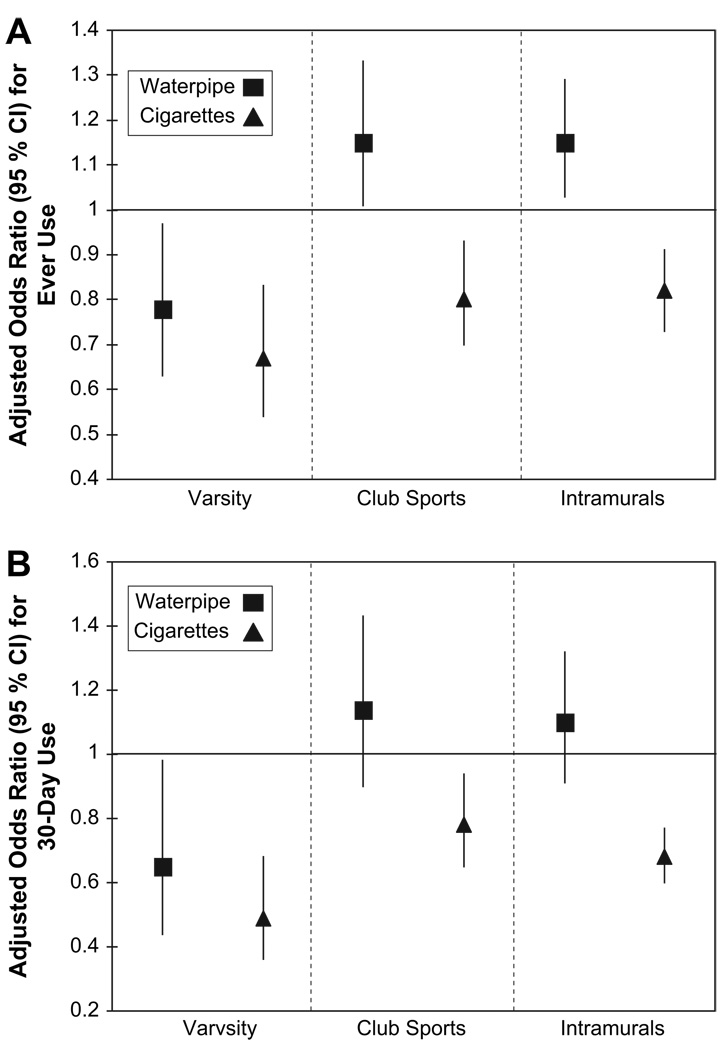
Results: Participants reported participation in varsity (5.2%), club (11.9%), and intramural (24.9%) athletics. Varsity athletes and individuals who were not varsity athletes had similar rates of waterpipe tobacco smoking (27.6% vs. 29.5%, p=.41). However, other types of athletes were more likely than their counterparts to have smoked waterpipe tobacco (35.1% vs. 28.7%, p < .001 for club sports and 34.8% vs. 27.7%, p < .001 for intramural sports). In fully-adjusted multivariable models, sports participants of any type had lower odds of having smoked cigarettes, whereas participants who played intramural sports (odds ratio=1.15, 95% confidence interval=1.03, 1.29) or club sports (odds ratio=1.15, 95% confidence interval=1.001, 1.33) had significantly higher odds of having smoked waterpipe tobacco.
Conclusions: College athletes are susceptible to waterpipe tobacco use. In fact, compared with their nonathletic counterparts, club sports participants and intramural sports participants generally had higher odds of waterpipe tobacco smoking. Allure for waterpipe tobacco smoking may exist even for individuals who are traditionally considered at low risk for tobacco use.
Copyright 2010 Society for Adolescent Medicine. Published by Elsevier Inc. All rights reserved.
Figures
References
-
- Mokdad AH, Marks JS, Stroup DF, et al. Actual causes of death in the United States, 2000. J Am Med Assoc. 2004;291:1238–1245. - PubMed
-
- Centers for Disease Control and Prevention. Cigarette use among high school students—United States, 1991–2005. MMWR Morb Mortal Wkly Rep. 2006;55:724–726. - PubMed
-
- Kilmer G, Roberts H, Hughes E, et al. Surveillance of certain health behaviors and conditions among states and selected local areas—Behavioral Risk Factor Surveillance System (BRFSS). United States, 2006. MMWR Surveill Summ. 2008;57:1–188. - PubMed
-
- Cigarette sales in US reach historic 55-year low. Washington, DC: National Association of Attorneys General; 2006. Mar 8, National Assocation of Attorneys General.
Publication types
MeSH terms
Grants and funding
LinkOut - more resources
Full Text Sources
Medical
