


Age-related decline in the microstructural integrity of white matter in children with early- and continuously-treated PKU: a DTI study of the corpus callosum
- PMID: 20123469
- PMCID: PMC3640282
- DOI: 10.1016/j.ymgme.2009.09.016
Age-related decline in the microstructural integrity of white matter in children with early- and continuously-treated PKU: a DTI study of the corpus callosum
Abstract
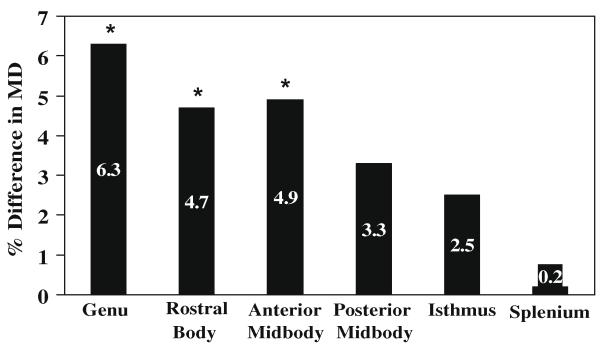
Structural, volumetric, and microstructural abnormalities have been reported in the white matter of the brain in individuals with phenylketonuria (PKU). Very little research, however, has been conducted to investigate the development of white matter in children with PKU, and the developmental trajectory of their white matter microstructure is unknown. In the current study, diffusion tensor imaging (DTI) was used to examine the development of the microstructural integrity of white matter across six regions of the corpus callosum in 34 children (7-18 years of age) with early- and continuously-treated PKU. Comparison was made with 61 demographically-matched healthy control children. Two DTI variables were examined: mean diffusivity (MD) and relative anisotropy (RA). RA was comparable to that of controls across all six regions of the corpus callosum. In contrast, MD was restricted for children with PKU in anterior (i.e., genu, rostral body, anterior midbody) but not posterior (posterior midbody, isthmus, splenium) regions of the corpus callosum. In addition, MD restriction became more pronounced with increasing age in children with PKU in the two most anterior regions of the corpus callosum (i.e., genu, rostral body). These findings point to an age-related decrement in the microstructural integrity of the anterior white matter of the corpus callosum in children with PKU.
Copyright 2009 Elsevier Inc. All rights reserved.
Figures

References
-
- Scriver CR. The PAH gene, phenylketonuria, and a paradigm shift. Hum. Mutat. 2007;28:831–845. - PubMed
-
- Scriver CR, Kaufman S. Hyperphenylalaninemia: phenylalanine hydroxylase deficiency. In: Scriver CR, Beaudet AL, Sly W, Valle D, Childs B, Vogelstein B, editors. The Metabolic and Molecular Basis of Inherited Disease. McGraw-Hill; New York: 2001. pp. 1667–1724.
-
- DeRoche K, Welsh M. Twenty-five years of research on neurocognitive outcomes in early-treated phenylketonuria: intelligence and executive function. Dev. Neuropsychol. 2008;33:474–504. - PubMed
-
- Christ SE, Huijbregts SCJ, de Sonnerville LMJ, White DA. Executive function in early-treated phenylketonuria: profile and underlying mechanisms. Mol. Genet. Metab. 2009;99:S22–S32. - PubMed
-
- Anderson PJ, Wood SJ, Francis DE, Coleman L, Warwick L, Casanelia S, Anderson VA, Boneh A. Neuropsychological functioning in children with early-treated phenylketonuria: impact of white matter abnormalities. Dev. Med. Child Neurol. 2004;46:230–238. - PubMed
Publication types
MeSH terms
Grants and funding
LinkOut - more resources
Full Text Sources
Medical
