Efficacy of a theory-based abstinence-only intervention over 24 months: a randomized controlled trial with young adolescents
- PMID: 20124144
- PMCID: PMC4349626
- DOI: 10.1001/archpediatrics.2009.267
Efficacy of a theory-based abstinence-only intervention over 24 months: a randomized controlled trial with young adolescents
Abstract
Objective: To evaluate the efficacy of an abstinence-only intervention in preventing sexual involvement in young adolescents.
Design: Randomized controlled trial.
Setting: Urban public schools.
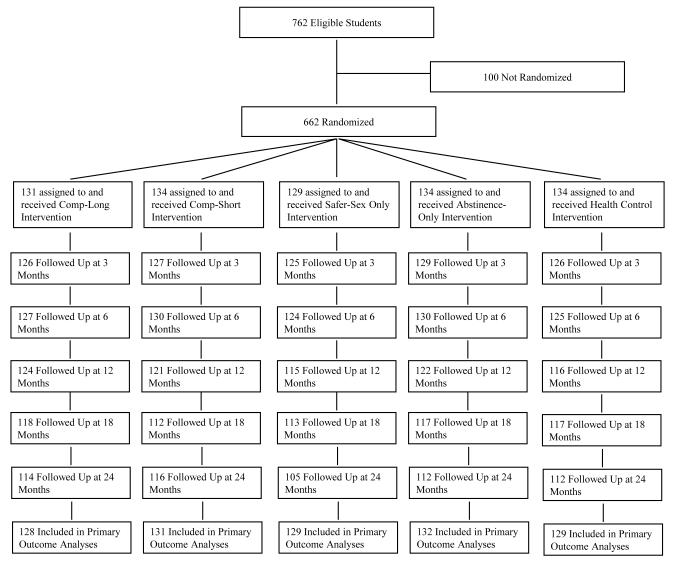
Participants: A total of 662 African American students in grades 6 and 7.
Interventions: An 8-hour abstinence-only intervention targeted reduced sexual intercourse; an 8-hour safer sex-only intervention targeted increased condom use; 8-hour and 12-hour comprehensive interventions targeted sexual intercourse and condom use; and an 8-hour health-promotion control intervention targeted health issues unrelated to sexual behavior. Participants also were randomized to receive or not receive an intervention maintenance program to extend intervention efficacy.
Outcome measures: The primary outcome was self-report of ever having sexual intercourse by the 24-month follow-up. Secondary outcomes were other sexual behaviors.
Results: The participants' mean age was 12.2 years; 53.5% were girls; and 84.4% were still enrolled at 24 months. Abstinence-only intervention reduced sexual initiation (risk ratio [RR], 0.67; 95% confidence interval [CI], 0.48-0.96). The model-estimated probability of ever having sexual intercourse by the 24-month follow-up was 33.5% in the abstinence-only intervention and 48.5% in the control group. Fewer abstinence-only intervention participants (20.6%) than control participants (29.0%) reported having coitus in the previous 3 months during the follow-up period (RR, 0.94; 95% CI, 0.90-0.99). Abstinence-only intervention did not affect condom use. The 8-hour (RR, 0.96; 95% CI, 0.92-1.00) and 12-hour comprehensive (RR, 0.95; 95% CI, 0.91-0.99) interventions reduced reports of having multiple partners compared with the control group. No other differences between interventions and controls were significant.
Conclusion: Theory-based abstinence-only interventions may have an important role in preventing adolescent sexual involvement.
Trial registration: clinicaltrials.gov Identifier: NCT00640653.
Figures
Comment in
-
Research, policy, and adolescent sexual behavior.Arch Pediatr Adolesc Med. 2010 Feb;164(2):200. doi: 10.1001/archpediatrics.2009.288. Arch Pediatr Adolesc Med. 2010. PMID: 20124152 No abstract available.
-
Abstinence-only education modestly delays initiation of sexual activity.J Pediatr. 2010 Jul;157(1):172-3. doi: 10.1016/j.jpeds.2010.05.011. J Pediatr. 2010. PMID: 20547272 No abstract available.
-
Integrating past research on related abstinence and safer-sex interventions.Arch Pediatr Adolesc Med. 2010 Jul;164(7):679-80; author reply 680-1. doi: 10.1001/archpediatrics.2010.120. Arch Pediatr Adolesc Med. 2010. PMID: 20603473 No abstract available.
-
Maximizing the clinical relevance of sexual abstinence-only program evaluations.Arch Pediatr Adolesc Med. 2010 Jul;164(7):679; author reply 680-1. doi: 10.1001/archpediatrics.2010.119. Arch Pediatr Adolesc Med. 2010. PMID: 20603474 No abstract available.
References
-
- Centers for Disease Control and Prevention . HIV/AIDS surveillance –general epidemiology (through 2005) Division of HIV/AIDS, National Center for HIV/AIDS, Viral Hepatitis, STD, and TB Prevention, Centers for Disease Control and Prevention; Atlanta, GA: [Downloaded on February 19, 2008]. Oct 23, 2007. atwww.cdc.gov/hiv/topics/surveillance/resources/slides/general/index.htm.
-
- Centers for Disease Control and Prevention . Sexually transmitted disease surveillance 2006. Division of STD Prevention, National Center for HIV/AIDS, Viral Hepatitis, STD, and TB Prevention, Centers for Disease Control and Prevention; Atlanta, GA: [Downloaded on February 22. 2008]. Nov, 2007. at http://www.cdc.gov/std/
-
- Centers for Disease Control and Prevention QuickStats: Pregnancy, birth, and abortion rates for teenagers aged 15–17 years---United States, 1976-2004. MMWR. 2005;54(04):100.
-
- Martin JA, Hamilton BE, Sutton PD, et al. [Downloaded June 6, 2007];Births: Final data for 2004. National Vital Statistics Reports. 2006 55(1):52. at www.cdc.gov/nchs/data/nvsr/nvsr55/nvsr55_01.pdf. - PubMed
-
- Centers for Disease Control and Prevention . HIV/AIDS surveillance in adolescents and young adults (through 2005) Division of HIV/AIDS, National Center for HIV/AIDS, Viral Hepatitis, STD, and TB Prevention, Centers for Disease Control and Prevention; Atlanta, GA: [Downloaded on February 19, 2008]. Oct 23, 2007. at www.cdc.gov/hiv/topics/surveillance/resources/slides/adolescents/index.htm.
Publication types
MeSH terms
Associated data
Grants and funding
LinkOut - more resources
Full Text Sources
Medical