. 2010 Mar;112(3):576-85.
doi: 10.1097/ALN.0b013e3181cded1f.

Hyperglycemia adversely modulates endothelial nitric oxide synthase during anesthetic preconditioning through tetrahydrobiopterin- and heat shock protein 90-mediated mechanisms

Affiliations

Hyperglycemia adversely modulates endothelial nitric oxide synthase during anesthetic preconditioning through tetrahydrobiopterin- and heat shock protein 90-mediated mechanisms

Julien Amour et al. Anesthesiology. 2010 Mar.

Abstract

Background: Endothelial nitric oxide synthase activity is regulated by (6R-)5,6,7,8-tetrahydrobiopterin (BH4) and heat shock protein 90. The authors tested the hypothesis that hyperglycemia abolishes anesthetic preconditioning (APC) through BH4- and heat shock protein 90-dependent pathways.

Methods: Myocardial infarct size was measured in rabbits in the absence or presence of APC (30 min of isoflurane), with or without hyperglycemia, and in the presence or absence of the BH4 precursor sepiapterin. Isoflurane-dependent nitric oxide production was measured (ozone chemiluminescence) in human coronary artery endothelial cells cultured in normal (5.5 mm) or high (20 mm) glucose conditions, with or without sepiapterin (10 or 100 microm).

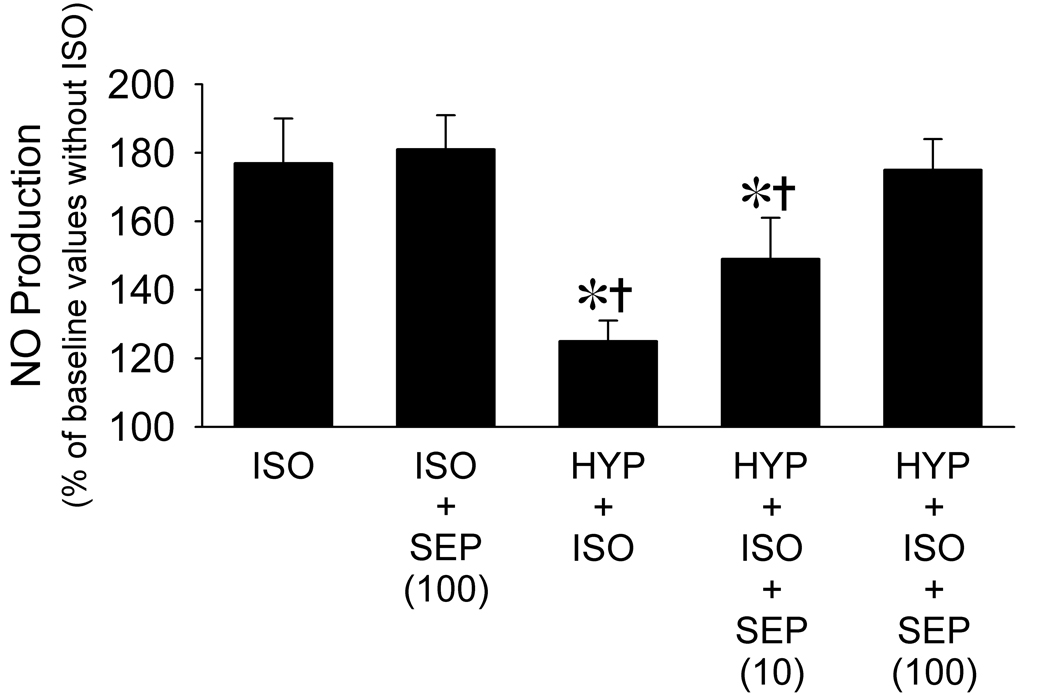
Results: APC decreased myocardial infarct size compared with control experiments (26 +/- 6% vs. 46 +/- 3%, respectively; P < 0.05), and this action was blocked by hyperglycemia (43 +/- 4%). Sepiapterin alone had no effect on infarct size (46 +/- 3%) but restored APC during hyperglycemia (21 +/- 3%). The beneficial actions of sepiapterin to restore APC were blocked by the nitric oxide synthase inhibitor N (G)-nitro-L-arginine methyl ester (47 +/- 2%) and the BH4 synthesis inhibitor N-acetylserotonin (46 +/- 3%). Isoflurane increased nitric oxide production to 177 +/- 13% of baseline, and this action was attenuated by high glucose concentrations (125 +/- 6%). Isoflurane increased, whereas high glucose attenuated intracellular BH4/7,8-dihydrobiopterin (BH2) (high performance liquid chromatography), heat shock protein 90-endothelial nitric oxide synthase colocalization (confocal microscopy) and endothelial nitric oxide synthase activation (immunoblotting). Sepiapterin increased BH4/BH2 and dose-dependently restored nitric oxide production during hyperglycemic conditions (149 +/- 12% and 175 +/- 9%; 10 and 100 microm, respectively).

Conclusion: The results indicate that tetrahydrobiopterin and heat shock protein 90-regulated endothelial nitric oxide synthase activity play a central role in cardioprotection that is favorably modulated by volatile anesthetics and dysregulated by hyperglycemia. Enhancing the production of BH4 may represent a potential therapeutic strategy.


Figures

Figure 1
Figure 1
Schematic diagram depicting the experimental protocols used to determine myocardial infarct size in rabbits in vivo. CON = control; HYP = hyperglycemia; APC = anesthetic preconditioning; NAS = N-acetylserotonin; ISO = isoflurane; SEP = Sepiapterin; L-NAME = N (G)-nitro-L-arginine methyl ester.
Figure 2
Figure 2
Myocardial infarct size depicted as a percentage of left ventricular area at risk in rabbits in the absence (CON) or presence of anesthetic preconditioning (APC), with or without hyperglycemia (HYP), and in the absence (panel A) or presence (panel B) of pre-treatment with sepiapterin (SEP; 2 mg·kg−1), N-acetylserotonin (NAS; 15 mg·kg−1), or N (G)-nitro-L-arginine methyl ester (L-NAME; 10 mg·kg−1). Each point represents a single experiment. Data are mean ± SD; *P<0.05 vs. CON; †P<0.05 vs. HYP alone; ‡P<0.05 vs. HYP + APC; §P<0.05 vs. HYP + APC + SEP + NAS or L-NAME.
Figure 3
Figure 3
Histograms depicting nitric oxide (NO) production in human coronary artery endothelial cells exposed to air (CON; n=12) or isoflurane (ISO, 0.42 mM or the equivalent of 1 minimum alveolar concentration; n=12), with and without sepiapterin (SEP; 100 µM; n=9 each group) in growth media during normal glucose concentrations (5.5 mM glucose; panel A). Panel B shows the effects of high glucose (HYP; 20 mM glucose; n=12 each group) concentrations on NO production during ISO with or without SEP (10 or 100 µM; n=9 each group). Data are mean ± SD; *P<0.05 vs. CON; †P<0.05 vs. ISO; ‡P<0.05 vs. HYP; §P<0.05 vs. HYP + ISO; ¶P<0.05 vs. HYP + ISO + SEP (10 µM); #P<0.05 vs. ISO + SEP (100 µM).
Figure 4
Figure 4
Nitric oxide (NO) production in human coronary artery endothelial cells expressed as a percentage of control values during isoflurane (ISO, 0.42 mM or the equivalent of 1 minimum alveolar concentration; n=12 each group), with normal (5.5 mM glucose) or high glucose (HYP; 20 mM glucose) conditions, with or without pre-treatment with sepiapterin (SEP; 10 or 100 µM; n=9 each group). Data are mean ± SD; *P<0.05 vs. ISO; †P<0.05 vs. HYP + ISO + SEP (100 µM).
Figure 5
Figure 5
The ratio of reduced (BH4) to oxidized (BH2) biopterin in human coronary artery endothelial cells exposed to isoflurane (ISO, 0.42 mM or the equivalent of 1 minimum alveolar concentration) or air (CON) in growth media with normal (5.5 mM glucose) or high glucose (HYP; 20 mM glucose) concentrations, and without (panel A) or with (panel B) sepiapterin (SEP; 10 or 100 µM). Data are mean ± SD; Panel A: *P<0.05 vs. CON; †P<0.05 vs. ISO; Panel B; ‡P<0.05 vs. HYP + SEP 100 µM; §P<0.05 vs. HYP + ISO + SEP (10 µM); n=3 per group.
Figure 6
Figure 6
Representative western blots (panel A) depicting total and phosphorylated endothelial nitric oxide synthase (eNOS) and the ratio (panel B) of phospho- to total eNOS in human coronary artery endothelial cells exposed to isoflurane (ISO, 0.42 mM or the equivalent of 1 minimum alveolar concentration) or air (CON) in growth media with normal (5.5 mM) or high glucose (HYP; 20 mM glucose) concentrations, and in the presence of sepiapterin (SEP; 100 µM). Data are mean ± SD; *P<0.05 vs. ISO; †P<0.05 vs. HYP + ISO + SEP (n=6 each group).
Figure 7
Figure 7
Co-localization (panel A) of endothelial nitric oxide synthase (eNOS) with heat shock protein 90 (Hsp90) in human coronary artery endothelial cells exposed to isoflurane (ISO, 0.42 mM or the equivalent of 1 minimum alveolar concentration), as compared with air (CON; n=11 fields) during normal (5.5 mM glucose; n=18 fields) or high glucose (HYP; 20 mM glucose; n=15 fields HYP alone; n=11 fields HYP+ISO) concentrations and expressed as a percentage of total cell count (panel B). The eNOS/Hsp90 co-localization is demonstrated by yellow staining (panel A). Data are mean ± SD; *P<0.05 vs. CON; †P<0.05 vs. ISO alone.

References

    1. Amour J, Brzezinska AK, Weihrauch D, Billstrom AR, Zielonka J, Krolikowski JG, Bienengraeber MW, Warltier DC, Pratt PF, Jr, Kersten JR. Role of heat shock protein 90 and endothelial nitric oxide synthase during early anesthetic and ischemic preconditioning. Anesthesiology. 2009;110:317–325. - PMC - PubMed
    1. Gu W, Kehl F, Krolikowski JG, Pagel PS, Warltier DC, Kersten JR. Simvastatin restores ischemic preconditioning in the presence of hyperglycemia through a nitric oxide-mediated mechanism. Anesthesiology. 2008;108:634–642. - PMC - PubMed
    1. Chiari PC, Bienengraeber MW, Weihrauch D, Krolikowski JG, Kersten JR, Warltier DC, Pagel PS. Role of endothelial nitric oxide synthase as a trigger and mediator of isoflurane-induced delayed preconditioning in rabbit myocardium. Anesthesiology. 2005;103:74–83. - PubMed
    1. Burwell LS, Brookes PS. Mitochondria as a target for the cardioprotective effects of nitric oxide in ischemia-reperfusion injury. Antioxid Redox Signal. 2008;10:579–599. - PubMed
    1. McCabe TJ, Fulton D, Roman LJ, Sessa WC. Enhanced electron flux and reduced calmodulin dissociation may explain "calcium-independent" eNOS activation by phosphorylation. J Biol Chem. 2000;275:6123–6128. - PubMed

MeSH terms