


Favorable climate change response explains non-native species' success in Thoreau's woods
- PMID: 20126652
- PMCID: PMC2811191
- DOI: 10.1371/journal.pone.0008878
Favorable climate change response explains non-native species' success in Thoreau's woods
Abstract
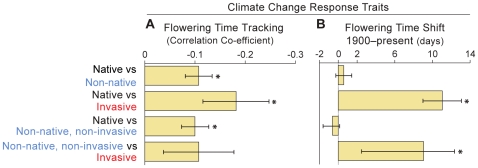
Invasive species have tremendous detrimental ecological and economic impacts. Climate change may exacerbate species invasions across communities if non-native species are better able to respond to climate changes than native species. Recent evidence indicates that species that respond to climate change by adjusting their phenology (i.e., the timing of seasonal activities, such as flowering) have historically increased in abundance. The extent to which non-native species success is similarly linked to a favorable climate change response, however, remains untested. We analyzed a dataset initiated by the conservationist Henry David Thoreau that documents the long-term phenological response of native and non-native plant species over the last 150 years from Concord, Massachusetts (USA). Our results demonstrate that non-native species, and invasive species in particular, have been far better able to respond to recent climate change by adjusting their flowering time. This demonstrates that climate change has likely played, and may continue to play, an important role in facilitating non-native species naturalization and invasion at the community level.
Conflict of interest statement
Figures
References
-
- Mack RN, Simberloff D, Lonsdale WM, Evans H, Clout M, et al. Biotic invasions: causes, epidemiology, global consequences, and control. Ecol App. 2000;10:689–710.
-
- Pimentel D, Zuniga R, Morrison D. Update on the environmental and economic costs associated with alien-invasive species in the United States. Ecol Econ. 2005;52:273–288.
-
- Dukes JS, Mooney HA. Does global change increase the success of biological invaders? Trends Ecol Evol. 1999;14:135–139. - PubMed
-
- Simberloff D. Global climate change and introduced species in United States forests. Sci Total Environ. 2000;262:253–261. - PubMed
-
- Thuiller W, Richardson DM, Midgley GF. Will climate change promote alien invasions? In: Nentwig W, editor. Biological Invasions. Berlin: Springer-Verlag; 2007. pp. 197–211.
Publication types
MeSH terms
LinkOut - more resources
Full Text Sources
Other Literature Sources
