


Individual differences in socioaffective skills influence the neural bases of fear processing: the case of alexithymia
- PMID: 20127873
- PMCID: PMC6870595
- DOI: 10.1002/hbm.20953
Individual differences in socioaffective skills influence the neural bases of fear processing: the case of alexithymia
Abstract
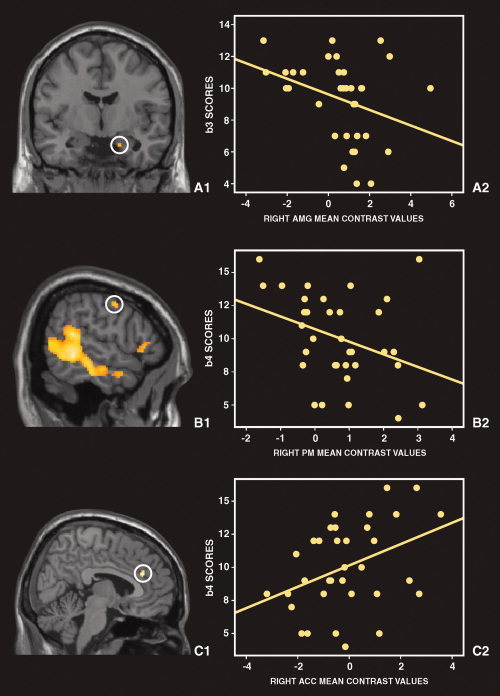
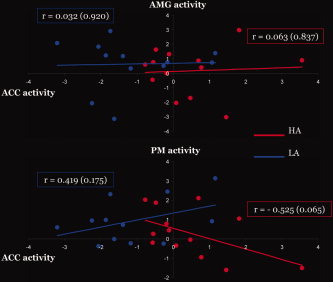
Being exposed to fear signals makes us feel threatened and prompts us to prepare an adaptive response. In our previous studies, we suggested that amygdala (AMG) and premotor cortex (PM) play a role in the preparation of the observers' motor response required by the situation. The present experiment aimed at assessing how interindividual differences in alexithymia--a personality trait associated with deficits in emotional reactivity and regulation--influence the neural network associated with the perception of fear. Using fMRI, we scanned 34 healthy subjects while they were passively observing fearful body expressions. Applying a dimensional approach, we performed correlation analyses between fear-related brain areas and alexithymia scores among all participants. Using a categorical approach, we conducted a between-group comparison (13 high vs. 12 low-alexithymia subjects). Our results were threefold. First, the right AMG activity in response to fearful stimuli was negatively correlated with the level of difficulty to identify emotions. Second, PM activity was linked to reduced subjective emotional reactivity. Third, the between-group comparison revealed greater activity in anterior cingulate cortex (ACC) for high than low-alexithymia scorers. Moreover, the relationship between ACC and PM was in opposite direction in individuals with high (negative link) and low (positive link) alexithymia. Therefore, compared to our previous findings, we hereby further reveal how ACC interacts with PM to sustain self-regulation of one's own emotional state in response to threatening social signals. Moreover, this neural mechanism could account for the description of the "cold-blooded" personality of individuals with alexithymia.
© 2010 Wiley-Liss, Inc.
Figures
References
-
- Adolphs R, Tranel D ( 1999): Preferences for visual stimuli following amygdala damage. J Cogn Neurosci 11: 610–616. - PubMed
-
- Adolphs R, Tranel D, Damasio H, Damasio AR ( 1994): Impaired recognition of emotion in facial expressions following bilateral damage to the human amygdala. Nature 372: 669–672. - PubMed
-
- Adolphs R, Tranel D, Damasio H ( 2001): Emotion recognition from faces and prosody following temporal lobectomy. Neuropsychology 15: 396–404. - PubMed
-
- Amaral DG ( 2003): The amygdala, social behavior, and danger detection. Ann NY Acad Sci 1000: 337–347. - PubMed
Publication types
MeSH terms
LinkOut - more resources
Full Text Sources
