


Hepatitis D: Scenario in the Asia-Pacific region
- PMID: 20128022
- PMCID: PMC2816266
- DOI: 10.3748/wjg.v16.i5.554
Hepatitis D: Scenario in the Asia-Pacific region
Abstract
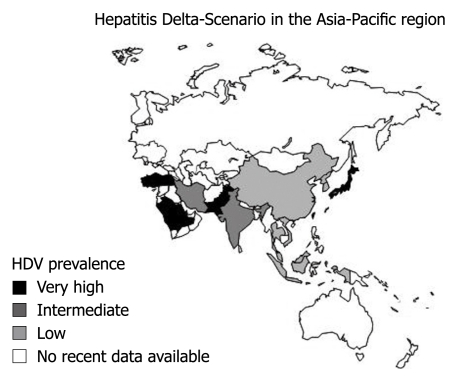
Hepatitis D virus (HDV) infection is present worldwide and affects all age groups. Around 18 million people are estimated to be infected with HDV. An important trend in HDV infection is global decline. HDV prevalence has decreased significantly in Europe since the 1970s and 1980s when it was first reported. The Asia-Pacific region now seems to be where HDV is a major health concern. There is a lack of available data from most of the countries from this region; hence, the true status of HDV cannot be determined. In South Asia, most of the countries have conditions that are favorable for the spread of hepatitis B and other related infections. Countries like Pakistan and Iran have shown an increase in HDV prevalence over a period of time. Other countries and region like China, Turkey, Australia, Japan, India and Taiwan, some of which had very high HDV prevalence in the past, have shown a decline in the incidence, but high prevalence persists in some. Intravenous drug abusers, homosexual men and women, prostitutes, and people on hemodialysis are the groups with very high HDV prevalence.
Figures
References
-
- World Health Organization. Hepatitis Delta [WHO/CDS/CSR/NCS/2001.1] Available from: http://www.searo.who.int/EN/Section10/Section1027_9489.htm.
-
- Fonseca JC. [Hepatitis D] Rev Soc Bras Med Trop. 2002;35:181–190. - PubMed
-
- Rizzetto M. Hepatitis D: the comeback? Liver Int. 2009;29 Suppl 1:140–142. - PubMed
-
- Koytak ES, Yurdaydin C, Glenn JS. Hepatitis d. Curr Treat Options Gastroenterol. 2007;10:456–463. - PubMed
Publication types
MeSH terms
LinkOut - more resources
Full Text Sources
Other Literature Sources
Miscellaneous
