


Cannabidiol ameliorates cognitive and motor impairments in bile-duct ligated mice via 5-HT1A receptor activation
- PMID: 20128798
- PMCID: PMC2829220
- DOI: 10.1111/j.1476-5381.2009.00589.x
Cannabidiol ameliorates cognitive and motor impairments in bile-duct ligated mice via 5-HT1A receptor activation
Abstract
Background and purpose: We aimed to demonstrate the involvement of 5-HT(1A) receptors in the therapeutic effect of cannabidiol, a non-psychoactive constituent of Cannabis sativa, in a model of hepatic encephalopathy induced by bile-duct ligation (BDL) in mice.
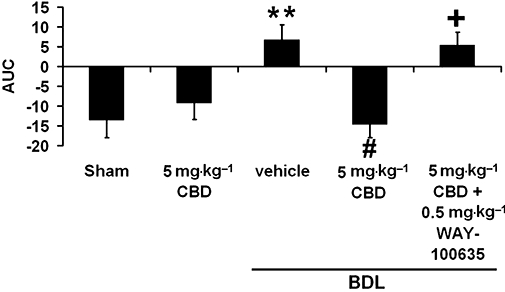
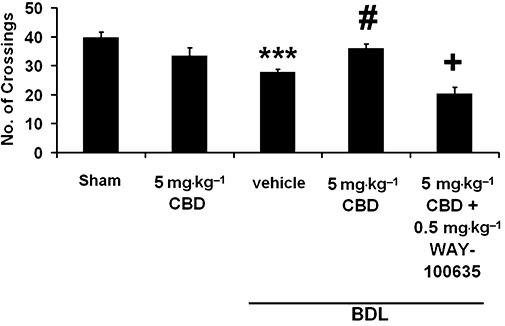
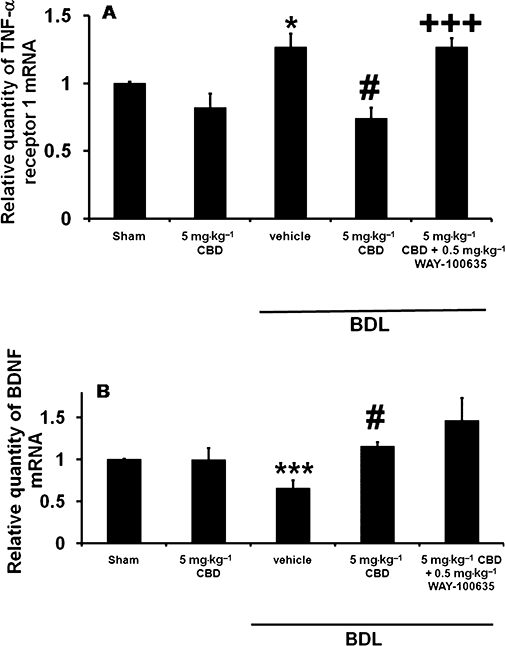
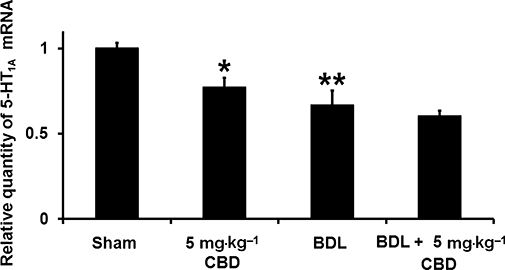
Experimental approach: Cannabidiol (5 mg x kg(-1); i.p.) was administered over 4 weeks to BDL mice. Cognition and locomotion were evaluated using the eight-arm maze and the open field tests respectively. Hippocampi were analysed by RT-PCR for expression of the genes for tumour necrosis factor-alpha receptor 1, brain-derived neurotrophic factor (BDNF) and 5-HT(1A) receptor. N-(2-(4-(2-methoxy-phenyl)-1-piperazin-1-yl)ethyl)-N-(2-pyridyl) cyclohexanecarboxamide (WAY-100635), a 5-HT(1A) receptor antagonist (0.5 mg x kg(-1)), was co-administered with cannabidiol. Liver function was evaluated by measuring plasma liver enzymes and bilirubin.
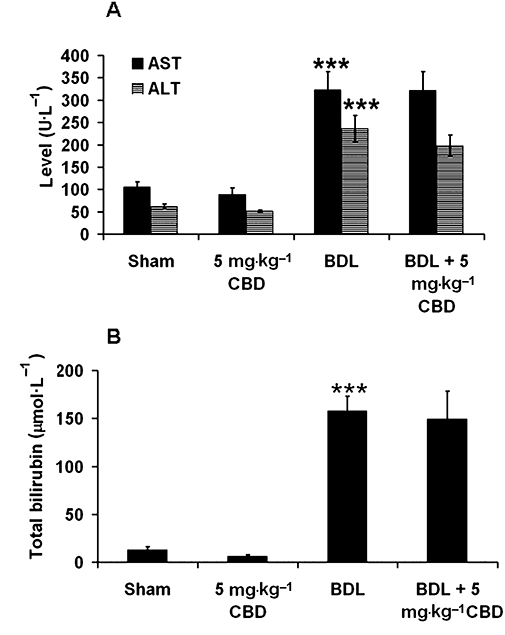
Key results: Cannabidiol improved cognition and locomotion, which were impaired by BDL, and restored hippocampal expression of the tumour necrosis factor-alpha receptor 1 and the BDNF genes, which increased and decreased, respectively, following BDL. It did not affect reduced 5-HT(1A) expression in BDL mice. All the effects of cannabidiol, except for that on BDNF expression, were blocked by WAY-100635, indicating 5-HT(1A) receptor involvement in cannabidiol's effects. Cannabidiol did not affect the impaired liver function in BDL.
Conclusions and implications: The behavioural outcomes of BDL result from both 5-HT(1A) receptor down-regulation and neuroinflammation. Cannabidiol reverses these effects through a combination of anti-inflammatory activity and activation of this receptor, leading to improvement of the neurological deficits without affecting 5-HT(1A) receptor expression or liver function. BDNF up-regulation by cannabidiol does not seem to account for the cognitive improvement.
Figures
References
-
- Apelqvist G, Bergqvist PB, Larsson B, Bugge M, Bengtsson F. Regional brain serotonin receptor changes in portacaval shunted rats. Acta Physiol Scand. 1998;162:509–516. - PubMed
-
- Avraham Y, Israeli E, Gabbay E, Okun A, Zolotarev O, Silberman I, et al. Endocannabinoids affect neurological and cognitive function in thioacetamide-induced hepatic encephalopathy in mice. Neurobiol Dis. 2006;21:237–245. - PubMed
-
- Avraham Y, Zolotarev O, Grigoriadis NC, Poutahidis T, Magen I, Vorobiav L, et al. Cannabinoids and capsaicin improve liver function following thioacetamide-induced acute injury in mice. Am J Gastroenterol. 2008;103:3047–3056. - PubMed
Publication types
MeSH terms
Substances
Grants and funding
LinkOut - more resources
Full Text Sources
