. 2010 Feb 1;159(3):709-16.
doi: 10.1111/j.1476-5381.2009.00575.x. Epub 2010 Jan 28.

Stimulation of angiotensin AT2 receptors by the non-peptide agonist, Compound 21, evokes vasodepressor effects in conscious spontaneously hypertensive rats

Affiliations

Stimulation of angiotensin AT2 receptors by the non-peptide agonist, Compound 21, evokes vasodepressor effects in conscious spontaneously hypertensive rats

S Bosnyak et al. Br J Pharmacol. .

Abstract

Background and purpose: Angiotensin type 2 receptor (AT(2) receptor) stimulation evokes vasodilator effects in vitro and in vivo that oppose the vasoconstrictor effects of angiotensin type 1 receptors (AT(1) receptors). Recently, a novel non-peptide AT(2) receptor agonist, Compound 21, was described, which exhibited high AT(2) receptor selectivity.

Experimental approach: Functional cardiovascular effects of the drug candidate Compound 21 were assessed, using mouse isolated aorta and rat mesenteric arteries in vitro and in conscious spontaneously hypertensive rats (SHR).

Key results: Compound 21 evoked dose-dependent vasorelaxations in aortic and mesenteric vessels, abolished by the AT(2) receptor antagonist, PD123319. In vivo, Compound 21 administered alone, at doses ranging from 50 to 1000 ng.kg(-1).min(-1) over 4 h did not decrease blood pressure in conscious normotensive Wistar-Kyoto rats or SHR. However, when given in combination with the AT(1) receptor antagonist, candesartan, Compound 21 (300 ng.kg(-1).min(-1)) lowered blood pressure in SHR only. Further analysis in separate groups of conscious SHR revealed that, at a sixfold lower dose, Compound 21 (50 ng.kg(-1).min(-1)) still evoked a significant depressor response in adult SHR ( approximately 30 mmHg) when combined with different doses of candesartan (0.01 or 0.1 mg.kg(-1)). Moreover, the Compound 21-evoked depressor effect was abolished when co-infused (50 microg.kg(-1).min(-1) for 2 h) with the AT(2) receptor antagonist PD123319.

Conclusion and implications: Collectively, our results indicate that acute administration of Compound 21 evoked blood pressure reductions via AT(2) receptor stimulation. Thus Compound 21 can be considered an excellent drug candidate for further study of AT(2) receptor function in cardiovascular disease.


Figures
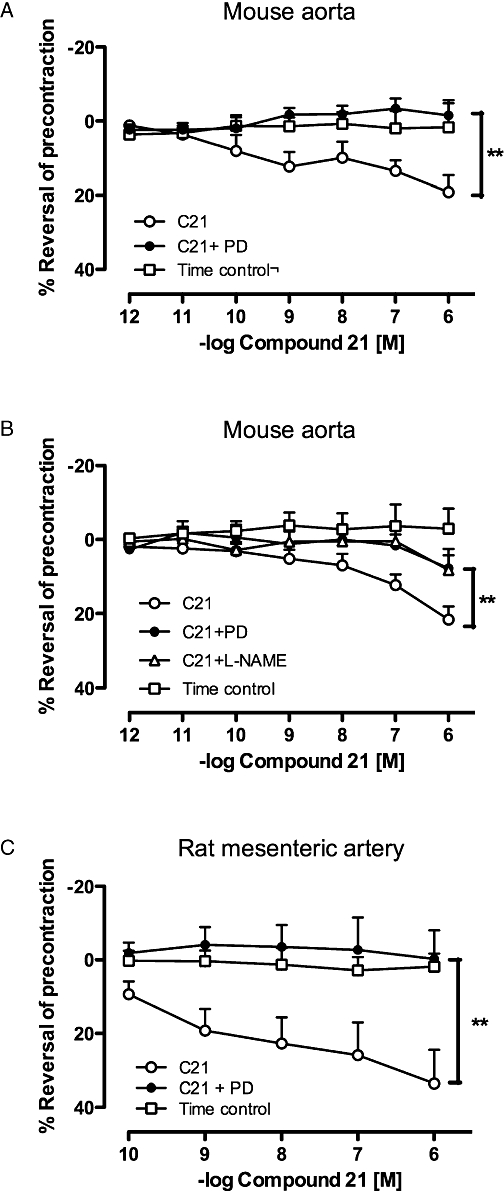
Figure 1
Figure 1
Dose–response curves to Compound 21 (C21) performed in (A) mouse aorta and (C) third order perfused rat mesenteric artery in the absence (n= 5 and 9 for aorta and mesenteric artery respectively) and presence (n= 5 and 3 for aorta and mesenteric artery respectively) of PD123319 (PD); all experiments in Figure 1A and C performed in the presence of angiotensin type 1 receptor (AT1 receptor) blockade, as described in the Methods. (B) Effect of Compound 21 in mouse aorta in the absence of AT1 receptor blockade and in the presence of PD123319 or L-NAME (n= 10 for each). Values represent mean ± SEM. **P < 0.01 for treatment effect between Compound 21 and Compound 21 + PD123319 or Compound 21 + L-NAME (two-way repeated measures anova).
Figure 2
Figure 2
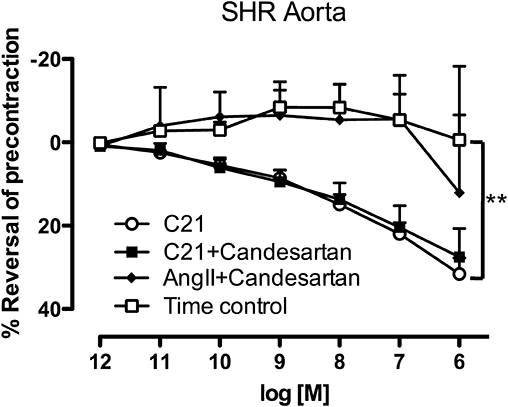
Dose–response curves to either angiotensin II (Ang II) or Compound 21 (C21) performed in aorta obtained from naive spontaneously hypertensive rat (SHR) in the absence (Compound 21) and presence (Ang II & Compound 21) of candesartan (0.1 µM) (n= 5 for each). Values represent mean ± SEM. **P < 0.01 for treatment effect between Compound 21 and time control (two-way repeated measures anova).
Figure 4
Figure 4
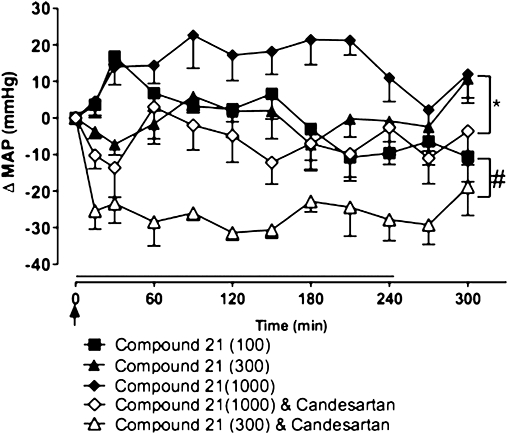
Effects of Compound 21 (100, 300 and 1000 ng·kg−1·min−1), administered as a 4 h infusion (shown by horizontal line), on mean arterial pressure (MAP) in spontaneously hypertensive rats (n= 5). Compound 21 was given in the presence or absence of the angiotensin type 1 receptor agonist, candesartan (0.1 mg·kg−1 i.v. bolus, shown by an arrow). Values represent mean ± SEM. #P < 0.001 for treatment effect between Compound 21 (300 ng·kg−1·min−1) + candesartan and Compound 21(300 ng·kg−1·min−1) (two-way repeated measures anova); *P < 0.05 for treatment effect between Compound 21(1000 ng·kg−1·min−1) + candesartan and Compound 21(1000 ng·kg−1·min−1) (two-way repeated measures anova).
Figure 3
Figure 3
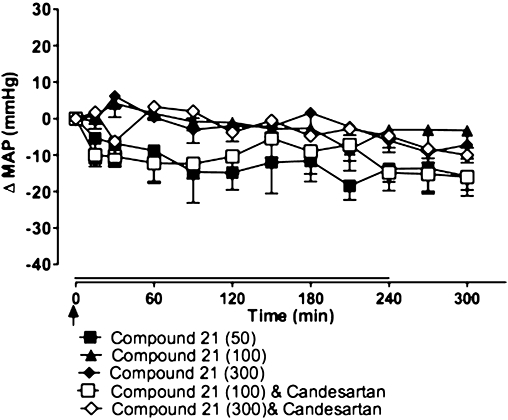
Effects of Compound 21 (50, 100 and 300 ng·kg−1·min−1), administered as a 4 h infusion (shown by horizontal line), on mean arterial pressure (MAP) in Wistar-Kyoto rats (n= 5). Compound 21 was given in the presence or absence of the angiotensin type 1 receptor antagonist, candesartan (0.1 mg·kg−1 i.v. bolus; shown by an arrow). Values represent mean ± SEM.
Figure 6
Figure 6
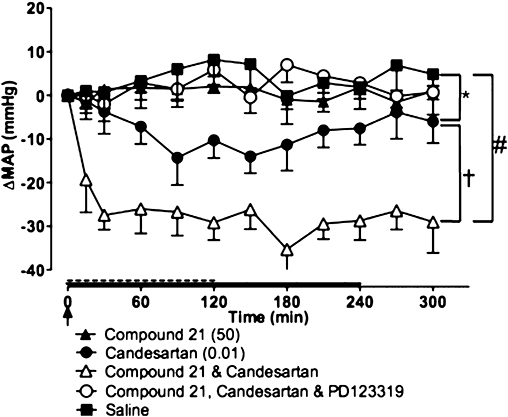
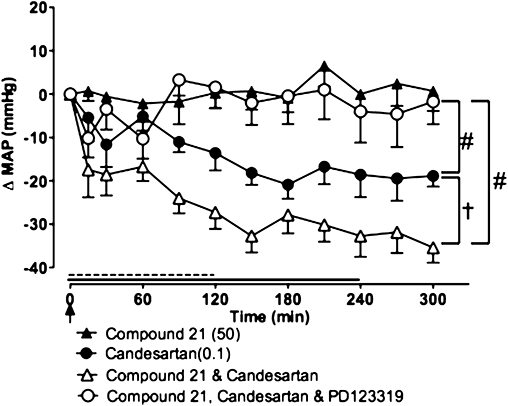
Effect of Compound 21 (50 ng·kg−1·min−1; 4 h infusion shown by full line), low-dose candesartan (0.01 mg·kg−1 bolus i.v.; shown by an arrow), Compound 21 + candesartan and Compound 21 + candesartan + PD123319 (50 µg·kg−1·min−1 for 2 h; shown by dashed line), on mean arterial pressure (MAP) in spontaneously hypertensive rat (n= 7). Values represent mean ± SEM. *P < 0.05 for treatment effect between Compound 21 and candesartan; #P < 0.001 for overall effect of individual treatment versus Compound 21 (two-way repeated measures anova); †P < 0.01 for treatment effect between Compound 21 + candesartan and candesartan alone (two-way repeated measures anova).
Figure 5
Figure 5
Effect of Compound 21 (50 ng·kg−1·min−1; 4 h infusion shown by full line), high-dose candesartan (0.1 mg·kg−1 bolus i.v.; shown by an arrow), Compound 21 + candesartan and Compound 21 + candesartan + PD123319 (50 µg·kg−1·min−1 for 2 h; (dashed line), on mean arterial pressure (MAP) in spontaneously hypertensive rat (n= 7). Values represent mean ± SEM. #P < 0.001 for overall effect of treatment versus Compound 21 (two-way repeated measures anova); †P < 0.01 for treatment effect between Compound 21 + candesartan and candesartan (two-way repeated measures anova).

References

    1. Alexander SPH, Mathie A, Peters JA. Guide to receptors and channels (GRAC), 3rd edition. Br J Pharmacol. 2008;153:S1–S209. - PMC - PubMed
    1. Barber MN, Sampey DB, Widdop RE. AT2 receptor stimulation enhances antihypertensive effect of AT1 receptor antagonist in hypertensive rats. Hypertension. 1999;34:1112–1116. - PubMed
    1. Carey RM. Update on the role of the AT(2) receptor. Curr Opin Nephrol Hypertens. 2005;14:67–71. - PubMed
    1. Carey RM, Howell NL, Jin X-H, Siragy HM. Angiotensin type 2 receptor-mediated hypotension in angiotensin type-1 receptor-blocked rats. Hypertension. 2001;38:1272–1277. - PubMed
    1. Cosentino F, Savoia C, De Paolis P, Francia P, Russo A, Maffei A, et al. Angiotensin II type 2 receptors contribute to vascular responses in spontaneously hypertensive rats treated with angiotensin II type 1 receptor antagonists. Am J Hypertens. 2005;18:493–499. - PubMed

Publication types

MeSH terms