


Level of response and safety of pharmacological monotherapy in the treatment of acute bipolar I disorder phases: a systematic review and meta-analysis
- PMID: 20128953
- PMCID: PMC3005373
- DOI: 10.1017/S1461145709991246
Level of response and safety of pharmacological monotherapy in the treatment of acute bipolar I disorder phases: a systematic review and meta-analysis
Abstract
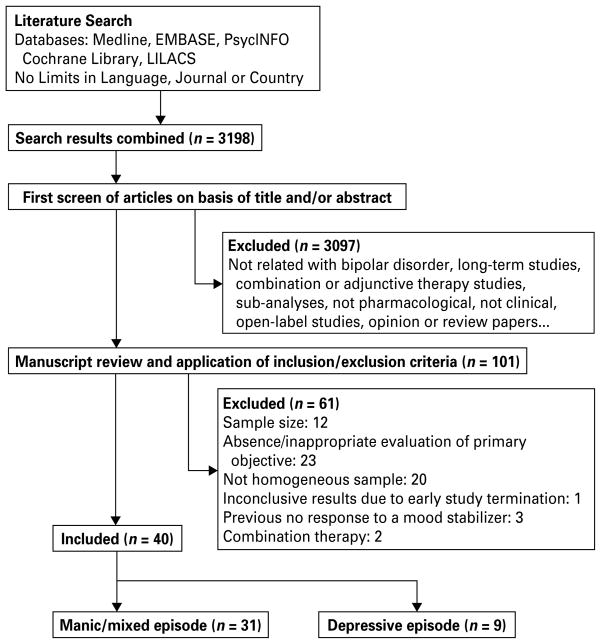
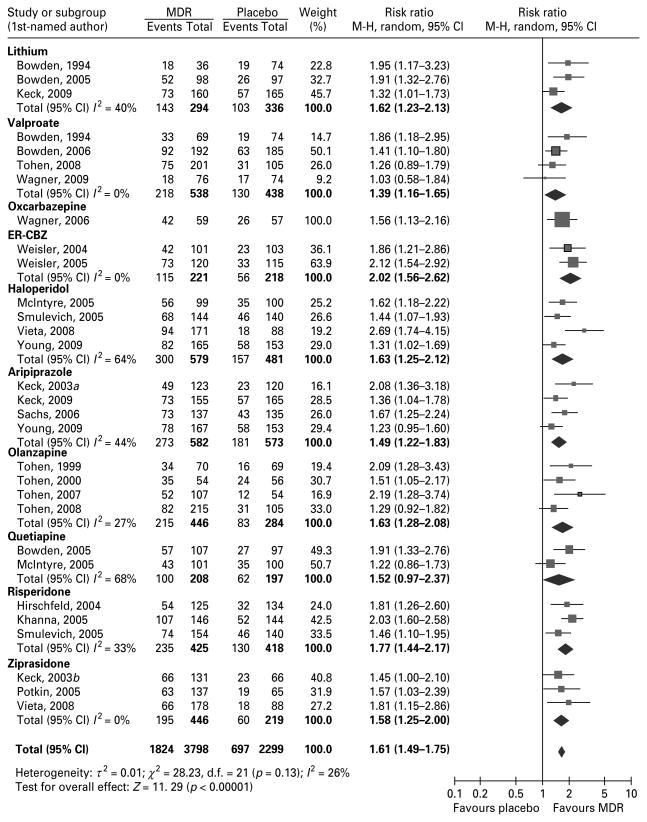
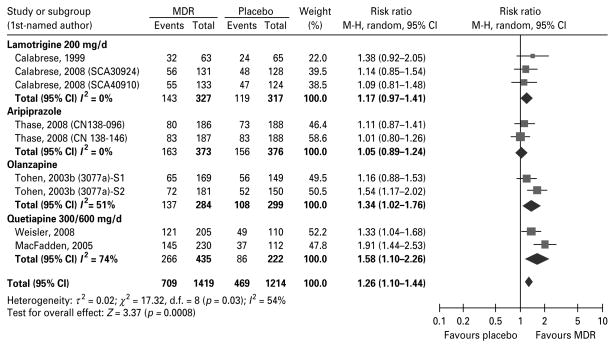
In recent years, combinations of pharmacological treatments have become common for the treatment of bipolar disorder type I (BP I); however, this practice is usually not evidence-based and rarely considers monotherapy drug regimen (MDR) as an option in the treatment of acute phases of BP I. Therefore, we evaluated comparative data of commonly prescribed MDRs for both manic and depressive phases of BP I. Medline, PsycINFO, EMBASE, the Cochrane Library, the ClinicalStudyResults.org and other data sources were searched from 1949 to March 2009 for placebo and active controlled randomized clinical trials (RCTs). Risk ratios (RRs) for response, remission, and discontinuation rates due to adverse events (AEs), lack of efficacy, or discontinuation due to any cause, and the number needed to treat or harm (NNT or NNH) were calculated for each medication individually and for all evaluable trials combined. The authors included 31 RCTs in the analyses comparing a MDR with placebo or with active treatment for acute mania, and 9 RCTs comparing a MDR with placebo or with active treatment for bipolar depression. According to the collected evidence, most of the MDRs when compared to placebo showed significant response and remission rates in acute mania. In the case of bipolar depression only quetiapine and, to a lesser extent, olanzapine showed efficacy as MDR. Overall, MDRs were well tolerated with low discontinuation rates due to any cause or AE, although AE profiles differed among treatments. We concluded that most MDRs were efficacious and safe in the treatment of manic episodes, but very few MDRs have demonstrated being efficacious for bipolar depressive episodes.
Figures
References
-
- Amsterdam JD, Shults J. Comparison of fluoxetine, olanzapine, and combined fluoxetine plus olanzapine initial therapy of bipolar type I and type II major depression–lack of manic induction. Journal of Affective Disorders. 2005;87:121–130. - PubMed
-
- Baldessarini RJ, Leahy L, Arcona S, Gause D, et al. Patterns of psychotropic drug prescription for U.S. patients with diagnoses of bipolar disorders. Psychiatry Services. 2007;58:85–91. - PubMed
-
- Ballenger JC, Post RM. Therapeutic effects of carbamazepine in affective illness: a preliminary report. Communications in Psychopharmacology. 1978;2:159–175. - PubMed
-
- Ballenger JC, Post RM. Carbamazepine in manic-depressive illness: a new treatment. American Journal of Psychiatry. 1980;137:782–790. - PubMed
-
- Baron M, Gershon ES, Rudy V, Jonas WZ, et al. Lithium carbonate response in depression. Prediction by unipolar/bipolar illness, average-evoked response, catechol-O-methyl transferase, and family history. Archives of General Psychiatry. 1975;32:1107–1111. - PubMed
