


Outcome over seven years of healthy adults with and without subjective cognitive impairment
- PMID: 20129317
- PMCID: PMC3873197
- DOI: 10.1016/j.jalz.2009.10.002
Outcome over seven years of healthy adults with and without subjective cognitive impairment
Abstract
Background: Subjective cognitive impairment (SCI) in older persons without manifest symptomatology is a common condition with a largely unclear prognosis. We hypothesized that (1) examining outcome for a sufficient period by using conversion to mild cognitive impairment (MCI) or dementia would clarify SCI prognosis, and (2) with the aforementioned procedures, the prognosis of SCI subjects would differ significantly from that of demographically matched healthy subjects, free of SCI, termed no cognitive impairment (NCI) subjects.
Methods: A consecutive series of healthy subjects, aged > or =40 years, presenting with NCI or SCI to a brain aging and dementia research center during a 14-year interval, were studied and followed up during an 18-year observation window. The study population (60 NCI, 200 SCI, 60% female) had a mean age of 67.2 +/- 9.1 years, was well-educated (mean, 15.5 +/- 2.7 years), and cognitively normal (Mini-Mental State Examination, 29.1 +/- 1.2).
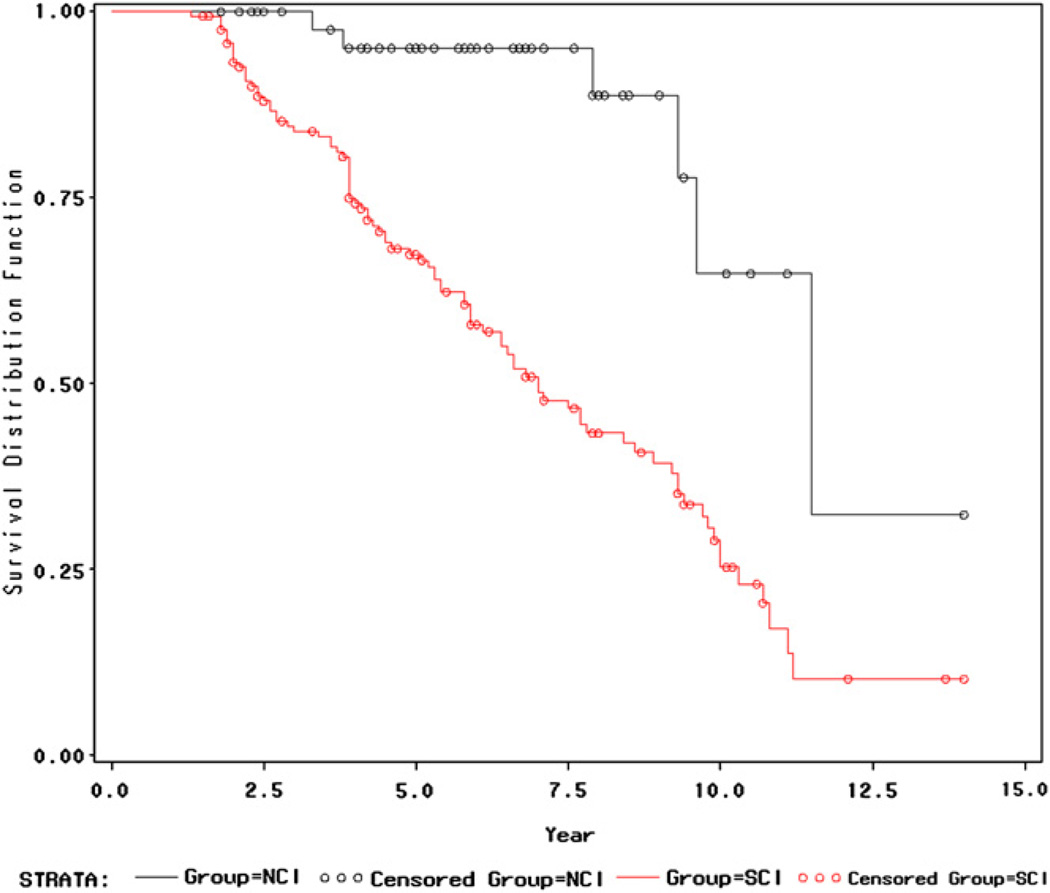
Results: A total of 213 subjects (81.9% of the study population) were followed up. Follow-up occurred during a mean period of 6.8 +/- 3.4 years, and subjects had a mean of 2.9 +/- 1.6 follow-up visits. Seven NCI (14.9%) and 90 SCI (54.2%) subjects declined (P < .0001). Of NCI decliners, five declined to MCI and two to probable Alzheimer's disease. Of SCI decliners, 71 declined to MCI and 19 to dementia diagnoses. Controlling for baseline demographic variables and follow-up time, Weibull proportional hazards model revealed increased decline in SCI subjects (hazard ratio, 4.5; 95% confidence interval, 1.9-10.3), whereas the accelerated failure time model analysis with an underlying Weibull survival function showed that SCI subjects declined more rapidly, at 60% of the rate of NCI subjects (95% confidence interval, 0.45-0.80). Furthermore, mean time to decline was 3.5 years longer for NCI than for SCI subjects (P = .0003).
Conclusions: These results indicate that SCI in subjects with normal cognition is a harbinger of further decline in most subjects during a 7-year mean follow-up interval. Relevance for community populations should be investigated, and prevention studies in this at-risk population should be explored.
2010 The Alzheimer's Association. All rights reserved.
Figures
References
-
- Jonker C, Geerlings MI, Schmand B. Are memory complaints predictive for dementia? a review of clinical and population-based studies. Int J Geriatr Psychiatry. 2000;15:983–991. - PubMed
-
- Gagnon M, Dartigues JF, Mazaux JM, Dequae L, Letenneur L, Giroire JM, et al. Self-reported memory complaints and memory performance in elderly French community residents: results of the PA-QUID Research Program. Neuroepidemiology. 1994;13:145–154. - PubMed
-
- Tobiansky R, Blizard R, Livingston G, Mann A. The Gospel Oak Study stage IV: the clinical relevance of subjective memory impairment in older people. Psychol Med. 1995;25:779–786. - PubMed
-
- Blazer DG, Hays JC, Fillenbaum GG, Gold DT. Memory complaint as a predictor of cognitive decline: a comparison of African American and White elders. J Aging Health. 1997;9:171–184. - PubMed
-
- Reisberg B, Gordon B, McCarthy M, Ferris SH, de Leon MJ. Insight and denial accompanying progressive cognitive decline in normal aging and Alzheimer’s disease. In: Stanley B, editor. Geriatric psychiatry: ethical and legal issues. Washington, DC: American Psychiatric Press; 1985. pp. 37–79.
Publication types
MeSH terms
Grants and funding
LinkOut - more resources
Full Text Sources
Other Literature Sources
Medical
