


Proliferation capacity and cytotoxic activity are mediated by functionally and phenotypically distinct virus-specific CD8 T cells defined by interleukin-7R{alpha} (CD127) and perforin expression
- PMID: 20130059
- PMCID: PMC2849500
- DOI: 10.1128/JVI.02565-09
Proliferation capacity and cytotoxic activity are mediated by functionally and phenotypically distinct virus-specific CD8 T cells defined by interleukin-7R{alpha} (CD127) and perforin expression
Abstract
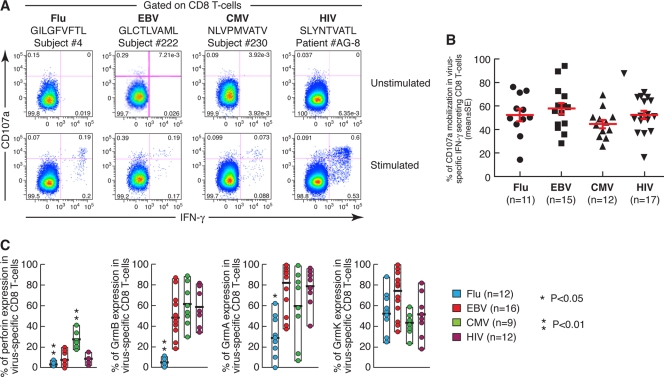
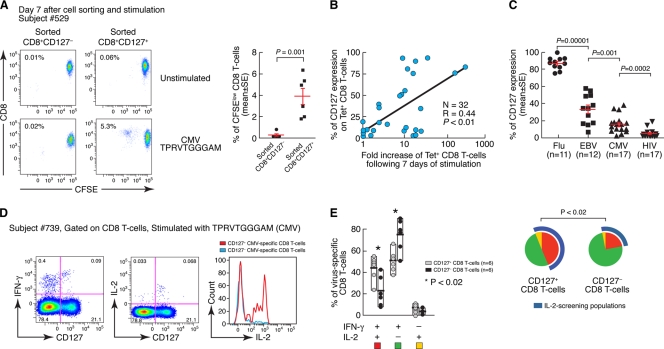
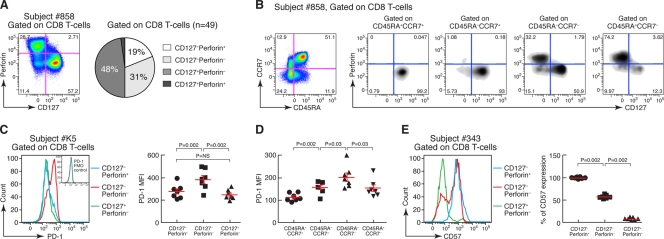
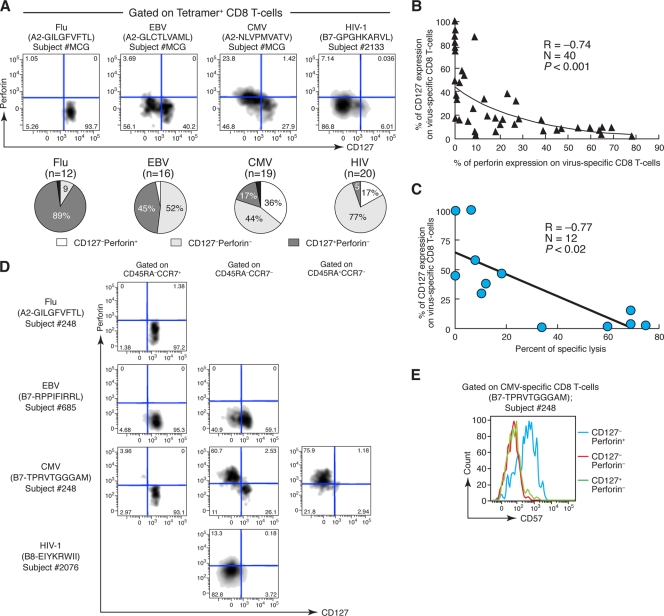
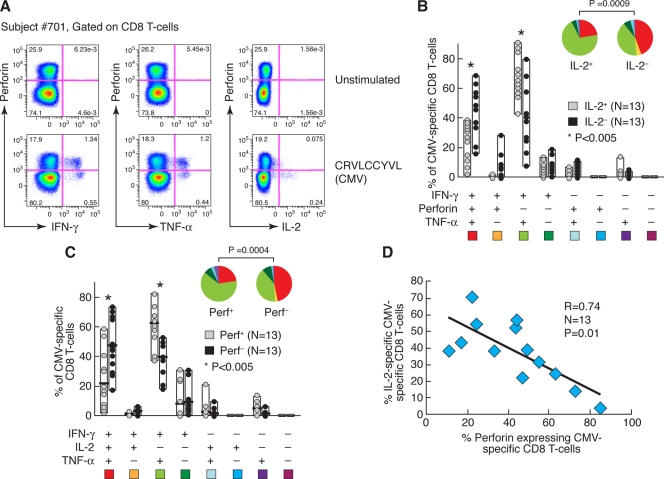
Cytotoxicity and proliferation capacity are key functions of antiviral CD8 T cells. In the present study, we investigated a series of markers to define these functions in virus-specific CD8 T cells. We provide evidence that there is a lack of coexpression of perforin and CD127 in human CD8 T cells. CD127 expression on virus-specific CD8 T cells correlated positively with proliferation capacity and negatively with perforin expression and cytotoxicity. Influenza virus-, cytomegalovirus-, and Epstein-Barr virus/human immunodeficiency virus type 1-specific CD8 T cells were predominantly composed of CD127(+) perforin(-)/CD127(-) perforin(+), and CD127(-)/perforin(-) CD8 T cells, respectively. CD127(-)/perforin(-) and CD127(-)/perforin(+) cells expressed significantly more PD-1 and CD57, respectively. Consistently, intracellular cytokine (gamma interferon, tumor necrosis factor alpha, and interleukin-2 [IL-2]) responses combined to perforin detection confirmed that virus-specific CD8 T cells were mostly composed of either perforin(+)/IL-2(-) or perforin(-)/IL-2(+) cells. In addition, perforin expression and IL-2 secretion were negatively correlated in virus-specific CD8 T cells (P < 0.01). As previously shown for perforin, changes in antigen exposure modulated also CD127 expression. Based on the above results, proliferating (CD127(+)/IL-2-secreting) and cytotoxic (perforin(+)) CD8 T cells were contained within phenotypically distinct T-cell populations at different stages of activation or differentiation and showed different levels of exhaustion and senescence. Furthermore, the composition of proliferating and cytotoxic CD8 T cells for a given antiviral CD8 T-cell population appeared to be influenced by antigen exposure. These results advance our understanding of the relationship between cytotoxicity, proliferation capacity, the levels of senescence and exhaustion, and antigen exposure of antiviral memory CD8 T cells.
Figures
References
-
- Ahmed, R., and D. Gray. 1996. Immunological memory and protective immunity: understanding their relation. Science 272:54-60. - PubMed
-
- Appay, V., P. R. Dunbar, M. Callan, P. Klenerman, G. M. Gillespie, L. Papagno, G. S. Ogg, A. King, F. Lechner, C. A. Spina, S. Little, D. V. Havlir, D. D. Richman, N. Gruener, G. Pape, A. Waters, P. Easterbrook, M. Salio, V. Cerundolo, A. J. McMichael, and S. L. Rowland-Jones. 2002. Memory CD8+ T cells vary in differentiation phenotype in different persistent virus infections. Nat. Med. 8:379-385. - PubMed
-
- Appay, V., D. F. Nixon, S. M. Donahoe, G. M. Gillespie, T. Dong, A. King, G. S. Ogg, H. M. Spiegel, C. Conlon, C. A. Spina, D. V. Havlir, D. D. Richman, A. Waters, P. Easterbrook, A. J. McMichael, and S. L. Rowland-Jones. 2000. HIV-specific CD8+ T cells produce antiviral cytokines but are impaired in cytolytic function. J. Exp. Med. 192:63-75. - PMC - PubMed
-
- Appay, V., R. A. van Lier, F. Sallusto, and M. Roederer. 2008. Phenotype and function of human T lymphocyte subsets: consensus and issues. Cytometry A 73:975-983. - PubMed
-
- Ashton-Rickardt, P. G. 2005. The granule pathway of programmed cell death. Crit. Rev. Immunol. 25:161-182. - PubMed
Publication types
MeSH terms
Substances
LinkOut - more resources
Full Text Sources
Other Literature Sources
Medical
Research Materials
