. 2010 Feb 3;30(5):1631-6.
doi: 10.1523/JNEUROSCI.5255-09.2010.

Cognitive loss in zinc transporter-3 knock-out mice: a phenocopy for the synaptic and memory deficits of Alzheimer's disease?

Affiliations

Cognitive loss in zinc transporter-3 knock-out mice: a phenocopy for the synaptic and memory deficits of Alzheimer's disease?

Paul A Adlard et al. J Neurosci. .

Abstract

Zinc transporter-3 (ZnT3) protein controls synaptic vesicular Zn(2+) levels, which is predicted to regulate normal cognitive function. Surprisingly, previous studies found that 6- to 10-week-old ZnT3 knock-out (KO) mice did not show impairment in the Morris water maze. We hypothesized that older ZnT3 KO animals would display a cognitive phenotype. Here, we report that ZnT3 KO mice exhibit age-dependent deficits in learning and memory that are manifest at 6 months but not at 3 months of age. These deficits are associated with significant alterations in key hippocampal proteins involved in learning and memory, as assessed by Western blot. These include decreased levels of the presynaptic protein SNAP25 (-46%; p < 0.01); the postsynaptic protein PSD95 (-37%; p < 0.01); the glutamate receptors AMPAR (-34%; p < 0.01), NMDAR2a (-64%; p < 0.001), and NMDAR2b (-49%; p < 0.05); the surrogate marker of neurogenesis doublecortin (-31%; p < 0.001); and elements of the BDNF pathway, pro-BDNF (-30%; p < 0.05) and TrkB (-22%; p < 0.01). In addition, there is a concomitant decrease in neuronal spine density (-6%; p < 0.05). We also found that cortical ZnT3 levels fall with age in wild-type mice (-50%; p < 0.01) in healthy older humans (ages, 48-91 years; r(2) = 0.47; p = 0.00019) and particularly in Alzheimer's disease (AD) (-36%; p < 0.0001). Thus, age-dependent loss of transsynaptic Zn(2+) movement leads to cognitive loss, and since extracellular beta-amyloid is aggregated by and traps this pool of Zn(2+), the genetic ablation of ZnT3 may represent a phenocopy for the synaptic and memory deficits of AD.


Figures

Figure 1.
Figure 1.
Morris water maze assessment of ZnT3 KO mice. a, Learning trials for 3-month-old WT (C57×129Sv background strain for the ZnT3 KOs; 6 males, 6 females) and ZnT3 KO mice (4 males, 6 females). ZnT3 KOs performed better than WTs on the task, driven by differences on trial days 1–3, but maximal performance was not different between the two genotypes. b, Probe trial for 3-month-old mice, showing no significant difference between genotypes. c, Learning trials for 6-month-old WT (8 males, 4 females) and ZnT3 KO mice (8 males, 8 females). ZnT3 KO mice performed significantly worse than age-matched WT overall (p < 0.0001), with the performance of the ZnT3 KO mice separating from WT on the last 4 trial days (days 3–6, respectively; p = 0.0003; p = 0.001; p = 0.0002; p = 0.003, compared with WT). d, Probe trial for 6-month-old WT and ZnT3 KO animals, showing that ZnT3 KO mice are significantly impaired in their retention of the task, compared with WT animals (p < 0.0001). e, Quadrant analysis, showing that 6-month-old WT animals have a significant preference for the correct northwest quadrant and a diminished preference for both the southeast and southwest quadrants, whereas the age-matched ZnT3 KO animals show equal preference for all four quadrants, indicating a lack of learning/memory. The asterisks (*) represent means that are different from age-matched WT means. *p < 0.05; **p < 0.01; ***p < 0.001.
Figure 2.
Figure 2.
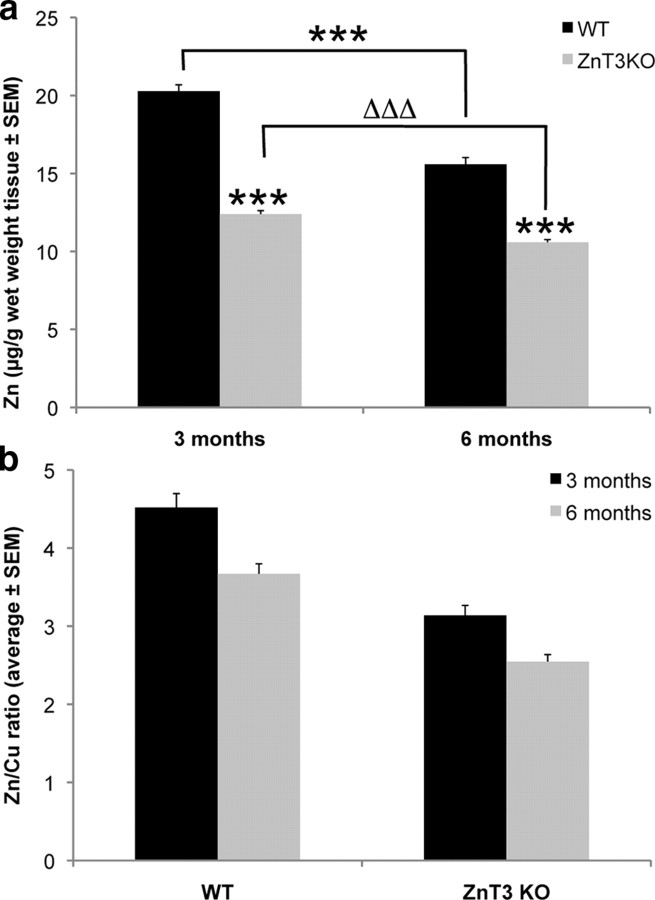
Hippocampal metal analysis of ZnT3 KO mice. a, Hippocampal zinc levels were assayed using inductively coupled plasma mass spectrometry in 3- and 6-month-old mice, showing that aging in both the WT and ZnT3 KO mice causes a significant decline. There is a significant additional zinc deficit in the ZnT3 KO animals at both ages. b, Zn levels were normalized to the Cu levels for each individual sample, showing that there is a significant drop in the Zn/Cu ratio with aging in WT and ZnT3 KO animals. The asterisks (*) represent means that are different from age-matched WT means, and delta (Δ) represents a difference between 3- and 6-month-old ZnT3 KO mice. ***, ΔΔΔ p < 0.001.
Figure 3.
Figure 3.
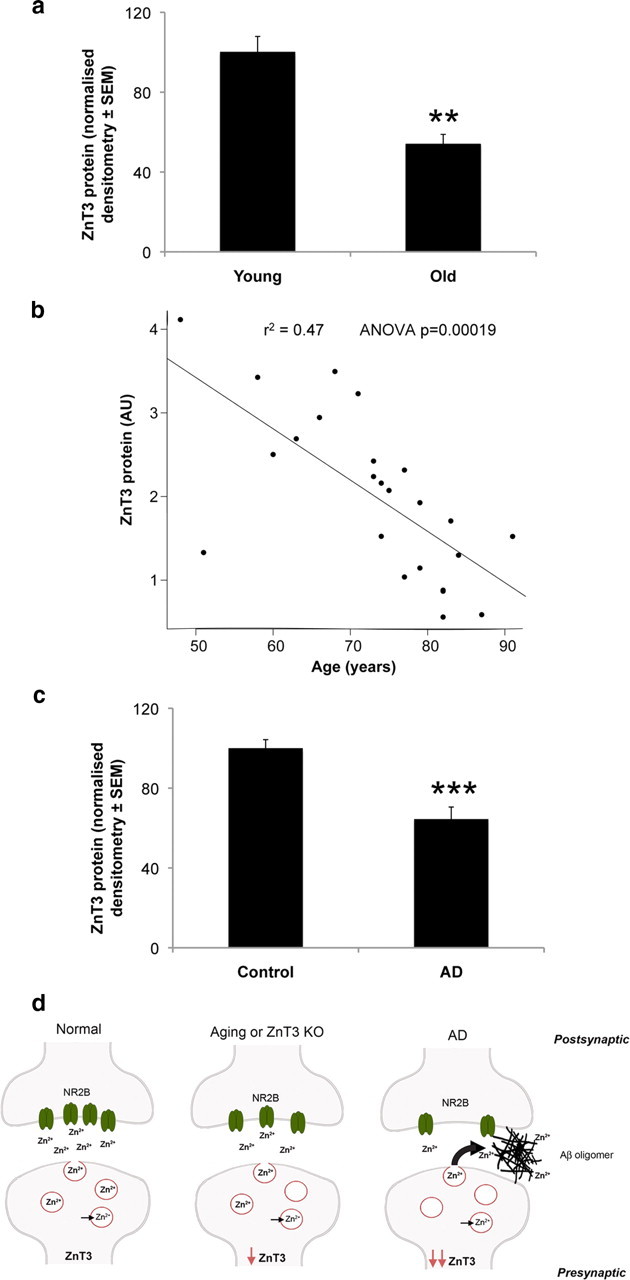
Decline of brain ZnT3 levels in murine and human aging. a, Cerebral ZnT3 levels over age assayed by Western blot in normal mice (B6C3 strain; n = 8 per group; 50% male; average ages: young, 1.9 months; old, 8.7 months), demonstrating a significant decline in ZnT3 with age (ANOVA, p = 0.0026). b, ZnT3 levels in BA8/9 of normal humans (n = 16 males, 8 females; age range, 48–91 years; average age ± SD, 73 ± 11 years). The linear regression line is shown (r 2 = 0.47; p = 0.00019), demonstrating a significant age-related decline in ZnT3. c, ZnT3 levels in BA8/9 are further decreased (−36%; ANOVA, p < 0.0001) in AD (n = 4 males, 5 females; 81 ± 9 years) compared with the healthy controls (n = 8 males, 6 females; 73 ± 13 years). d, ZnT3-associated decline in synaptic zinc in age and Alzheimer's disease. This diagrammatic model shows a zinc-containing glutamatergic synapse in health, aging, and disease. In health, ZnT3 loads Zn2+ into vesicles, whereupon it is transported and released at the synapse. After release, Zn2+ can interact with postsynaptic targets such as NMDA receptors (NR2B subunit shown here). With aging, or after the genetic ablation of ZnT3, the loss of ZnT3 inhibits Zn2+ delivery and leads to a decline in NR2B and other postsynaptic targets involved in learning and memory (see text). In AD, there is a profound impairment of synaptic Zn2+ reaching its postsynaptic targets because there is both an accentuated drop in ZnT3 levels as well as entrapment of extracellular Zn2+ by Aβ oligomers. Loss of transsynaptic Zn2+ signaling leads to decreased expression of select postsynaptic targets such as NR2B and cognitive decline. The asterisks (*) represent means that are different from age-matched WT means. **p < 0.01; ***p < 0.001.

References

    1. Adlard PA, Cherny RA, Finkelstein DI, Gautier E, Robb E, Cortes M, Volitakis I, Liu X, Smith JP, Perez K, Laughton K, Li QX, Charman SA, Nicolazzo JA, Wilkins S, Deleva K, Lynch T, Kok G, Ritchie CW, Tanzi RE, et al. Rapid restoration of cognition in Alzheimer's transgenic mice with 8-hydroxy quinoline analogs is associated with decreased interstitial Abeta. Neuron. 2008;59:43–55. - PubMed
    1. Besser L, Chorin E, Sekler I, Silverman WF, Atkin S, Russell JT, Hershfinkel M. Synaptically released zinc triggers metabotropic signaling via a zinc-sensing receptor in the hippocampus. J Neurosci. 2009;29:2890–2901. - PMC - PubMed
    1. Beyer N, Coulson DT, Heggarty S, Ravid R, Irvine GB, Hellemans J, Johnston JA. ZnT3 mRNA levels are reduced in Alzheimer's disease post-mortem brain. Mol Neurodegener. 2009;4:53. - PMC - PubMed
    1. Chapman PF, White GL, Jones MW, Cooper-Blacketer D, Marshall VJ, Irizarry M, Younkin L, Good MA, Bliss TV, Hyman BT, Younkin SG, Hsiao KK. Impaired synaptic plasticity and learning in aged amyloid precursor protein transgenic mice. Nat Neurosci. 1999;2:271–276. - PubMed
    1. Chowanadisai W, Kelleher SL, Lönnerdal B. Maternal zinc deficiency reduces NMDA receptor expression in neonatal rat brain, which persists into early adulthood. J Neurochem. 2005;94:510–519. - PubMed

Publication types

MeSH terms