


Cellular and molecular biology of Neisseria meningitidis colonization and invasive disease
- PMID: 20132098
- PMCID: PMC2830671
- DOI: 10.1042/CS20090513
Cellular and molecular biology of Neisseria meningitidis colonization and invasive disease
Abstract
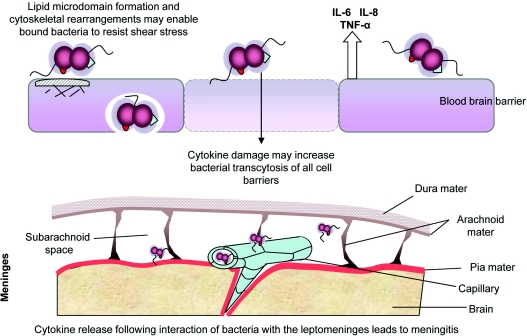
The human species is the only natural host of Neisseria meningitidis, an important cause of bacterial meningitis globally, and, despite its association with devastating diseases, N. meningitidis is a commensal organism found frequently in the respiratory tract of healthy individuals. To date, antibiotic resistance is relatively uncommon in N. meningitidis isolates but, due to the rapid onset of disease in susceptible hosts, the mortality rate remains approx. 10%. Additionally, patients who survive meningococcal disease often endure numerous debilitating sequelae. N. meningitidis strains are classified primarily into serogroups based on the type of polysaccharide capsule expressed. In total, 13 serogroups have been described; however, the majority of disease is caused by strains belonging to one of only five serogroups. Although vaccines have been developed against some of these, a universal meningococcal vaccine remains a challenge due to successful immune evasion strategies of the organism, including mimicry of host structures as well as frequent antigenic variation. N. meningitidis express a range of virulence factors including capsular polysaccharide, lipopolysaccharide and a number of surface-expressed adhesive proteins. Variation of these surface structures is necessary for meningococci to evade killing by host defence mechanisms. Nonetheless, adhesion to host cells and tissues needs to be maintained to enable colonization and ensure bacterial survival in the niche. The aims of the present review are to provide a brief outline of meningococcal carriage, disease and burden to society. With this background, we discuss several bacterial strategies that may enable its survival in the human respiratory tract during colonization and in the blood during infection. We also examine several known meningococcal adhesion mechanisms and conclude with a section on the potential processes that may operate in vivo as meningococci progress from the respiratory niche through the blood to reach the central nervous system.
Figures

References
-
- Stabler R. A., Marsden G. L., Witney A. A., Li Y., Bentley S. D., Tang C. M., Hinds J. Identification of pathogen-specific genes through microarray analysis of pathogenic and commensal Neisseria species. Microbiology. 2005;151:2907–2922. - PubMed
-
- Cartwright K. Chichester: John Wiley & Sons; 1995. Meningococcal Carriage and Disease.
-
- Frasch C. E., Zollinger W. D., Poolman J. T. Serotype antigens of Neisseria meningitidis and a proposed scheme for designation of serotypes. Rev. Infect. Dis. 1985;7:504–510. - PubMed
-
- Brehony C., Jolley K. A., Maiden M. C. Multilocus sequence typing for global surveillance of meningococcal disease. FEMS Microbiol. Rev. 2007;31:15–26. - PubMed
Publication types
MeSH terms
Grants and funding
LinkOut - more resources
Full Text Sources
Other Literature Sources
Medical
