


Open questions in current models of antidepressant action
- PMID: 20132212
- PMCID: PMC2848923
- DOI: 10.1111/j.1476-5381.2009.00585.x
Open questions in current models of antidepressant action
Abstract
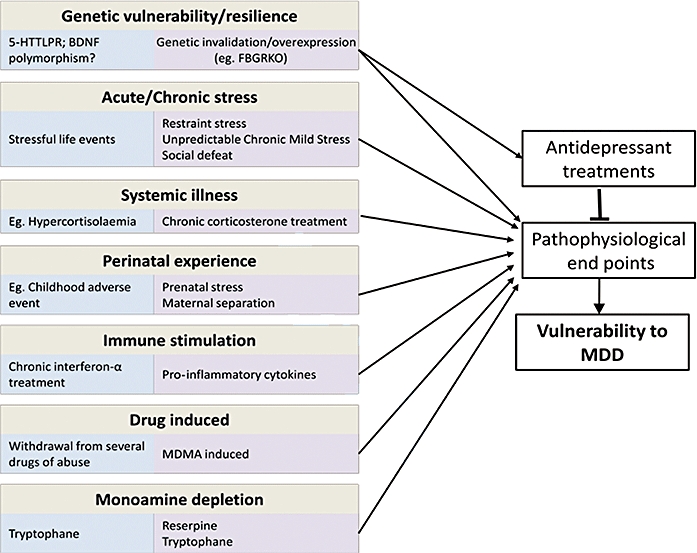
Research on depression and antidepressant drugs is necessary, as many patients display poor response to therapy. Different symptomatic and pathophysiological features have been proposed as end points of the depressive phenotype and of the antidepressant action, including anhedonia, depressed mood, alterations in morphology and activity of some brain areas (amygdala, nucleus accumbens, hippocampus, prefrontal cortex and cingulate cortex), modifications in the connectivity between brain structures, changes in neurotransmitters (serotonin, noradrenaline, glutamate and neuropeptides), brain plasticity (neurogenesis, neurotrophins) and abnormal function of the hypothalamic-pituitary adrenal axis. However, few models have been proposed to describe how these end points could induce the depressive phenotype and are involved in the mechanism of action of antidepressants. Here we propose a connectionist-inspired network of depression and antidepressant action, in which the different aetiological factors participating in the release of a depressive episode are represented by input nodes, the different symptomatic as well as pathophysiological end points are represented by an intermediate layer, and the onset of depression or of comorbid disease is represented by the output node. The occurrence of depression and the mechanism of the antidepressant action thus depend upon the weight of the interactions between the different end points, none of them being per se crucial to the onset of a depressive phenotype or to the antidepressant action. This model is heuristic to draw future lines of research concerning new antidepressant therapies, designing new animal models of depression and for a better understanding of the depressive pathology and of its comorbid pathology such as anxiety disorders.
Figures

References
-
- Airan RD, Meltzer LA, Roy M, Gong Y, Chen H, Deisseroth K. High-speed imaging reveals neurophysiological links to behavior in an animal model of depression. Science. 2007;317:819–823. - PubMed
-
- Alonso R, Griebel G, Pavone G, Stemmelin J, Le FG, Soubrie P. Blockade of CRF(1) or V(1b) receptors reverses stress-induced suppression of neurogenesis in a mouse model of depression. Mol Psychiatry. 2004;9:278–286. - PubMed
-
- Amsterdam JD. Selective serotonin reuptake inhibitor efficacy in severe and melancholic depression. J Psychopharmacol. 1998;12:S99–S111. - PubMed
-
- Anand A, Li Y, Wang Y, Wu J, Gao S, Bukhari L, et al. Activity and connectivity of brain mood regulating circuit in depression: a functional magnetic resonance study. Biol Psychiatry. 2005;57:1079–1088. - PubMed
Publication types
MeSH terms
Substances
LinkOut - more resources
Full Text Sources
Medical
