


Azithromycin is associated with increased survival in lung transplant recipients with bronchiolitis obliterans syndrome
- PMID: 20133163
- PMCID: PMC2854291
- DOI: 10.1016/j.healun.2009.12.003
Azithromycin is associated with increased survival in lung transplant recipients with bronchiolitis obliterans syndrome
Abstract
Background: Previous studies have suggested that azithromycin improves lung function in lung transplant recipients with bronchiolitis obliterans syndrome (BOS). However, these studies did not include a non-treated BOS control cohort or perform survival analysis. This study was undertaken to estimate the effect of azithromycin treatment on survival in lung transplant recipients with BOS.
Methods: We conducted a retrospective cohort study of consecutive lung transplant recipients who developed BOS between 1999 and 2007. An association between azithromycin treatment and death was assessed using univariate and multivariate time-dependent Cox regression analysis.
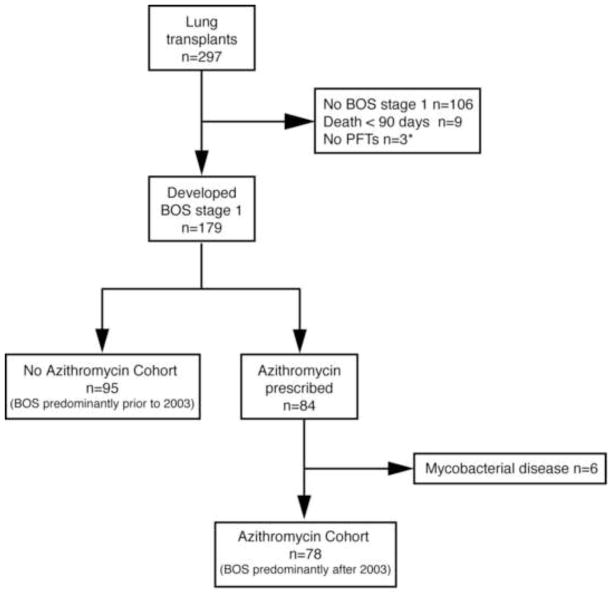
Results: Of the 178 recipients who developed BOS in our study, 78 did so after 2003 and were treated with azithromycin. The azithromycin-treated and untreated cohorts had similar baseline characteristics. Univariate analysis demonstrated that azithromycin treatment was associated with a survival advantage and this beneficial treatment effect was more pronounced when treatment was initiated during BOS Stage 1. Multivariate analysis demonstrated azithromycin treatment during BOS Stage 1 (adjusted hazard ratio = 0.23, p = 0.01) and absolute forced expiratory volume in 1 second (FEV(1)) at the time of BOS Stage 1 (adjusted hazard ratio = 0.52, p = 0.003) were both associated with a decreased risk of death.
Conclusions: In lung transplant recipients with BOS Stage 1, azithromycin treatment initiated before BOS Stage 2 was independently associated with a significant reduction in the risk of death. This finding supports the need for a randomized, controlled trial to confirm the impact of azithromycin on survival in lung transplant recipients.
Copyright (c) 2010 International Society for Heart and Lung Transplantation. Published by Elsevier Inc. All rights reserved.
Conflict of interest statement
No authors involved in the preparation of this manuscript have any financial relationships with industry or other agencies related to azithromycin or other macrolide antibiotics.
Figures
References
-
- Trulock EP, Christie JD, Edwards LB, et al. Registry of the International Society for Heart and Lung Transplantation: twenty-fourth official adult lung and heart-lung transplantation report-2007. J Heart Lung Transplant. 2007;26:782–95. - PubMed
-
- Christie JD, Carby M, Bag R, et al. Registry of the International Society for Heart and Lung Transplantation: twenty-fifth official adult lung and heart/lung transplantation report--2008. J Heart Lung Transplant. 2008;27:957–69. - PubMed
-
- Williams TJ, Verleden GM. Azithromycin: a plea for multicenter randomized studies in lung transplantation. Am J Respir Crit Care Med. 2005;172:657–9. - PubMed
-
- Kudoh S, Azuma A, Yamamoto M, et al. Improvement of survival in patients with diffuse panbronchiolitis treated with low-dose erythromycin. Am J Respir Crit Care Med. 1998;157:1829–32. - PubMed
Publication types
MeSH terms
Substances
Grants and funding
LinkOut - more resources
Full Text Sources
Medical
