Comparative Study
. 2010 May;108(5):1069-76.
doi: 10.1152/japplphysiol.01308.2009. Epub 2010 Feb 4.

The insulin-like growth factor (IGF)-I E-peptides are required for isoform-specific gene expression and muscle hypertrophy after local IGF-I production

Affiliations
Comparative Study

The insulin-like growth factor (IGF)-I E-peptides are required for isoform-specific gene expression and muscle hypertrophy after local IGF-I production

Elisabeth R Barton et al. J Appl Physiol (1985). 2010 May.

Abstract

Insulin-like growth factor I (IGF-I) coordinates proliferation and differentiation in a wide variety of cell types. The igf1 gene not only produces IGF-I, but also generates multiple carboxy-terminal extensions, the E-peptides, through alternative splicing leading to different isoforms. It is not known if the IGF-I isoforms share a common pathway for their actions, or if there are specific actions of each protein. Viral administration of murine IGF-IA, IGF-IB, and mature IGF, which lacked an E-peptide extension, was utilized to identify IGF-I isoform-specific responsive genes in muscles of young growing mice. Microarray analysis revealed responses that were driven by increased IGF-I regardless of the presence of E-peptide, such as Bcl-XL. In contrast, distinct expression patterns were observed after viral delivery of IGF-IA or IGF-IB, which included matrix metalloproteinase 13 (MMP13). Expression of Bcl-XL was prevented when viral administration of the IGF-I isoforms was performed into muscles of MKR mice, which lack functional IGF-I receptors on the muscle fibers. However, MMP13 expression persisted under the same conditions after viral injection of IGF-IB. At 4 mo after viral delivery, expression of IGF-IA or IGF-IB promoted muscle hypertrophy, but viral delivery of mature IGF-I failed to increase muscle mass. These studies provide evidence that local production of IGF-I requires the E-peptides to drive hypertrophy in growing muscle and that both common and unique pathways exist for the IGF-I isoforms to promote biological effects.


Figures

Fig. 1.
Fig. 1.
Distribution of changing transcripts with respect to IGF viral construct from microarray analysis. Viral delivery of either IGF-I isoform or mature IGF-I (IGFStop) caused changes in 79 transcripts. However, 109 transcripts changed only when the viral construct retained the E peptide (IGF-IA and IGF-IB), and not in response to mature IGF-I expression. A complete list of all changing transcripts is shown in Supplemental Fig. 1, available with the online version of this article.
Fig. 2.
Fig. 2.
IGF content in skeletal muscles 1 mo after recombinant adeno-associated virus serotype 2/8 (rAAV) injection. Total IGF-I was measured by ELISA for n = 4 muscles per condition. IGF-I content was significantly increased in tibialis anterior (TA) muscles by all IGF viral constructs compared with strain-matched controls (*P < 0.05 vs. control by 1-way ANOVA followed by Tukey test). Injection of rAAV IGF-Istop, which produced mature IGF-I, resulted in higher IGF-I levels than that measured in muscles injected with rAAV IGF-IA (†P < 0.05). Data are presented as means ± SE.
Fig. 3.
Fig. 3.
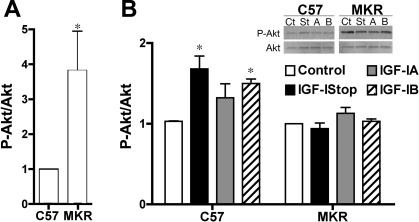
Phosphorylated Akt (P-Akt) levels as an indicator of IGF-I receptor signal transduction. A: relative basal P-Akt levels are 4-fold higher in untreated MKR muscles compared with C57 muscles. *P < 0.05 by unpaired t-test. B: relative P-Akt levels after viral injection of IGF-I isoforms. Levels are comparisons between injected and uninjected limbs for n = 4 animals per condition. Inset shows an immunoblot for phosphorylated and total Akt 1 mo after viral injection for all IGF viral constructs: Ct, Control; St, IGF-Istop; A, IGF-IA; B, IGF-IB. Injection of rAAV expressing IGF-Istop, IGF-IA, or IGF-IB caused a 30–70% increase in P-Akt compared with uninjected controls in C57 mice. However, the same injections into MKR mice did not result in increased P-Akt. Data are presented as means ± SE; *P < 0.05 by unpaired t-test between treated and untreated muscles for each IGF-I construct.
Fig. 4.
Fig. 4.
Immunoblot analysis of IGF-responsive genes. A: representative blot of Bcl-XL and matrix metalloproteinase 13 (MMP13) protein in control and rAAV-injected muscles 1 mo after injection. B: Bcl-XL protein significantly increased after viral delivery of IGF-Istop (St), IGF-IA (A), and IGF-IB (B) in C57 muscles but did not change in MKR muscle after the same treatment. Untreated control MKR muscles had significantly less Bcl-XL than untreated C57 muscles. C: a significant increase of MMP13 occurred in C57 muscles after viral injection of IGF-IA or IGF-IB but not after injection of IGF-Istop. Only injection of rAAV IGF-IB resulted in increased MMP13 in MKR muscles. *P < 0.05 vs. strain-matched controls; †P < 0.05 MKR vs. C57 for untreated muscles (1-way ANOVA followed by Tukey test, n = 3–4 for each condition).
Fig. 5.
Fig. 5.
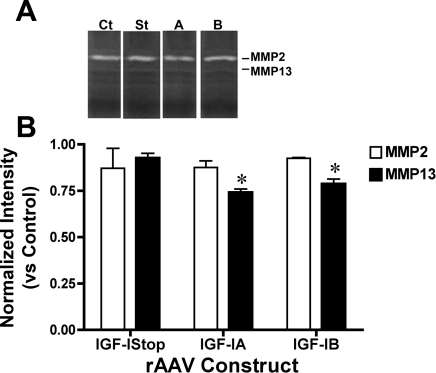
MMP activity after rAAV injection. A: collagen zymography of muscle lysates from C57 muscles after viral injection of IGF-Istop (St), IGF-IA (A), IGF-IB (B), or PBS (Ct). B: MMP13 activity decreased after viral injection of IGF-IA or IGF-IB compared with saline-injected controls. MMP2 activity was not affected by viral injection. *P < 0.05 vs. strain-matched controls (1-way ANOVA followed by Tukey test on n = 3 samples).
Fig. 6.
Fig. 6.
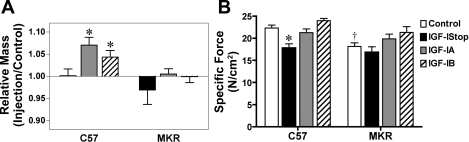
Muscle mass and force generation 4 mo after viral injection. A: viral injection of IGF-IA and IGF-IB resulted in a significant increase in muscle mass compared with the contralateral control muscle in C57 mice but did not cause hypertrophy after injection into muscles of MKR mice. Injection of IGF-Istop did not cause increase muscles mass in either mouse strain. B: specific tetanic force in C57 muscles was not affected by viral injection of IGF-IA or IGF-IB but decreased after injection of IGF-Istop. No change in specific force was observed in MKR muscles after viral injection compared with controls. Without viral injection, the MKR muscles were weaker than those from C57 mice. *P < 0.05 vs. strain-matched controls; †P < 0.05 MKR vs. C57 for untreated muscles (1-way ANOVA followed by Tukey test, n = 4–8 for each condition).

Comment in

References

    1. Adamo ML, Neuenschwander S, LeRoith D, Roberts CT. Structure, expression, and regulation of the IGF-1 gene. Adv Exp Med Biol 343: 1–11, 1993 - PubMed
    1. Adams GR, McCue SA. Localized infusion of IGF-I results in skeletal muscle hypertrophy in rats. J Appl Physiol 84: 1716–1722, 1998 - PubMed
    1. Adams JM, Cory S. The Bcl-2 protein family: arbiters of cell survival. Science 281: 1322–1326, 1998 - PubMed
    1. Barton ER. The ABCs of IGF-I isoforms: impact on muscle hypertrophy and implications for repair. Appl Physiol Nutr Metab 31: 791–797, 2006 - PubMed
    1. Barton ER. Viral expression of insulin-like growth factor-I isoforms promotes different responses in skeletal muscle. J Appl Physiol 100: 1778–1784, 2006 - PubMed

Publication types

MeSH terms

Substances