. 2010 Feb 16;107(7):3087-92.
doi: 10.1073/pnas.0914897107. Epub 2010 Jan 26.

Targeted disruption of the CREB coactivator Crtc2 increases insulin sensitivity

Affiliations

Targeted disruption of the CREB coactivator Crtc2 increases insulin sensitivity

Yiguo Wang et al. Proc Natl Acad Sci U S A. .

Abstract

Under fasting conditions, increases in circulating concentrations of pancreatic glucagon maintain glucose homeostasis through induction of gluconeogenic genes by the CREB coactivator CRTC2. Hepatic CRTC2 activity is elevated in obesity, although the extent to which this cofactor contributes to attendant increases in insulin resistance is unclear. Here we show that mice with a knockout of the CRTC2 gene have decreased circulating glucose concentrations during fasting, due to attenuation of the gluconeogenic program. CRTC2 was found to stimulate hepatic gene expression in part through an N-terminal CREB binding domain that enhanced CREB occupancy over relevant promoters in response to glucagon. Deletion of sequences encoding the CREB binding domain in CRTC2 (-/-) mice lowered circulating blood glucose concentrations and improved insulin sensitivity in the context of diet-induced obesity. Our results suggest that small molecules that attenuate the CREB-CRTC2 pathway may provide therapeutic benefit to individuals with type 2 diabetes.


Conflict of interest statement

The authors declare no conflict of interest.

Figures

Fig. 1.
Fig. 1.
CRTC2 increases CREB promoter occupancy in response to fasting signals. (A) Immunoblot (Upper) and immunocytochemical (Lower) analysis showing CRTC2 dephosphorylation and nuclear translocation in primary hepatocytes exposed to forskolin (FSK). Scale bar, 5 um. (B) Chromatin immunoprecipitation (ChIP) assay of CREB (Upper) and CRTC2 (Lower) occupancy over the human PEPCK promoter in HEK293T cells exposed to FSK (black bars) or vehicle (white bars) (n = 3, P < 0.05; SEM). Location of CREB binding sites indicated. (C) Gel mobility shift assay of CREB and GST-CRTC2 proteins using a 32P-labeled double-stranded CRE oligonucleotide. Protein–DNA complexes and free probe indicated. (D) (Upper Left) Schematic diagram showing organiziation of wild-type or mutant CRTC2 vectors lacking either the N-terminal CREB binding domain (aa 1–50) or central regulatory region (aa 51–539) indicated. (Upper Right) Immunoblot with anti-flag epitope antiserum showing relative expression of each CRTC2 polypeptide in transfected cells. (Lower) Transient assay of HEK293T cells transfected with cAMP responsive EVX-luc reporter vector and exposed to FSK as indicated (n = 3, P < 0.05; SEM).
Fig. 2.
Fig. 2.
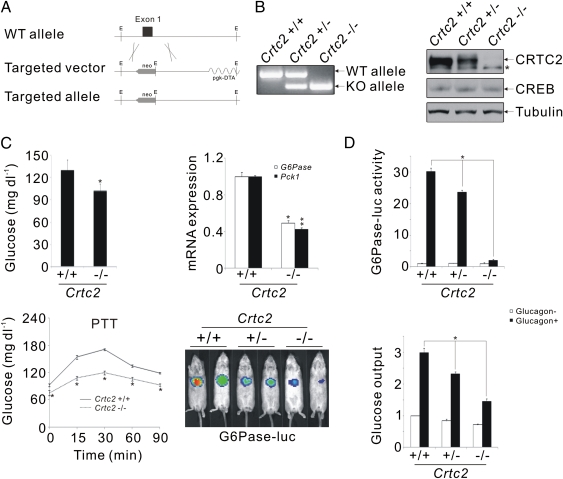
Fasting hypoglycemia in CRTC2−/− mice. (A) Schematic diagram of wild-type and mutant CRTC2 alleles following homologous recombination with targeting vector lacking exon 1 sequences. (B) (Left) PCR analysis showing CRTC2 fragments generated from wild-type, heterozygous, or homozygous CRTC2 mutant mice. (Right) Immunoblot of CRTC2 protein amounts in hepatic extracts from from wild-type and CRTC2 mutant mice. *Nonspecific band. CRTC2 antiserum was developed against aa 454–607 of mouse CRTC2. (C) (Top) Circulating glucose concentrations (Left) and hepatic mRNA amounts for gluconeogenic genes (Right; G6Pase, PEPCK) in wild-type and CRTC2−/− mice (n = 10, P < 0.05; SEM). (Lower) pyruvate tolerance testing (n = 5, P < 0.05; SEM) (Left) and G6Pase-luc reporter activity (Right) in fasted wild-type and CRTC2 mutant mice. (D) G6Pase reporter activity (Top) and glucose output (Bottom) from primary hepatocytes (wild-type, CRTC2+/−, CRTC2−/−) under basal conditions and following exposure to glucagon (n = 3, P < 0.05; SEM).
Fig. 3.
Fig. 3.
CRTC2−/− mice have enhanced insulin sensitivity under high-fat diet conditions. (A) Circulating triglyceride, cholesterol, and insulin concentrations in wild-type and CRTC2 mutant mice on a normal chow (NC) diet (n = 15, P < 0.05; SEM). (B) Whole-body insulin sensitivity of NC-fed wild-type and CRTC2 mutant mice by IP glucose and insulin tolerance testing (GTT, ITT) (n = 5, P < 0.05; SEM). (C) Effect of high-fat diet (HFD) feeding on weight gain, circulating insulin concentrations, and whole-body insulin sensitivity (GTT, ITT) of wild-type and CRTC2 mutant mice (n = 5, P < 0.05; SEM). (D) Quantitative PCR analysis of gluconeogenic gene expression in wild-type and CRTC2 mutant mice under NC or HFD conditions (n = 5, P < 0.05; SEM).
Fig. 4.
Fig. 4.
CRTC2 increases CREB occupancy over gluconeogenic genes. (A) Q-PCR analysis of gluconeogenic gene expression in wild-type or CRTC2−/− primary hepatocytes under basal conditions and following exposure to glucagon (n = 3, P < 0.05; SEM). Effect of adenoviral CRTC2 or green fluorescent protein (GFP) expression shown. (B and C) ChIP assays of CRTC2 (B) and CREB (C) occupancy over G6Pase and PEPCK promoters in wild-type or CRTC2−/− hepatocytes (n = 3, P < 0.05; SEM). Exposure to glucagon indicated. Effect of adenoviral CRTC2 expression relative to control (Ad-GFP) shown. (D) Model for activation of the gluconeogenic program by CREB and CRTC2 during fasting. Increases in circulating glucagon trigger CRTC2 dephosphorylation and nuclear entry. Binding of nuclear CRTC2 to CREB increases CREB binding to relevant promoters.

References

    1. Saltiel AR, Kahn CR. Insulin signalling and the regulation of glucose and lipid metabolism. Nature. 2001;414:799–806. - PubMed
    1. Saltiel AR. New perspectives into the molecular pathogenesis and treatment of type 2 diabetes. Cell. 2001;104:517–529. - PubMed
    1. Biddinger SB, Kahn CR. From mice to men: Insights into the insulin resistance syndromes. Annu Rev Physiol. 2006;68:123–158. - PubMed
    1. Koo SH, et al. The CREB coactivator TORC2 is a key regulator of fasting glucose metabolism. Nature. 2005;437:1109–1111. - PubMed
    1. Shaw RJ, et al. The kinase LKB1 mediates glucose homeostasis in liver and therapeutic effects of metformin. Science. 2005;310:1642–1646. - PMC - PubMed

Publication types

MeSH terms