. 2010 Feb 2;107(5):2093-8.
doi: 10.1073/pnas.0906710107. Epub 2010 Jan 19.

Resource limitation is a driver of local adaptation in mycorrhizal symbioses

Affiliations

Resource limitation is a driver of local adaptation in mycorrhizal symbioses

Nancy Collins Johnson et al. Proc Natl Acad Sci U S A. .

Abstract

Symbioses may be important mechanisms of plant adaptation to their environment. We conducted a reciprocal inoculation experiment to test the hypothesis that soil fertility is a key driver of local adaptation in arbuscular mycorrhizal (AM) symbioses. Ecotypes of Andropogon gerardii from phosphorus-limited and nitrogen-limited grasslands were grown with all possible "home and away" combinations of soils and AM fungal communities. Our results indicate that Andropogon ecotypes adapt to their local soil and indigenous AM fungal communities such that mycorrhizal exchange of the most limiting resource is maximized. Grasses grown in home soil and inoculated with home AM fungi produced more arbuscules (symbiotic exchange structures) in their roots than those grown in away combinations. Also, regardless of the host ecotype, AM fungi produced more extraradical hyphae in their home soil, and locally adapted AM fungi were, therefore, able to sequester more carbon compared with nonlocal fungi. Locally adapted mycorrhizal associations were more mutualistic in the two phosphorus-limited sites and less parasitic at the nitrogen-limited site compared with novel combinations of plants, fungi, and soils. To our knowledge, these findings provide the strongest evidence to date that resource availability generates evolved geographic structure in symbioses among plants and soil organisms. Thus, edaphic origin of AM fungi should be considered when managing for their benefits in agriculture, ecosystem restoration, and soil-carbon sequestration.


Conflict of interest statement

The authors declare no conflict of interest.

Figures
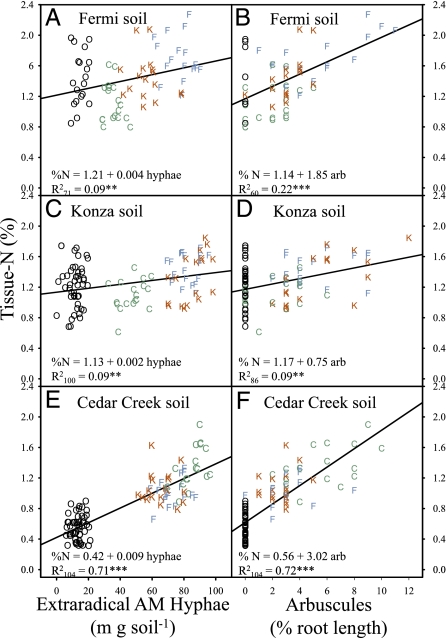
Fig. 1.
Fig. 1.
The relationship between tissue nitrogen and extraradical hyphal density and the proportion of root length colonized by arbuscules in Fermi, Konza, and Cedar Creek soils. Symbols represent treatment-inoculum source (blue F, Fermi; red K, Konza; green C, Cedar Creek; black O, nonmycorrhizal controls). Arbuscule-colonization data were arcsine square root transformed before statistical analysis. R 2 subscript indicates the number of samples included in the regression. Significance of the regression equations are indicated as **P < 0.01 > 0.001 and ***P < 0.0001.
Fig. 2.
Fig. 2.
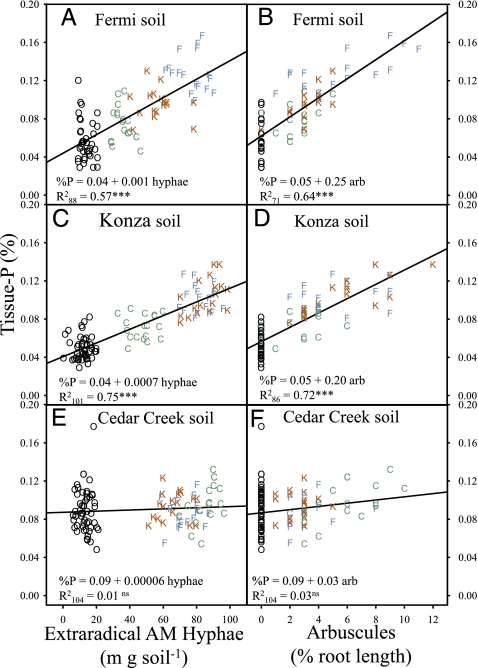
The relationship between tissue phosphorus and extraradical hyphal density and the proportion of root length colonized by arbuscules in Fermi, Konza, and Cedar Creek soils. Symbols represent treatment-inoculum source (blue F, Fermi; red K, Konza; green C, Cedar Creek; black O, nonmycorrhizal controls). Arbuscule-colonization data were arcsine square root transformed before statistical analysis. R 2 subscript indicates the number of samples included in the regression. Significance of the regression equations are indicated as ***P < 0.0001 (ns, not significant).
Fig. 3.
Fig. 3.
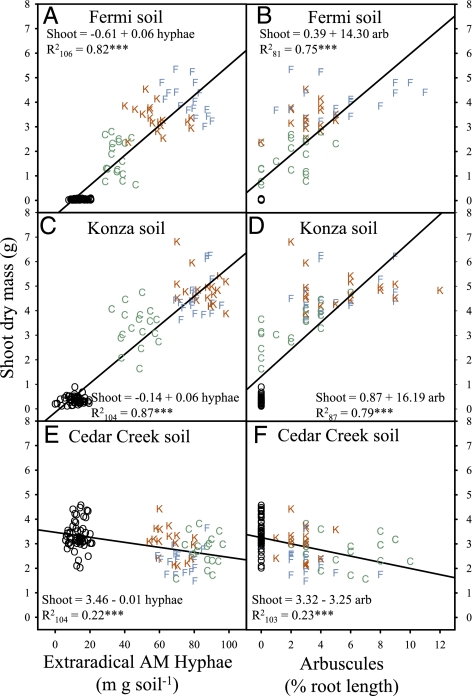
The relationship between shoot biomass and extraradical hyphal density and the proportion of root length colonized by arbuscules in Fermi, Konza, and Cedar Creek soils. Symbols represent treatment-inoculum source (blue F, Fermi; red K, Konza; green C, Cedar Creek; black O, nonmycorrhizal controls). Arbuscule-colonization data were arcsine square root transformed before statistical analysis. R 2 subscript indicates the number of samples included in the regression. Significance of the regression equations are indicated as ***P < 0.0001.
Fig. 4.
Fig. 4.
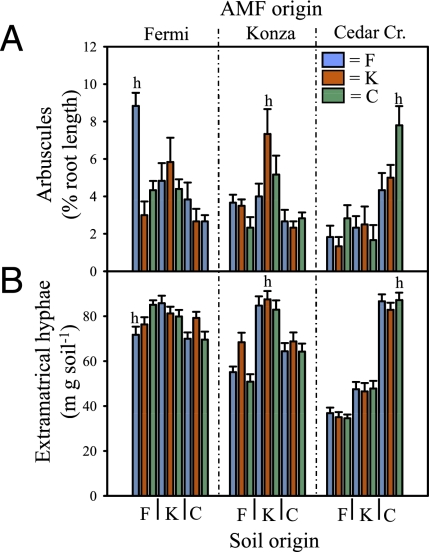
Mean arbuscular colonization of A. gerardii (A) and extraradical AM hyphae (B) in all possible combinations of soil, plant, and fungal origins. The letter h indicates the all-home combination of soil, plants, and AM fungi. Values are means ± SE (n = 6). Blue, Fermi; red, Konza; green, Cedar Creek.
Fig. 5.
Fig. 5.
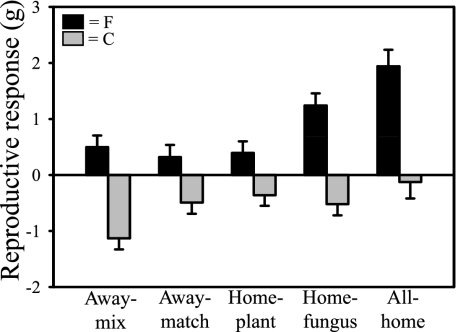
Reproductive response measured as the difference in total inflorescence biomass of A. gerardii grown with and without AM fungi and associated soil organisms. Biomass differences are shown for five mutually exclusive categories of home and away treatment combinations of plants and inoculum from Fermi (black bars) and Cedar Creek (gray bars). Away-mix, soil, plants, and inoculum originated from three different sites; away-match, plants and fungi originated from the same site but from a different location than the soil in which they were grown; home-plant, plants and soil came from the same location (different from the fungi); home-fungus, fungi and soil came from the same location (different from the plants); all-home, soil, plants, and fungi all originated from the same location. Negative values indicate that the nonmycorrhizal plants have larger inflorescences than those inoculated with AM fungi. Values are means ± SE (n = 6).

References

    1. Thompson JN. The Geographic Mosaic of Coevolution. Chicago, IL: University of Chicago Press; 2005.
    1. Hoeksema JD, Thompson JN. Geographic structure in a widespread plant-mycorrhizal interaction: Pines and false truffles. J Evol Biol. 2007;20:1148–1163. - PubMed
    1. Johnson MTJ, Stinchcombe JR. An emerging synthesis between community ecology and evolutionary biology. Trends Ecol Evol. 2007;22:250–257. - PubMed
    1. Johnson NC, Graham JH, Smith FA. Functioning of mycorrhizal associations along the mutualism-parasitism continuum. New Phytol. 1997;135:575–585.
    1. Koide RT. Nutrient supply, nutrient demand and plant response to mycorrhizal infection. New Phytol. 1991;117:365–386. - PubMed

Publication types